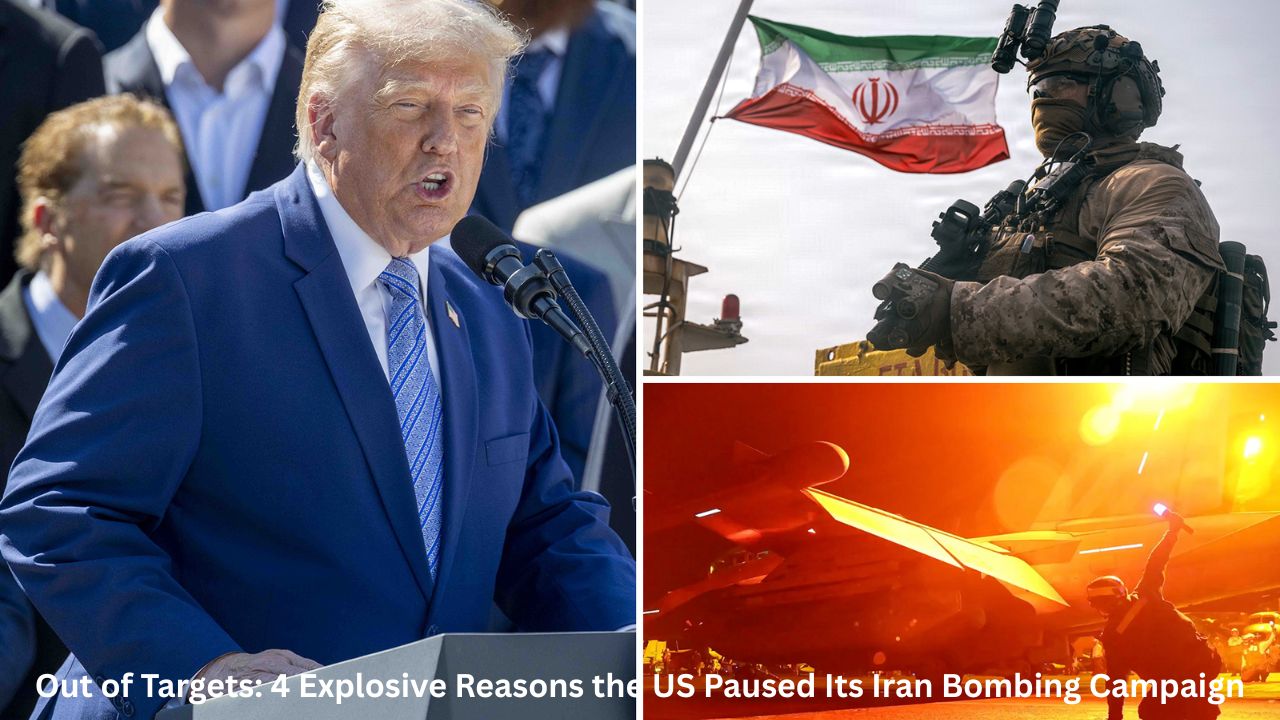
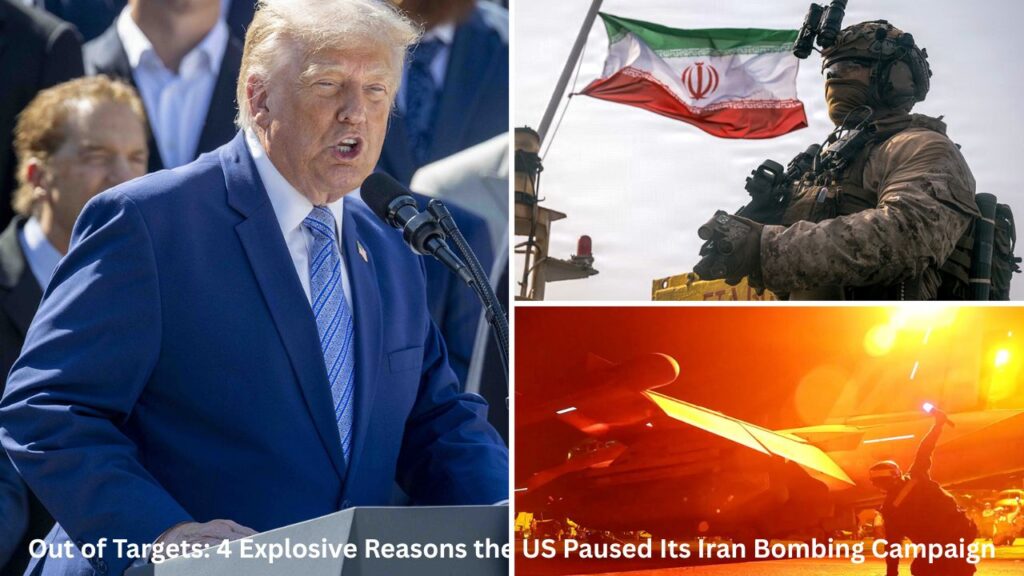
Out of Targets: 4 Explosive Reasons the US Paused Its Iran Bombing Campaign near the Strait of Hormuz. For the first time in nearly two weeks, the United States has gone multiple consecutive days without striking Iran. The sudden halt, which began Friday, has ended a punishing run of nightly bombardments around the Strait of Hormuz and paused the retaliatory attacks Iran had been launching against US military assets across the Gulf.
On the surface, the White House has framed the pause as a diplomatic gesture.
But according to detailed reporting, the real story behind this ceasefire is far more layered — involving a blunt military assessment, dwindling weapons stockpiles, and mounting economic pressure on both sides.
Here’s a full breakdown of what’s actually driving this pause, what remains unresolved, and where the fragile diplomacy stands right now.
Out of Targets: 4 Explosive Reasons the US Paused Its Iran Bombing Campaign
The Military Commander Who Said “Enough”
Perhaps the most striking detail to emerge is that this pause wasn’t primarily a diplomatic decision — it followed a direct recommendation from the top US military commander overseeing the region.
Admiral Brad Cooper, head of US Central Command, reportedly told the Pentagon, the Joint Chiefs of Staff, and the White House that the bombing campaign around the Strait of Hormuz had effectively reached the limit of its usefulness.
According to two sources familiar with his assessment, Cooper explained that nearly two weeks of continuous strikes had already significantly degraded Iran’s ability to attack ships in the strait, and that most of the designated targets had already been destroyed.
His message was blunt:
continuing the campaign without a bigger escalation wouldn’t accomplish much more.
He reportedly told officials that the only real next step would be launching a far larger operation to finish off the remaining roughly 20 percent of targets originally identified under the broader military campaign — something that would mean committing to full-scale combat operations rather than continued limited strikes.
Trump Was Reportedly Leaning Toward Escalation First
What makes this even more notable is that, according to multiple reports, Trump had actually been leaning toward ordering a return to major combat operations in the days leading up to the pause.
His position reportedly began shifting Thursday evening, and by Friday, he had made the call to hit the brakes instead.
That reversal lines up closely with Cooper’s warning, alongside input from other senior officials, including Joint Chiefs Chairman General Dan Caine.
Is the US Actually Running Low on Weapons?
A second major factor circulating in reporting on this pause involves the state of America’s air defense stockpiles in the region.
Multiple outlets have reported that the US is running low on Patriot missile interceptors and other munitions positioned across the Middle East, raising concerns about the military’s ability to protect its own forces and regional allies if the conflict escalates further.
Trump himself has firmly pushed back on this narrative. Speaking to The Wall Street Journal, he insisted the US has “far more munitions than anyone in the world, and far more than we need.”
Despite his denial, many analysts believe the dwindling weapons situation remains one of the more significant, if unofficial, reasons behind the decision to stand down.
The human cost of the campaign has also come into sharper focus.
US officials confirmed that the fighting has killed at least 18 American personnel and wounded 482, though the Pentagon later revised the death toll down to 14.
What US Officials Are Saying Publicly
Publicly, the Trump administration has framed the pause purely in diplomatic terms.
US Ambassador to the United Nations Mike Waltz told reporters the move was designed to give negotiations “some space,” emphasizing that talks between Washington and Tehran remain ongoing.
He described Trump as “a president of peace” who is giving diplomacy every opportunity to succeed.
Trump’s own comments have struck a similarly dual tone — insisting he’s ready for war while also signaling genuine interest in a deal.
Describing the choice facing him, Trump told reporters there was “a military exit where we just keep going” and “knock out everything they have,” or “a smarter strategy” that involves making a deal, adding that Iran “wants to make a deal.”
The Economics Behind the Pause
Beyond the battlefield, economists say the financial toll of this conflict has become impossible to ignore.
Iranian-American economist Nader Habibi told reporters that when fighting resumed two weeks ago, crude oil prices spiked by more than 20 percent, briefly climbing above $100 a barrel — a shock that rattled markets and put pressure on the Trump administration from allies and domestic audiences alike.
Once the two sides paused their exchange of strikes, global oil prices dropped roughly 4 percent, a clear signal that markets see this lull as a genuine, if fragile, step toward de-escalation.
Habibi also pointed out that Iran’s own retaliatory strikes on Gulf countries carried a steep cost, risking damage to the economies of key US allies in the region.
Meanwhile, Iran’s domestic economy has been squeezed hard by the ongoing naval blockade and sanctions, with residents reportedly waiting in gasoline and diesel lines stretching up to a kilometer long, compounding the damage already done to bridges, railways, and other infrastructure by US strikes.
Where Diplomacy Actually Stands
Despite the pause, one of the central disputes of this war — control over the Strait of Hormuz — remains unresolved.
The critical waterway, which Iran effectively shut down to international shipping after the war began in late February, is still closed.
Iran’s state broadcaster reported that several ships attempting to pass through an unauthorized route were turned back or involved in an incident early this week, with Iranian officials blaming the US military for provoking the situation.
Iran has reportedly been in discussions with Oman, whose territorial waters also touch the strait, about a shared management framework that could allow shipping to resume safely.
Whether that arrangement would satisfy Washington or Gulf Cooperation Council members remains unclear.
According to Ali Vaez of the International Crisis Group, the core problem traces back to an earlier US-Iran memorandum of understanding signed in June, which called for the strait to remain open for at least 60 days during talks — an agreement that collapsed once the two sides disagreed over which shipping routes ships should be permitted to use.
Regional mediators including Qatar, Egypt, and Pakistan have also gotten involved, recently submitting a proposal for a 10-day pause in hostilities to give negotiators more breathing room.
Iran’s Foreign Ministry has confirmed that messages are being exchanged through intermediaries, though a spokesperson noted that Tehran feels it has been “betrayed” by past diplomatic efforts — a sign that trust between the two sides remains in short supply even as the guns fall silent for now.
Tensions Spilling Into Other Waterways
The Strait of Hormuz isn’t the only maritime flashpoint tied to this conflict anymore.
Shipping traffic through the Bab al-Mandeb strait, near the entrance to the Red Sea, has also slowed considerably following Houthi attacks on vessels along Yemen’s coastline and the group’s announcement of a naval blockade targeting the largest Gulf Cooperation Council member.
Separately, a Ukrainian strike on an Iranian vessel in the Caspian Sea added yet another layer of tension, killing at least one Iranian sailor and prompting Tehran to summon Ukrainian diplomats over what it called a “hostile and criminal” act.
Ukraine, for its part, said the vessel was carrying military cargo linked to Iran’s support for Russia’s war effort.
Taken together, these overlapping flashpoints show just how far this conflict’s ripple effects have spread beyond the original battlefield.
Why This Pause Could Still Collapse
It’s worth remembering just how quickly this same conflict flared back up once before.
The Strait of Hormuz dispute alone was the direct trigger for the previous breakdown in ceasefire talks, when disagreements over shipping routes led to Iranian attacks on vessels and, ultimately, a return to US strikes.
With that same core issue still unresolved, and tensions simultaneously spilling into other waterways like the Bab al-Mandeb strait near Yemen and even as far as the Caspian Sea, there’s little guarantee this current lull holds for long.
What This Means for Global Readers
For international audiences, this pause is a useful reminder that battlefield lulls in modern conflicts are often driven as much by military logistics and economic pressure as by genuine diplomatic breakthroughs.
The Strait of Hormuz remains one of the world’s most important corridors for oil shipments, and any renewed disruption there could send energy prices spiking again just as markets have started to stabilize.
Until a durable framework is reached on shipping access through the strait, this pause should be read as a strategic timeout rather than the end of the conflict.
Conclusion
The US pause on strikes against Iran reflects a complicated convergence of factors:
a blunt military assessment that the bombing campaign had run its course, real questions about dwindling munitions, and mounting economic pressure that both governments are eager to relieve.
Public statements from Washington continue to frame this as a genuine push for diplomacy, and regional mediators are actively working to build on the momentum.
But with the Strait of Hormuz still closed and deep mistrust lingering on both sides, whether this becomes a lasting turning point or just a brief intermission before renewed fighting remains very much an open question.
Also Read: Trump’s 3 Blunt Warnings to China and Russia Over Iran Arms Sales
Also Read: Iran blames US for Hormuz dispute as both sides confirm ongoing talks
Related Posts:
- 10 Explosive Warnings as Donald Trump Calls Iran…
- 12 Explosive Claims as Donald Trump Says Iran War…
- 3 Explosive Conditions Iran Sets to End War with US…

- 11 Explosive Warnings as Trump Vows to ‘Knock the…

- 10 Explosive Strikes: Israel Bombs Tehran Oil Depots…

- 7 Explosive Signs Russia Is Quietly Backing Iran in…