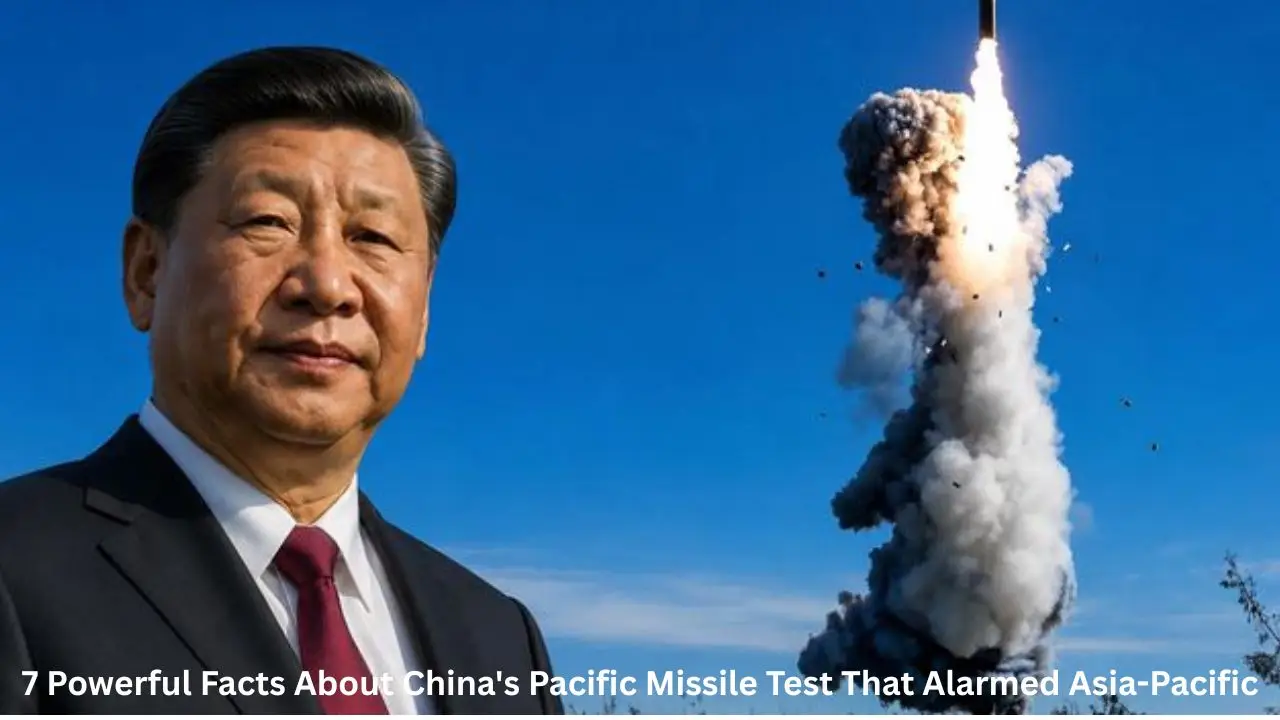
7 Powerful Facts About China’s Pacific Missile Test That Alarmed Asia-Pacific and raised fresh concerns over regional security. China has carried out one of its most significant military demonstrations in recent years by launching a submarine-fired ballistic missile into the Pacific Ocean, drawing immediate concern from Australia, New Zealand, Japan and other regional powers.
According to Chinese state media, a nuclear-powered submarine of the People’s Liberation Army Navy (PLAN) launched a strategic missile carrying a simulated (dummy) warhead into designated international waters in the Pacific.
Beijing described the launch as part of its annual military training program and stressed that it was not aimed at any specific country.
Despite China’s assurances, the timing and nature of the launch have intensified concerns over regional stability, particularly as strategic competition between China and Western allies continues to grow across the Indo-Pacific.
7 Powerful Facts About China’s Pacific Missile Test That Alarmed Asia-Pacific
A Rare Display of China’s Submarine-Based Nuclear Capability
Unlike China’s more frequent land-based missile exercises, this launch was conducted from a nuclear-powered submarine, highlighting an increasingly important component of Beijing’s nuclear deterrence.
Although Chinese officials did not officially identify the missile model, defence analysts believe it was likely one of China’s long-range submarine-launched ballistic missiles (SLBMs), possibly the JL-3, which is capable of carrying nuclear warheads and has an estimated range sufficient to reach targets thousands of kilometres away, including parts of the continental United States.
The successful launch demonstrates China’s continuing efforts to strengthen its sea-based nuclear forces, widely regarded as the most survivable element of a country’s nuclear arsenal.
China Says the Test Was Routine
Beijing sought to downplay international concerns soon after the launch.
According to official statements, the missile test formed part of routine annual military exercises and complied with international law and established international practice.
Chinese authorities also said relevant countries had been notified before the launch and emphasized that the missile carried a simulated training warhead rather than a live nuclear payload.
China’s Foreign Ministry urged neighbouring countries not to overreact or misinterpret the exercise, insisting it was not directed against any specific nation.
Australia Calls the Launch “Destabilising”
Australia was among the strongest critics of the missile test.
Foreign Minister Penny Wong confirmed Canberra had received advance notification from Beijing but nevertheless described the launch as “destabilising to the region.”
Acting Prime Minister Richard Marles also expressed concern, saying that while advance notice had been provided, the test represented a significant military event that warranted close monitoring.
Australian officials stressed that the Indo-Pacific should remain a region where transparency and stability are prioritised over displays of military power.
New Zealand and Japan Express Concern
New Zealand also voiced strong reservations.
Foreign Minister Winston Peters described the missile launch as an “unwelcome and concerning development,” noting that it occurred within or near the South Pacific Nuclear Free Zone.
He added that Pacific nations had little interest in seeing the region become a testing ground for advanced missile capabilities.
Japan likewise expressed concern, with Chief Cabinet Secretary Minoru Kihara stating that Tokyo would maintain heightened surveillance while closely monitoring China’s military activities.
Japanese officials said developments affecting regional security remain a serious concern given the country’s proximity to China’s expanding military operations.
Taiwan Views the Test as Strategic Signalling
Taiwan interpreted the missile launch differently.
Officials in Taipei suggested the exercise was intended to demonstrate China’s growing military reach and send a strategic message amid continuing tensions across the Taiwan Strait.
China has significantly increased military pressure around Taiwan over recent years through naval patrols, military aircraft operations and missile exercises.
Although Beijing denied that the latest launch targeted any country, analysts believe it forms part of China’s broader effort to project military power beyond the First Island Chain and into the wider Pacific.
Timing Raises Strategic Questions
The missile launch occurred only hours after Australia and Fiji signed a landmark defence agreement known as the Ocean of Peace Alliance.
While both China and Australian officials stopped short of directly linking the two events, defence experts noted that the timing inevitably attracted attention.
The new Australia-Fiji agreement strengthens regional security cooperation at a time when China has been expanding its diplomatic and military influence among Pacific Island nations.
Some analysts believe the missile launch may have served as a reminder of Beijing’s strategic capabilities during a period of intensifying regional competition.
Why the Missile Test Matters
Military analysts say submarine-launched ballistic missile tests are relatively uncommon because they demonstrate several critical capabilities simultaneously.
These include:
Credible Nuclear Deterrence
A successful submarine launch reinforces China’s second-strike capability, ensuring it can maintain a nuclear deterrent even if land-based forces are compromised.
Operational Readiness
The exercise allows the Chinese Navy to validate crew readiness, command-and-control procedures and missile performance under operational conditions.
Strategic Messaging
Long-range missile tests often serve political as well as military purposes by signalling technological advancement and strategic resolve.
China has invested heavily in modernising its navy, aiming to operate more effectively across the Western Pacific and beyond.
Regional Security Implications
The latest missile test adds to a series of developments reshaping the Indo-Pacific security environment.
Countries across the region—including Australia, Japan, India, South Korea and the United States—have increased defence cooperation in response to China’s expanding military capabilities.
Meanwhile, Beijing argues that its military modernisation is defensive and necessary to protect national sovereignty and security interests.
The differing perspectives continue to fuel strategic competition throughout the Indo-Pacific.
Could the Test Increase Regional Tensions?
While no immediate military escalation followed the launch, analysts believe such demonstrations can contribute to rising mistrust among regional powers.
Public displays of advanced military capabilities often encourage neighbouring countries to strengthen surveillance, intelligence sharing and defence preparedness.
At the same time, China’s decision to notify several governments before the launch likely helped reduce the risk of accidental miscalculation.
Nevertheless, diplomatic concerns remain over the increasing frequency of strategic military activities in one of the world’s most important maritime regions.
China’s Expanding Military Modernisation
The missile launch also reflects broader trends in China’s military transformation.
Over the past decade, Beijing has invested heavily in:
- Modern nuclear submarines
- Advanced ballistic missiles
- Aircraft carriers
- Long-range naval operations
- Space and cyber capabilities
- Integrated missile defence systems
These investments are intended to support China’s objective of developing a world-class military capable of operating across multiple theatres while protecting its expanding national interests.
What Happens Next?
Regional governments are expected to continue monitoring China’s military activities closely.
Diplomatic discussions among Indo-Pacific partners are likely to focus on maintaining strategic stability, improving military communication channels and preventing misunderstandings that could escalate tensions.
China, meanwhile, is expected to continue emphasising that its military exercises are lawful and consistent with international practice.
Whether future missile tests become more frequent may influence how neighbouring countries adapt their defence planning and regional partnerships.
Key Takeaways
- China successfully launched a submarine-fired ballistic missile carrying a dummy warhead into the Pacific Ocean.
- Beijing described the exercise as routine annual military training and said relevant countries received advance notification.
- Australia called the launch “destabilising” despite prior notice.
- New Zealand described the missile test as an unwelcome development, while Japan expressed security concerns.
- Analysts believe the missile was likely China’s advanced JL-3 submarine-launched ballistic missile, though Beijing has not officially confirmed the model.
- The launch coincided with a new Australia-Fiji defence alliance, raising questions about strategic signalling.
- The event highlights intensifying geopolitical competition across the Indo-Pacific and renewed focus on regional security.
Conclusion
China’s latest submarine-launched ballistic missile test marks a significant moment in the evolving security landscape of the Indo-Pacific.
While Beijing has portrayed the launch as a routine military exercise conducted with advance notification and in accordance with international practice, the reactions from Australia, New Zealand, Japan and other regional actors underscore the deep strategic sensitivities surrounding China’s expanding military capabilities.
The test highlights Beijing’s growing confidence in its sea-based nuclear deterrent and reinforces its ambition to project power farther into the Pacific.
At the same time, it has renewed debates over military transparency, regional stability and the balance of power in one of the world’s most strategically important regions.
As defence partnerships deepen across the Indo-Pacific and military modernisation accelerates, the challenge for regional governments will be balancing deterrence with dialogue to reduce the risk of miscalculation.
China’s missile test may have lasted only moments, but its geopolitical implications are likely to shape strategic discussions across the Pacific for months to come.
Also Read: 7 Alarming Signs China’s Deep-Sea Mapping Could Transform Submarine Warfare