
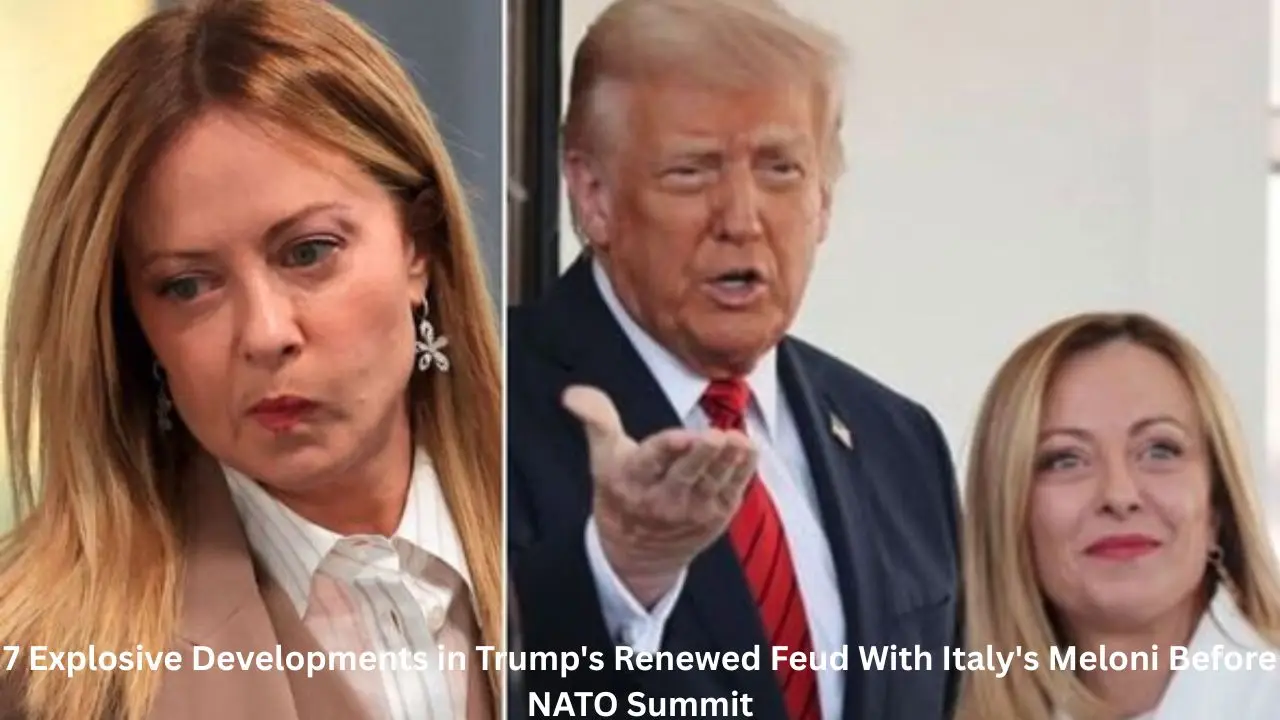
7 Explosive Developments in Trump’s Renewed Feud With Italy’s Meloni Before NATO Summit, raising fresh diplomatic questions. Just days before leaders gather for the NATO summit in Turkey, U.S. President Donald Trump has reignited his increasingly public dispute with Italian Prime Minister Giorgia Meloni, injecting fresh political drama into one of the alliance’s most anticipated meetings.
The latest controversy erupted after Trump shared an image of Meloni on his social media platform, Truth Social, carrying the caption “RESTRAINING ORDER NEEDED.” The post appeared to mock the Italian leader and quickly became the latest chapter in a feud that began following the recent G7 summit in France.
While the White House has not offered further clarification regarding Trump’s intent, the post immediately attracted widespread attention across Europe and the United States, prompting criticism from opposition politicians in Italy and renewed discussion about the state of U.S.-Italy relations.
7 Explosive Developments in Trump’s Renewed Feud With Italy’s Meloni Before NATO Summit
How the Dispute Began
The tensions between Trump and Meloni were not sparked overnight.
The disagreement dates back to the recent G7 Summit in France, where Trump publicly claimed during an interview that Meloni had repeatedly asked him for a photograph and had “begged” to pose with him.
Meloni firmly rejected the allegation, describing Trump’s account as fabricated and criticizing what she viewed as unnecessary attacks on an allied leader.
She also argued that such comments risked undermining unity among Western democracies at a time of heightened geopolitical instability.
The exchange marked a noticeable deterioration in relations between two politicians who had previously maintained cordial ties.
The “Restraining Order Needed” Post
Trump’s latest social media post featured an image showing Meloni looking toward him alongside the caption “RESTRAINING ORDER NEEDED.”
The wording led many observers to interpret the post as suggesting that Meloni was overly interested in or “obsessed” with Trump, although the president did not provide any explanation or additional commentary.
The image itself has also attracted scrutiny. Independent fact-checkers reported that the version circulated online was edited from original footage taken during the G7 summit and did not accurately reflect the original interaction between the two leaders.
Regardless of interpretation, the post quickly spread across social media and international news outlets.
Italy Responds With Calm but Firm Messaging
Unlike the heated exchanges that characterized the earlier dispute, Italy’s government has largely avoided escalating the latest controversy.
Italian Defence Minister Guido Crosetto emphasized that maintaining strong transatlantic relations remained the government’s priority despite disagreements between political leaders.
Speaking to Italian media, Crosetto remarked that political leaders “come and go,” while the relationship between Italy and the United States endures.
His comments appeared designed to reassure allies that the diplomatic partnership between Rome and Washington remains intact despite the personal dispute between Trump and Meloni.
Opposition Leaders Criticize Trump
While the Italian government avoided direct confrontation, opposition politicians reacted much more forcefully.
Several lawmakers condemned Trump’s remarks as inappropriate toward the leader of a close NATO ally.
Carlo Calenda, leader of Italy’s Azione party, described Trump as a “despicable, cheap bully” while expressing support for Meloni.
Other opposition figures argued that personal attacks between allied leaders distract from more pressing international security concerns.
The episode has therefore become both an international diplomatic story and a domestic political issue inside Italy.
A Relationship That Has Changed Dramatically
The latest dispute represents a striking reversal in what was once viewed as a close political relationship.
Meloni was among the first European leaders to build a constructive relationship with Trump and attended his inauguration in early 2025.
Both leaders have often shared conservative positions on immigration, national sovereignty, and economic policy. However, relations have become noticeably strained during recent months.
One significant disagreement emerged after Meloni criticized Trump’s remarks directed at Pope Leo following the pontiff’s comments on the Iran conflict.
Trump subsequently accused the Italian prime minister of lacking courage, further widening the political divide between the two leaders.
The personal relationship that once symbolized growing cooperation between conservative leaders has increasingly given way to public criticism.
Timing Raises Diplomatic Questions
The controversy comes at a particularly sensitive moment.
Trump and Meloni are expected to attend the NATO summit in Turkey, where alliance members will discuss defense spending, regional security, military cooperation, and ongoing geopolitical challenges.
Because both leaders are expected to participate in the same meetings, observers are watching closely to see whether the public dispute affects diplomatic interactions during the summit.
Although neither side has suggested that bilateral meetings will be canceled, the latest exchange adds an unexpected political dimension to discussions already expected to focus on global security.
Why NATO Unity Matters Now
The renewed disagreement comes as NATO faces several major strategic challenges.
Alliance members continue to coordinate responses to conflicts in Europe and the Middle East while also debating defense budgets and burden-sharing among member states.
Against that backdrop, public disagreements between prominent alliance leaders inevitably attract international attention.
Diplomats generally seek to project unity before major NATO gatherings because visible divisions can complicate negotiations and weaken perceptions of alliance cohesion.
Although Trump and Meloni’s disagreement is primarily personal in nature, its timing has amplified its diplomatic significance.
Social Media’s Growing Role in International Diplomacy
Trump has long relied on social media to communicate directly with supporters and shape public narratives.
His latest Truth Social post demonstrates how online messaging can rapidly become an international diplomatic issue.
Unlike formal government statements, social media posts often leave room for multiple interpretations while generating immediate global media coverage.
Political analysts note that this style of communication has increasingly blurred the lines between domestic political messaging and international diplomacy.
Within hours, Trump’s post had become headline news across Europe and North America, illustrating the powerful influence of digital platforms on modern foreign affairs.
Could the Feud Affect U.S.-Italy Relations?
Most foreign policy experts believe institutional ties between Washington and Rome remain strong despite the personal dispute.
Italy remains one of NATO’s founding members and an important strategic partner for the United States across defense, intelligence, trade, and regional security.
Italian officials have repeatedly emphasized that bilateral cooperation extends beyond individual political leaders.
Nevertheless, continued public disagreements could complicate diplomatic engagement if they persist over time.
The coming NATO summit may provide the first opportunity to gauge whether both leaders intend to move beyond the dispute or whether tensions will continue.
Key Takeaways
1. Trump revived his dispute with Giorgia Meloni by sharing a “Restraining Order Needed” image on Truth Social.
2. The disagreement began after Trump claimed Meloni had repeatedly sought a photograph with him during the recent G7 summit, a claim she denied.
3. Italian Defence Minister Guido Crosetto downplayed the controversy, stressing that the U.S.-Italy alliance remains strong.
4. Opposition politicians in Italy sharply criticized Trump’s latest remarks.
5. The controversy arrives immediately before an important NATO summit, increasing diplomatic attention.
6. Independent fact-checkers reported that the image shared online had been edited from original G7 footage.
7. Despite the personal clash, analysts expect institutional cooperation between Washington and Rome to continue.
Conclusion
Donald Trump’s renewed public criticism of Italian Prime Minister Giorgia Meloni has transformed what began as a disagreement over a G7 photo into a broader diplomatic story unfolding just before a crucial NATO summit.
His latest Truth Social post has reignited debate over the role of personal rhetoric in international politics and highlighted how quickly social media can shape global headlines.
While Italian officials have sought to minimize the dispute and emphasize the enduring strength of U.S.-Italy relations, the exchange underscores the challenges that personal political conflicts can pose to diplomatic optics.
Whether the controversy fades after the NATO summit or develops into a more lasting source of tension will likely depend on how both leaders choose to engage in the days ahead.
For now, the international community will be watching closely as two prominent NATO leaders meet against the backdrop of an increasingly public and closely scrutinized political feud.
Also Read: ‘Melodi’ Moment at G7: PM Modi, Italy’s Meloni Highlight Growing India-Italy Friendship
Also Read: What’s behind Donald Trump’s latest clash with Giorgia Meloni?
Related Posts:
- 9 Explosive Revelations as Trump Declares His Health…
- Awkward and Hilarious Moments at Gaza Peace Summit 2025

- Trump Stole the Show at 2025 Gaza Peace Summit in Egypt
- Trump’s 2025 Gaza Peace Plan Signing and Historic…

- Trump to Host 2026 G20 Summit at His Florida Golf…

- US President Donald Trump Fuels Third-Term…
