
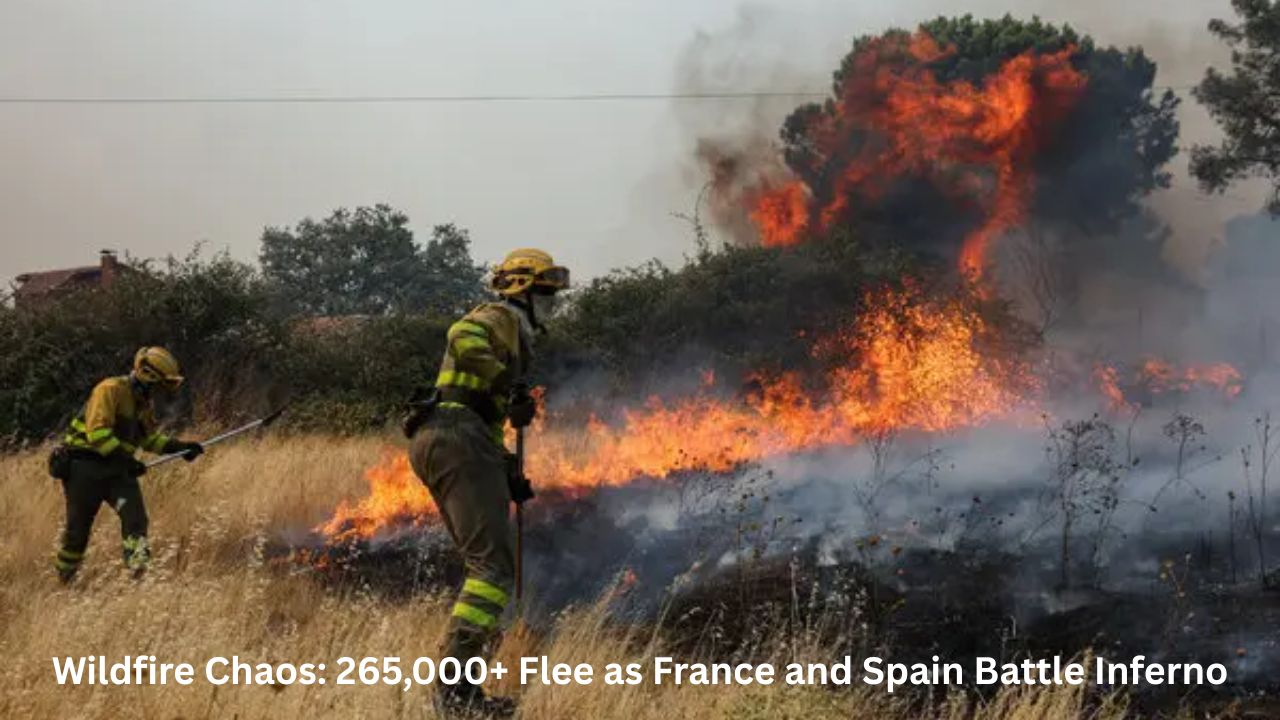
Wildfire Chaos: 265,000+ Flee as France and Spain Battle Inferno, prompting France to deploy a military cargo plane. Southwestern France and central Spain are facing one of the most destructive wildfire crises in years, with more than 265,000 people forced from their homes, at least one confirmed death, and entire towns reduced to ash.
As fire crews battle blazes that officials describe as unlike anything they’ve seen before, the flames have already destroyed roughly 140 homes, disrupted the final stage of the Tour de France, and pushed France to deploy a specially converted military cargo plane in a desperate bid to protect the wine city of Bordeaux.
The scale of the disaster has stunned even veteran firefighters. In France alone, wildfires have now burned through roughly 98,000 hectares of land this year, setting a new historical record for the country and surpassing even the devastating fire seasons of 2022.
Across the border in Spain, thousands have fled towns near Madrid and Valencia as fast-moving flames outran attempts to contain them.
Wildfire Chaos: 265,000+ Flee as France and Spain Battle Inferno
A Region Under Siege: The Scale of the France-Spain Wildfires
The numbers paint a stark picture of just how widespread this crisis has become.
In France, roughly 198,000 people have been evacuated across the Gironde, Landes, Var, and Tarn regions, with the overwhelming majority coming from Gironde alone, where authorities ordered 57,000 people out in a single overnight operation, bringing the region’s total evacuations to 167,000.
Around 30 separate fires were reportedly burning simultaneously across southwestern France at the height of the crisis.
In Spain, more than 11,500 people have been evacuated as blazes tore through the countryside near Madrid and Ávila, prompting the Spanish interior ministry to declare a state of emergency.
Twenty-three towns across those two provinces have been evacuated altogether.
One Death Confirmed in Spain
Amid the chaos, officials confirmed the wildfire crisis has already claimed at least one life.
A 78-year-old man with reduced mobility died after being caught by flames near his orchard in the town of Manises, northwest of Valencia.
Local authorities have since declared two days of official mourning for the victim, even as the fire that killed him has now been brought under control.
Firefighters elsewhere have treated a number of additional people for smoke inhalation and burns as the wildfires continue to spread.
Gironde in Flames: Bordeaux Braces for the Worst
Nowhere has the crisis been more dramatic than in Gironde, the wine-producing region surrounding Bordeaux.
The main blaze there grew into what regional prefect Sophie Brocas described as a genuine firestorm, generating winds of its own and forcing authorities to order evacuations from parts of three of Bordeaux’s western suburbs, along with several outlying towns and villages.
By Saturday, the fire sat roughly 30 kilometers from the city center, and officials warned that a forecast shift in wind direction could push the flames closer still.
The A400M: France’s New Weapon Against Fire
In a striking escalation of the response, French authorities deployed a specially converted A400M military transport plane to dump flame retardant on the Gironde blaze — a massive aircraft typically used for hauling cargo and troops, now repurposed as a heavyweight firefighting tool.
It joined a rotation of at least 18 other water- and retardant-dropping aircraft and helicopters already working the smoke-filled skies above the region.
French Interior Minister Laurent Nunez warned the fight ahead would be long and difficult, while French Prime Minister Sébastien Lecornu said the government’s overriding priority was protecting lives, and stressed that evacuation orders needed to be followed without delay.
Thousands Sheltered as Bordeaux Opens Its Doors
Bordeaux itself has scrambled to absorb the wave of displaced residents, setting up shelter and food at a local exhibition center that officials say could be expanded to house as many as 10,000 evacuees if needed.
The city’s airport has remained open throughout the crisis, though its bus and tram services were suspended as a precaution.
Evacuation orders have been pushed directly to residents’ phones through emergency alerts, giving people little time to gather belongings before fleeing.
In some coastal tourist towns further west, residents reportedly escaped by boat as flames swept in from the Atlantic side.
Spain’s Fight: State of Emergency in Madrid and Ávila
While France’s crisis has centered on Gironde, Spain has been fighting its own battle on multiple fronts.
Fires near Madrid and Ávila forced evacuations across 23 towns, with firefighters describing blazes that spread with a speed and violence that made direct frontal firefighting nearly impossible.
In the town of El Tiemblo, west of Madrid, a wildfire tore through a centuries-old chestnut grove that had long been a local landmark, leaving residents in shock at the scale of destruction.
Spanish emergency crews have continued working to contain multiple blazes even as the country’s interior ministry manages the broader emergency declaration.
A Record-Breaking Fire Season
What makes this year’s wildfires especially alarming is the scale relative to history.
French officials confirmed that the 98,000 hectares burned so far in 2026 represent a new record for the country, surpassing prior benchmark years.
French officials involved in the international response have described the current wildfires as significantly worse than those seen in 2022, which had previously stood as the worst fire season on record.
That comparison alone underscores just how extreme this year’s combination of extended heat, drought, and wind has proven for firefighting crews across the region.
Health Risks From the Smoke
Beyond the immediate threat of flames, authorities have grown increasingly concerned about the health impact of wildfire smoke drifting across the region.
French Prime Minister Lecornu announced that 1.5 million FFP2 masks would be rushed to the Gironde region to help protect residents from smoke inhalation.
France’s public health and safety agency has advised anyone in non-evacuated zones to limit time spent outdoors, keep windows and doors shut, and seek medical attention promptly if they experience breathing difficulties or other smoke-related symptoms.
For elderly residents, young children, and anyone with pre-existing respiratory conditions, health officials say the smoke exposure carries particular risk even far from the active fire lines.
Europe Rallies: International Firefighting Support
The scale of the crisis has triggered a continent-wide mutual aid response.
French President Emmanuel Macron formally requested activation of the European Union’s Civil Protection Mechanism, unlocking additional cross-border resources.
In response, France is expecting two water-bomber aircraft from Croatia, two more planes from Portugal, and heavy-lift Black Hawk helicopters from both the Czech Republic and Slovakia.
Spain, meanwhile, has already received support from the Netherlands and Portugal, with two additional Canadair water-dumping planes arriving from Italy and two more expected from Greece.
The coordinated response reflects how quickly wildfires of this scale can overwhelm even well-resourced national firefighting systems, making international cooperation essential.
Collateral Disruption: Tour de France, Bordeaux Wine Country, and Travel
The wildfires have rippled into everyday life across the region in unexpected ways.
Organizers shortened and rerouted the final stage of the Tour de France, freeing up security personnel who were redirected to support firefighting efforts instead — an unusual concession for one of the world’s most closely watched annual sporting events.
In Bordeaux’s famed vineyards, industry experts have moved quickly to reassure worried wine lovers around the world that, for now, the region’s grape harvests remain untouched by the flames, even as smoke blankets the surrounding countryside.
French officials have also urged international travelers not to cancel trips to France outright, emphasizing that large parts of the country, including Paris, remain entirely unaffected by the fires, while still urging visitors to stay informed about conditions in the specific regions they plan to visit.
What’s Driving This Wildfire Crisis?
Officials and climate experts point to a familiar but intensifying combination of factors behind this year’s extreme fire season:
prolonged heatwaves, deepening drought conditions, and the broader long-term effects of climate change, which together have primed vegetation across southern Europe to burn faster and more unpredictably than in past decades.
Fire crews in both France and Spain have described being caught off guard by just how quickly and violently this year’s blazes spread once ignited, a pattern that scientists increasingly link to warming global temperatures reshaping wildfire behavior across the Mediterranean region.
Conclusion
As firefighters, soldiers, and international reinforcements continue pouring into southwestern France and central Spain, the true scale of this wildfire crisis is still coming into focus.
More than 265,000 people have already been uprooted from their homes, at least one life has been lost, and a historic French fire season shows few signs of slowing as long as the heat and wind persist.
For now, the priority on the ground remains simple and urgent:
protect lives, hold the line around Bordeaux, and hope that shifting winds and arriving reinforcements can finally turn the tide against fires that have already rewritten the record books for this generation.
Also Read: Wildfire Near Marseille Injures Over 100, Shuts Down Airport and Trains
Also Read: “Will Take Long Time To Control”: Over 2 Lakh Evacuated Due To France Forest Fire
Related Posts:
- Wildfire Inferno: 5 Alarming Facts on the…
- 7 Heartbreaking Facts About Venezuela's Earthquake Disaster
- 5 Major Takeaways from the US Supreme Court's…

- Wildfire Near Marseille Injures Over 100, Shuts Down…
- 7 Powerful Facts About Ayatollah Ali Khamenei’s…

- Afghanistan–Pakistan War 2025: Inside the 48-Hour Ceasefire
