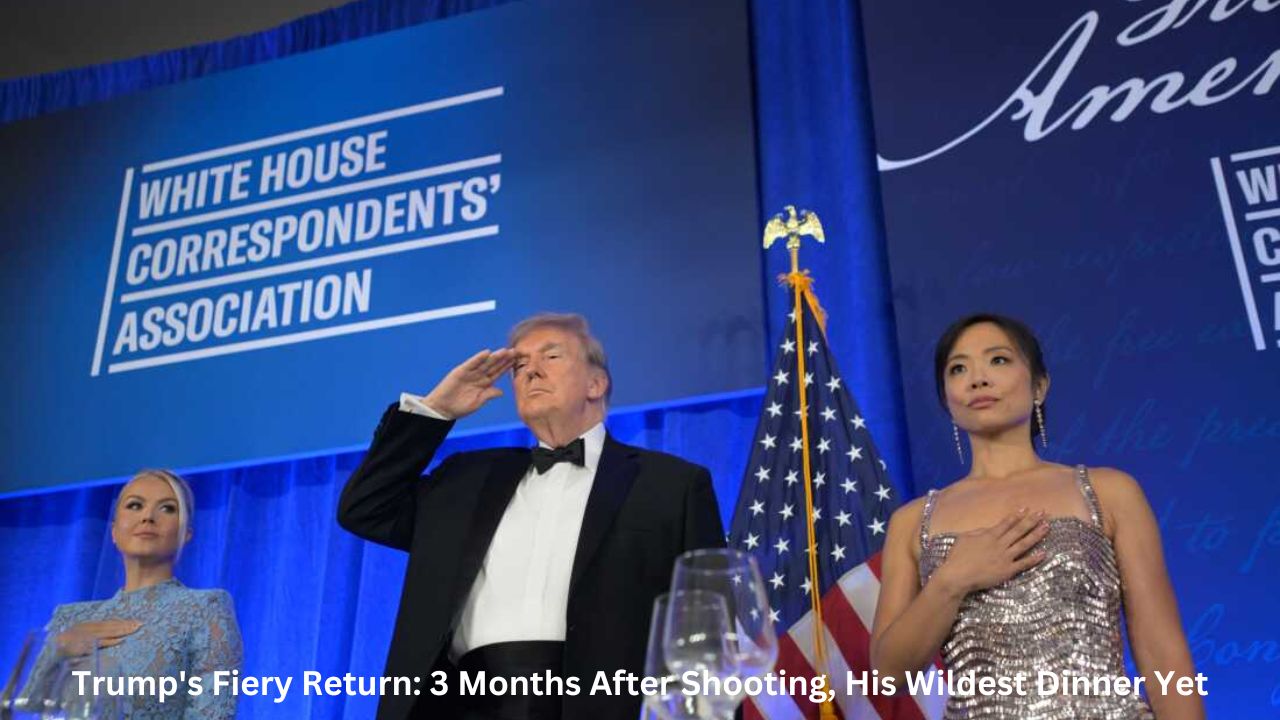
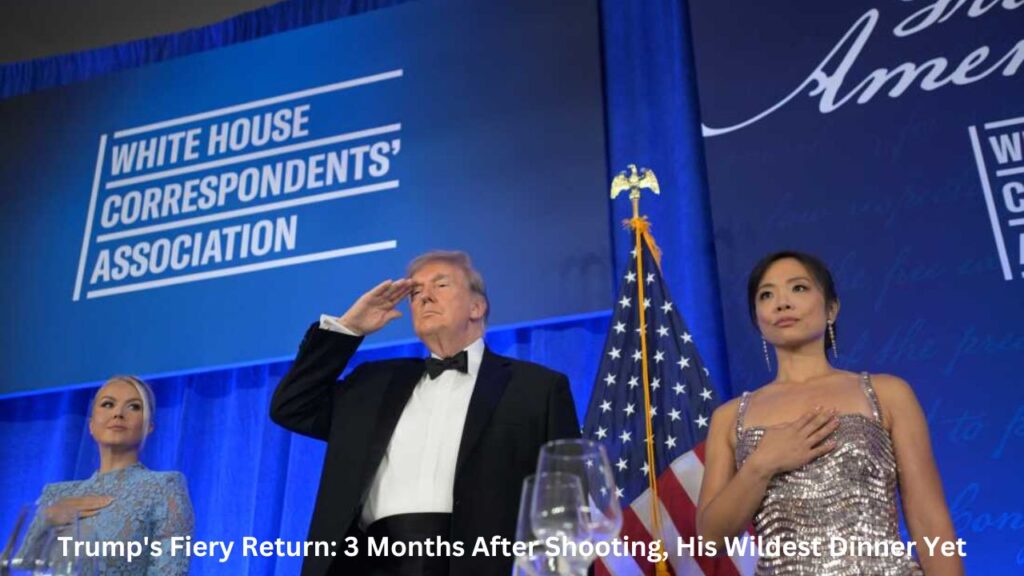
Trump’s Fiery Return: 3 Months After Shooting, His Wildest Dinner Yet at the White House Correspondents’ Dinner on Friday. Three months after a gunman’s attack forced the White House Correspondents’ Dinner to a chaotic, premature end, President Donald Trump returned to the podium on Friday night for a do-over that was equal parts defiant, chaotic, and classic Trump.
Wearing a “Trump 2028” cap and joking about a fourth term in office, the president delivered a rambling, hour-long speech at Washington’s Waldorf Astoria hotel that swung between praise for the press’s resilience and pointed personal jabs at some of its best-known names.
The rescheduled gala was always going to be about more than jokes.
It marked Trump’s first time ever speaking at the annual dinner, an event he skipped entirely during his first term, and it came against the backdrop of an administration that has repeatedly clashed with the media it was, for one night, being asked to celebrate.
Trump’s Fiery Return: 3 Months After Shooting, His Wildest Dinner Yet
A Dinner Delayed by Violence: Setting the Scene
The original White House Correspondents’ Dinner in April ended in chaos when a gunman attempted to force his way through a security checkpoint outside the ballroom at the Washington Hilton.
Secret Service agents evacuated Trump, First Lady Melania Trump, Vice President JD Vance, and members of the Cabinet as other guests took cover under their tables.
The suspect, identified as 31-year-old Cole Thomas Allen, was later charged with using a firearm in a crime of violence and assaulting a federal officer; he has pleaded not guilty.
From Washington Hilton to the Waldorf Astoria
Friday’s rescheduled dinner looked and felt different from the start.
Rather than returning to the Hilton, organizers moved the event to a smaller ballroom at the Waldorf Astoria — a hotel formerly branded as the Trump International Hotel — near the White House.
The guest list shrank dramatically too, from roughly 2,600 attendees in April to around 680 on Friday, with every guest pre-vetted and issued a unique QR code for entry through a private access point.
The program otherwise stayed close to tradition, including a performance from mentalist Oz Pearlman rather than the standard stand-up comedian.
Honoring the Secret Service
Before the jokes began, the tone was somber and defiant.
Outgoing White House Correspondents’ Association president Weijia Jiang of CBS News opened the evening by declaring that the group would not let violence have the final say, a message echoed later by Trump himself, who told the crowd the country does not yield to political violence.
The dinner also honored Secret Service officer Victor Gonzales, who was shot while helping stop the April attacker and was the only person wounded that night, along with Washington Hilton staff who assisted guests during the original evacuation.
Trump’s Correspondents’ Dinner Speech: Jabs, Jokes, and a 2028 Tease
Once the formalities were out of the way, Trump settled into the kind of freewheeling, off-the-cuff remarks that have become a signature of his public appearances.
He opened on a relatively conciliatory note, reflecting on the April shooting before declaring that the show must go on, and told the room he was going easier on them than he’d originally planned, joking that he had been ready to “rip” into people back in April before the event was cut short.
The “Trump 2028” Cap and the Fourth-Term Punchline
The headline-grabbing moment of the night came when Trump, sporting his “Trump 2028” cap, announced what he called a scoop:
his intention to seek what he described as a fourth term in the White House, claiming — inaccurately — that he had already won three presidential elections.
In reality, Trump has won two, in 2016 and 2024, and the US Constitution limits any president to two terms in office regardless, meaning the remark landed as pure showmanship rather than a serious political announcement.
Targets of the Night: Schumer, Schiff, Christie and More
From there, Trump moved through a long list of targets. He told the room that Senate Minority Leader Chuck Schumer had “turned Palestinian” after once being staunchly pro-Israel, joking that he’d send Schumer an outfit to wear when greeting Israeli Prime Minister Benjamin Netanyahu the following week.
He took aim at Representative Adam Schiff in blunter terms, and mocked former New Jersey Governor Chris Christie and Representative Jerry Nadler with an odd, self-aware bit about the two men fighting over a piece of cheesecake — a punchline so flat that even Trump paused mid-joke to ask who had written it for him.
Musician Bruce Springsteen and actress Jane Fonda were also swept into the routine, alongside broadcast journalists including Don Lemon, Lawrence O’Donnell, Kaitlan Collins, and Jake Tapper.
Illinois Governor JB Pritzker got an odd mixed message, with Trump insisting reporters shouldn’t call him overweight before immediately drawing attention to his physique anyway.
Press Secretary Karoline Leavitt didn’t escape either, with Trump remarking that she can be tough on people but has one of the toughest jobs in his administration, dealing with the press corps every single day.
A Softer Tone Than Promised — Sort Of
Despite the barrage of jabs, Trump insisted he’d actually dialed back his material compared to what he had planned for the original April dinner.
He told the crowd that the room represented, in his words, one of the largest gatherings of people afflicted with what he calls “Trump derangement syndrome” ever assembled in one place — but suggested many attendees should count themselves lucky that April’s shortened dinner meant they dodged his sharper original material.
The night wasn’t purely combative. Trump also handed out real recognition, shaking hands with reporters even as the Wall Street Journal received an award for coverage of his relationship with the late financier Jeffrey Epstein — reporting that has separately prompted a $10 billion lawsuit from Trump against the paper.
It was a striking split-screen moment: adversarial litigation playing out in courtrooms even as the same journalists were publicly honored and applauded from the podium.
Who Was There, and Who Wasn’t
Not everyone from Trump’s inner circle showed up for the redo.
First Lady Melania Trump, Vice President JD Vance, and Secretary of State Marco Rubio all skipped Friday’s dinner despite having attended the original April event, with the administration citing prior commitments.
Vance’s absence came just days after the birth of his fourth child with Second Lady Usha Vance.
Other senior officials filled the gap, including acting Attorney General Todd Blanche, FBI Director Kash Patel, and members of the Cabinet who joined Trump at the head table.
Press Freedom Under the Spotlight
Beneath the jokes, the underlying tension around press freedom in the Trump era was never far from the surface.
His administration has sparred repeatedly with news organizations, including a recent subpoena of New York Times journalists over their reporting on safety questions tied to Trump’s Qatari-donated Air Force One — subpoenas the Justice Department ultimately dropped under pressure from a federal judge just a day before the dinner.
Press freedom advocates have criticized the administration’s approach toward media access and litigation against outlets, criticism the White House rejects, framing its posture instead as a push for greater accountability from what it considers biased coverage.
Still, the dinner itself endures as a century-old tradition built around raising money for journalism scholarships and celebrating the press protections guaranteed by the First Amendment — a somewhat awkward pairing with a president who has built much of his political brand on attacking the very outlets being honored in the room.
Global Reactions and What It Means
International coverage of the dinner leaned heavily into the spectacle of it all — the “Trump 2028” cap, the fourth-term joke, the Schumer line about Netanyahu’s visit — treating the evening as much as a geopolitical curiosity as a domestic media story.
For audiences outside the United States, the dinner offered a window into just how personal and theatrical American political culture has become, with a sitting president trading barbs directly with the journalists who cover him, live and on the record, at what is nominally a celebration of their profession.
Trump closed the night by confirming he plans to return again in 2027, suggesting this rescheduled dinner may mark the start of a new, more combative chapter for an event he spent his entire first term boycotting altogether.
Conclusion
Friday’s rescheduled White House Correspondents’ Dinner was never going to be a simple do-over.
It carried the weight of April’s violence, the symbolism of a president finally showing up after years of boycotts, and the unmistakable friction between an administration and a press corps that have rarely seen eye to eye.
What emerged was something true to form:
part tribute to resilience, part roast, and part campaign tease, all wrapped into one unpredictable night in Washington.
Whether Trump’s promise to return in 2027 signals a genuine thaw in his relationship with the media, or simply another round in an ongoing rivalry, is a question the White House Correspondents’ Association will likely be asking itself long before the next invitation goes out.
Also Read: 10 Shocking Moments from Trump White House Dinner Shooting Scare
Also Read: Trump mixes jokes with barbs at press freedom dinner