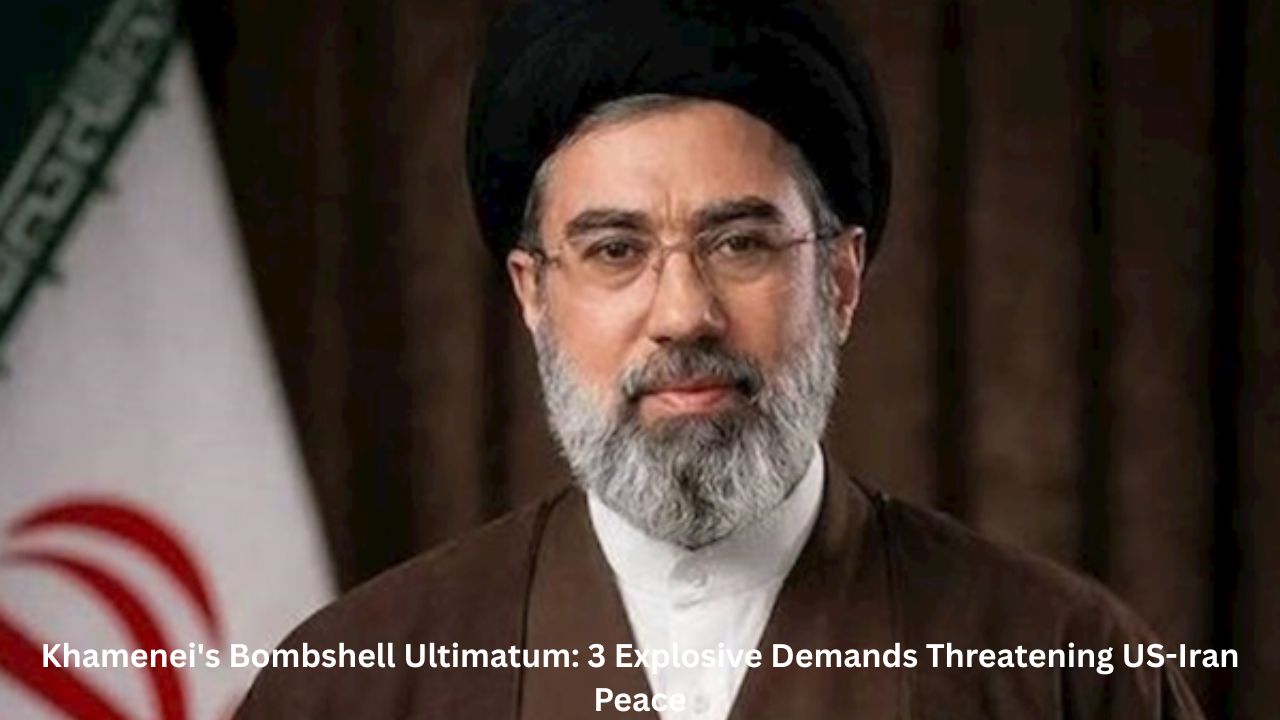
Khamenei’s Bombshell Ultimatum: 3 Explosive Demands Threatening US-Iran Peace as he sets new conditions. Iran’s Supreme Leader Mojtaba Khamenei has thrown a significant complication into fragile diplomacy between Tehran and Washington, declaring that any lasting peace between the two countries depends entirely on Israel ending its military operations in Lebanon.
The statement, posted on X on Sunday, arrives at a delicate moment, just as reports suggest a tentative pause in hostilities and renewed back-channel diplomacy between Iran and the United States.
Khamenei’s remarks went further than a simple policy statement, though — he also praised Hezbollah’s continued “jihad and resistance” against Israel and the US, raising fresh questions about whether a genuine, lasting peace agreement is realistically within reach.
Here’s a full breakdown of what he said, why Lebanon has become the central sticking point, and what it could mean for the broader region.
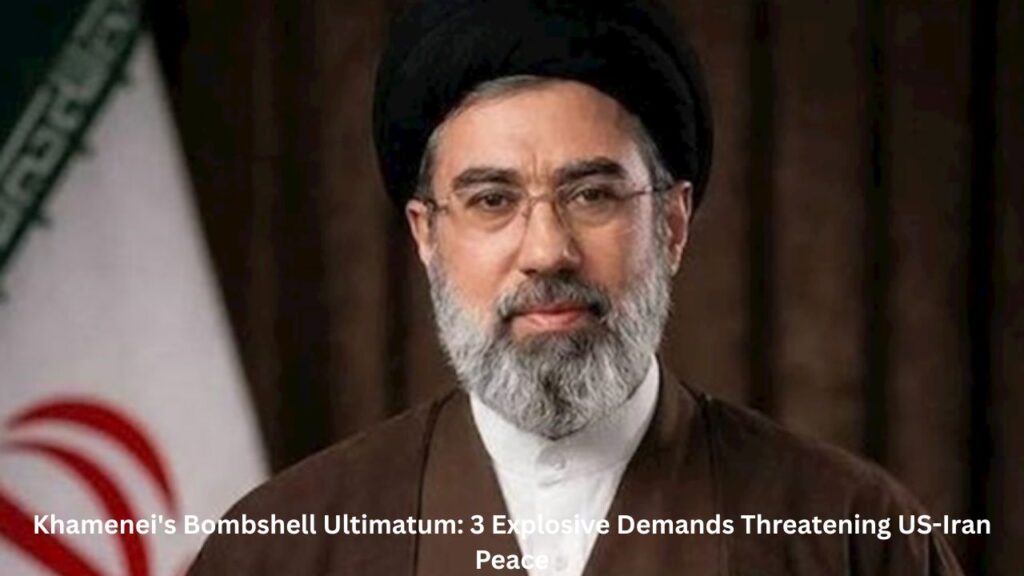
Khamenei’s Bombshell Ultimatum: 3 Explosive Demands Threatening US-Iran Peace
What Khamenei Actually Said
In his statement, Khamenei declared that Iran has designated the preservation of Lebanon’s territorial integrity, along with what he called the “absolute, unconditional termination” of Israeli aggression, as the primary condition for ending what Tehran describes as the imposed war with the United States.
It’s a clear signal that Iran isn’t treating its own conflict with Washington and Israel’s ongoing operations in Lebanon as separate issues — in Tehran’s framing, they’re now directly linked.
Khamenei also used the statement to voice explicit support for Hezbollah, the Lebanese armed group backed by Iran, along with its slain former leader Hassan Nasrallah and the people of southern Lebanon, who have borne the brunt of Israeli strikes.
He described defending Hezbollah, whom he referred to as “oppressed yet powerful mujahideen,” as a core strategic mandate for the Islamic Republic.
The “Jihad and Resistance” Comments
According to statements attributed to Khamenei and reported widely, he asserted that “there remains no path forward except jihad and resistance” against the United States and Israel.
The remarks reportedly came in response to a letter from Hezbollah pledging its continued allegiance to Iran’s Islamic Republic.
Khamenei is said to have praised Hezbollah’s commitment to armed resistance as an “inspiring message” for those seeking what he described as liberation from global domination.
He also paid tribute to Nasrallah, who was killed in Israeli strikes in 2024, describing him as Hezbollah’s “master of martyrs” and crediting him with transforming Hezbollah from what he called a “sapling of Islamic resistance into a mighty tree.”
Why Lebanon Has Become the Central Flashpoint
To understand why Khamenei is drawing such a hard line on Lebanon, it helps to look at how the country became entangled in this broader conflict in the first place.
Lebanon was pulled into the fighting back in March, after Hezbollah launched strikes on northern Israel.
The group cited two triggers:
the killing of Iran’s previous Supreme Leader, Ali Khamenei, on the first day of the US-Israel war on Iran in late February, and what Hezbollah described as Israel’s near-daily bombardment of Lebanese territory — attacks the group says violated a ceasefire that had ended an earlier round of fighting in 2024.
Mojtaba Khamenei, the son of the late Ali Khamenei, was selected as Iran’s new supreme leader following his father’s death.
His latest comments reaffirm that the current leadership intends to maintain, and even deepen, Iran’s commitment to Hezbollah’s cause.
Notably, Iran didn’t attach this Lebanon condition as an afterthought.
Tehran had already enshrined the demand that Israel end its Lebanon strikes as the very first clause of the memorandum of understanding it signed with Washington back in June.
That earlier agreement, however, has since collapsed amid a separate dispute over the Strait of Hormuz.
The Lebanon-Israel Agreement Nobody’s Happy With
Adding another layer of complexity, Lebanon and Israel did sign a separate, US-mediated framework agreement on June 26, following the original US-Iran memorandum.
That deal outlined a phased Israeli withdrawal from occupied Lebanese territory — but crucially, it didn’t include a firm timetable.
Instead, the agreement tied Israel’s withdrawal to Hezbollah’s disarmament, effectively making one condition dependent on the other.
Both Iran and Hezbollah — which wasn’t even a party to those negotiations — have rejected the agreement outright.
Ziad Abu Rish, an associate professor of Human Rights and Middle Eastern Studies at Bard College, described the deal’s terms as “lop-sided,” arguing that it largely reflects Israel’s preferences and effectively reframes the core issue in Lebanon.
Rather than being understood as a matter of Israeli aggression, he noted, the narrative shifts toward treating Hezbollah’s presence in the country as the central problem.
Implementation Is Already Breaking Down
Even the limited progress that was supposed to happen under that framework appears to be stalling. The first phase called for Israel to withdraw from three so-called “pilot zones” in southern Lebanon.
However, Lebanon’s military says Israeli forces have been actively obstructing that process, including refusing to withdraw from designated territories as agreed.
As of the most recent reporting, Israeli forces were still conducting bulldozing operations, shelling, and machine-gun sweeps across large areas of southern Lebanon that remain under occupation.
For residents attempting to return to towns near these pilot zones, the reality on the ground looks far removed from the phased, orderly withdrawal the framework agreement promised on paper.
The human cost of this extended conflict has been severe. At least 4,329 people have been killed in the latest round of Lebanon-related violence, while 37 Israeli soldiers and four Israeli civilians have also died.
According to United Nations peacekeepers, Israel has violated the earlier ceasefire with Hezbollah more than 10,000 times, a figure that has fueled deep skepticism in Lebanon and Iran alike about whether any new framework will fare any better without stronger international enforcement mechanisms attached.
A Region Already Stretched Thin
Khamenei’s statement doesn’t exist in isolation — it comes as tensions are simultaneously flaring on multiple other fronts.
Reports have emerged of renewed exchanges of attacks between Yemen’s Houthi movement and Saudi Arabia, another Iran-aligned front that adds further strain to an already volatile regional picture.
At the same time, US and Iranian officials have reportedly paused direct strikes on each other for a second consecutive day, suggesting some appetite on both sides for de-escalation, even as rhetoric around Lebanon hardens.
That contradiction — a battlefield pause alongside inflammatory public statements — captures just how fragile and contradictory this moment in Middle East diplomacy has become.
Public statements aimed at domestic and regional audiences don’t always align neatly with what’s happening in private negotiating rooms.
What This Means for Global Readers
For international observers, Khamenei’s comments serve as an important reality check on how close any US-Iran peace deal actually is.
Even if Washington and Tehran can find common ground on issues like the Strait of Hormuz or a broader nuclear framework, Iran’s leadership has now made unmistakably clear that Lebanon isn’t a side issue — it’s a precondition.
That significantly raises the bar for what a durable agreement would need to include, since it also requires meaningful movement from Israel, a country that hasn’t been a direct party to the core US-Iran talks.
It also underscores how interconnected these regional conflicts have become.
What happens in southern Lebanon, in the Strait of Hormuz, and even in Yemen are all, in Tehran’s view, part of one interlocking negotiation — making a narrow, bilateral US-Iran resolution far more difficult to achieve in isolation.
A Leadership Transition Shaping Iran’s Approach
It’s also worth understanding the context behind who is delivering this message.
Mojtaba Khamenei only recently assumed the role of Supreme Leader after his father, Ayatollah Ali Khamenei, was killed in the opening day of the US-Israel war on Iran back in February.
That transition matters here, because it raises real questions about how much continuity versus change to expect from Iran’s leadership going forward.
So far, the younger Khamenei’s public statements suggest he’s choosing to closely align himself with his father’s legacy on Hezbollah and Lebanon specifically, framing continued support for the group as a matter of long-standing, non-negotiable policy rather than something a new leader might use as a bargaining chip.
For a still-young Supreme Leader looking to consolidate authority both domestically and across Iran’s regional network of allied groups, publicly doubling down on support for Hezbollah may serve as much of a political purpose at home as it does a diplomatic signal to Washington.
Conclusion
Mojtaba Khamenei’s latest statement makes one thing unmistakably clear:
any hope for a lasting peace between Washington and Tehran now runs directly through Lebanon.
With Israeli forces reportedly stalling their withdrawal from agreed pilot zones, Hezbollah and Iran openly rejecting the current framework, and casualty figures continuing to climb, the path to a genuine, comprehensive resolution looks more complicated than ever.
Whether this latest ultimatum becomes a serious obstacle to renewed diplomacy — or simply reflects rhetoric aimed at Iran’s own domestic and regional audience — will likely become clearer as talks between Washington and Tehran continue to unfold in the days ahead.
Also Read: 10 Explosive Facts About Mojtaba Khamenei’s Rise as Iran’s Supreme Leader After His Father’s Death
Also Read: Khamenei ties US-Iran peace deal to Israel ending attacks on Lebanon
Related Posts:
- 5 Major Takeaways from the US Supreme Court's…

- 10 Explosive Facts About Mojtaba Khamenei’s Rise as…
- 3 Explosive Conditions Iran Sets to End War with US…
- 7 Powerful Facts About Ayatollah Ali Khamenei’s…
- 9 Explosive Claims as Trump Says US Winning Iran War

- 7 Heartbreaking Facts About Venezuela's Earthquake Disaster