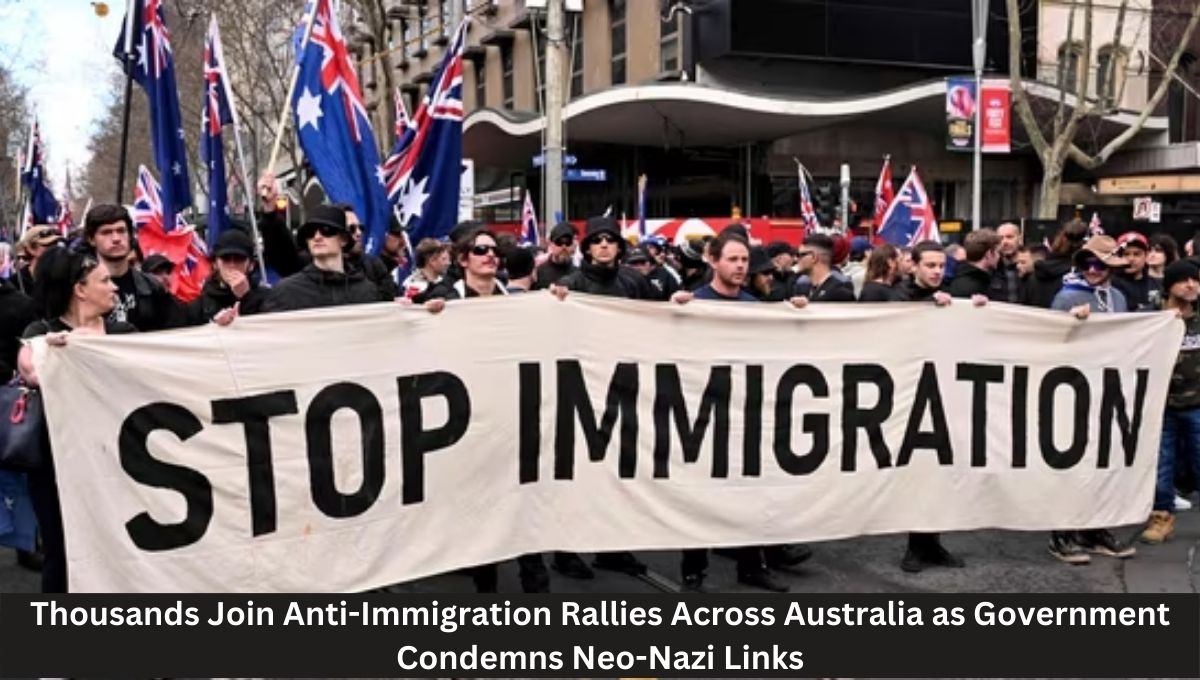
Under the “March for Australia” banner, Thousands Join Anti-Immigration Rallies Across Australia as Government Condemns Neo-Nazi Links. Australia witnessed some of its largest anti-immigration rallies in recent years, as thousands gathered in major cities under the banner of “March for Australia” to protest against what organisers called “mass migration.”
While attendees voiced frustration over housing, infrastructure, and services, the rallies were marked by strong far-right and neo-Nazi influences, with promotional material openly singling out Indian migrants. The federal government condemned the protests as racist, divisive, and dangerous, warning that they were fuelled by extremist groups.
Thousands Join Anti-Immigration Rallies Across Australia as Government Condemns Neo-Nazi Links
Sydney Rally Draws Thousands
In Sydney, between 5,000 and 8,000 people assembled near the course of the city marathon, many draped in the Australian flag. Police deployed hundreds of officers but reported no major incidents.
Nearby, a counter-protest organised by the Refugee Action Coalition attracted hundreds, with demonstrators carrying signs emphasising that “outside of Indigenous people, Australia is a nation of immigrants.”
“Our event shows the depth of disgust and anger about the far-right agenda of March For Australia,” said a Refugee Action Coalition spokesperson.
Despite the largely peaceful outcome, the Sydney rally carried strong anti-immigration messages. Protesters claimed that Australia’s housing market, hospitals, roads, and schools were “bursting at the seams” due to migration.
Violent Clashes in Melbourne
The largest tensions erupted in Melbourne, where police used pepper spray, baton rounds, and public order munitions after clashes between protesters and counter-demonstrators.
An estimated 5,000 people were present, with six arrests made and two officers injured.
Notably, neo-Nazi figure Thomas Sewell addressed the crowd from the steps of Parliament House, declaring that “his men” had led the march.
Sewell has a history of far-right activism and has been linked to violent extremist groups.
Later, a group of men associated with Sewell reportedly attacked Camp Sovereignty, an Indigenous protest camp in Melbourne, injuring several people.
Organisers accused police of arriving only after the attackers had left, sparking outrage.
Adelaide and Other Cities See Turnout
In Adelaide, police estimated 15,000 people took part in both the anti-immigration rally and a counter-demonstration. Authorities described the crowds as “generally well-behaved.”
Smaller rallies also occurred in Canberra, Perth, Brisbane, Hobart, and Townsville, with varying levels of participation.
In Townsville, veteran populist MP Bob Katter attended a rally, where he was “swarmed by hundreds of supporters.” Katter had made headlines days earlier after threatening a reporter for mentioning his Lebanese heritage in the context of his participation in the protests.
In Canberra, One Nation leader Pauline Hanson and Senator Malcolm Roberts attended, addressing crowds near Parliament House.
Flyers Target Indian Migrants
One of the most controversial aspects of the rallies was the targeting of Indian migrants.
Promotional material circulated online and at rallies highlighted census data showing that the Indian-born population in Australia doubled between 2013 and 2023, reaching 845,800 people (around 3% of the population).
One flyer read:
“More Indians in 5 years, than Greeks and Italians in 100. And that’s just from one country. We know migration has a cultural impact. This isn’t a slight cultural change – it’s replacement plain and simple. Australia is not an economic zone to be exploited by international finance.”
This rhetoric alarmed politicians, activists, and multicultural groups, who said the anti-Indian messaging was racist and dangerous.
Shadow Attorney General Julian Leeser warned:
“I’ve seen some of the material for that particular protest, and I’m really concerned about the anti-Indian sentiment that is being expressed and some of the antisemitic undertones of some of those protests.”
Also Read: Why are Indians a target of anti-immigration rallies in Australia?
Government Condemnation
The Anthony Albanese government was quick to denounce the rallies, with multiple ministers speaking out.
- Tony Burke, Minister for Home Affairs, declared:
“There is no place in our country for people who seek to divide and undermine our social cohesion. We stand with modern Australia against these rallies – nothing could be less Australian.”
- Dr Anne Aly, Minister for Multicultural Affairs, said:
“We stand with all Australians, no matter where they were born, against those who seek to divide us and who seek to intimidate migrant communities. We will not be intimidated. This brand of far-right activism grounded in racism and ethnocentrism has no place in modern Australia.”
- Murray Watt, Federal Minister, told Sky News:
“We absolutely condemn the March for Australia rally… It’s not about increasing social harmony. We don’t support rallies like this that are about spreading hate and dividing our community. These events were organised and promoted by neo-Nazi groups.”
Opposition leader Sussan Ley also posted a video message ahead of the protests, warning:
“There is no place for violence, racism, or intimidation. Whether incited from afar or stirred up here, we cannot let hatred and fear tear at our social cohesion.”
Roots in Far-Right Extremism
The March for Australia movement has links to anti-lockdown campaigners who rose to prominence during the COVID-19 pandemic, as well as established far-right figures such as Thomas Sewell.
The group’s website and social media pages claim that:
- “Mass migration has torn at the bonds that held our communities together.”
- Rallies aim to do “what mainstream politicians never have the courage to do: demand an end to mass immigration.”
Although organisers denied direct links to extremist groups, several neo-Nazi activists and far-right politicians were visible at the events.
Australia has been grappling with a rise in right-wing extremism in recent years, with its domestic intelligence agency warning that such groups are becoming more organised.
New laws introduced in 2024 banned the Nazi salute and the display or sale of extremist symbols, making violations punishable by mandatory prison sentences.
The Broader Debate: Housing, Hospitals, and Services
Beyond extremist rhetoric, many protesters expressed economic frustrations, linking immigration to Australia’s stretched housing market, infrastructure, and public services.
In Sydney, participant Glenn Allchin told Reuters:
“It’s about our country bursting at the seams and our government bringing more and more people in. Our kids struggling to get homes, our hospitals – we have to wait seven hours – our roads, the lack of roads.”
These concerns resonated with some ordinary Australians who may not share extremist ideology but feel frustrated by rising housing costs and strained services.
However, critics argue that targeting migrants particularly Indians is a misplaced response to complex structural issues such as underinvestment in infrastructure, housing affordability policies, and wage stagnation.
Counter-Protesters Highlight Multicultural Australia
Australia is one of the most multicultural nations in the world, with nearly half the population either born overseas or having at least one parent born abroad.
Counter-protesters in multiple cities highlighted this reality, rejecting the idea that immigration is a threat.
Cassandra Goldie, CEO of the Australian Council of Social Services, said:
“Australia’s diversity is a great strength, not a threat. There is no place in Australia for ideology that targets people because of who they are, where they come from, or what they believe.”
Greens deputy leader Mehreen Faruqi went further, describing the protests as:
“Acts of racist fear-mongering and hate… These rallies must be called out for what they are.”
Rising Far-Right Threat in Australia
The protests underscore a wider rise in far-right extremism in Australia. Authorities have pointed to growing activity among neo-Nazi groups, visible at protests and online.
This comes against a backdrop of:
- Antisemitic attacks on synagogues, cars, and buildings following the Israel-Gaza conflict.
- The 2019 Christchurch mosque massacre, carried out by an Australian-born white supremacist, which killed 51 Muslim worshippers in New Zealand.
- Recent plots disrupted by Australian security agencies linked to far-right terrorism.
These events highlight the security risks posed by extremist groups and the challenge of balancing free speech with protecting communities from hate and intimidation.
Conclusion: A Divided Moment for Australia
The March for Australia rallies may have drawn thousands, but they have also exposed deep divisions in Australian society.
For many participants, concerns about housing, hospitals, and infrastructure drove them to the streets. But the rallies were dominated by anti-immigration rhetoric, far-right symbols, and targeted attacks on Indian migrants, sparking fears of a growing extremist movement.
The Australian government, opposition leaders, and community groups stood united in condemning the rallies as racist and un-Australian, vowing to defend the nation’s multicultural identity. As the debate over migration continues, Australia faces a choice between embracing its diversity or succumbing to the fear-driven narratives of far-right extremism.
Also Read: “No Kings” Protests Rock Nation as Trump Celebrates Military Parade and Birthday
Related Posts:
- 7 Alarming Facts About Super Typhoon Fung-wong
- Trump’s 20-Point Gaza Peace Plan Gains Urgent Global…

- Afghanistan–Pakistan War 2025: Inside the 48-Hour Ceasefire

- Israel–Hamas Ceasefire Under Strain: 4 More Hostage…

- China Hosts SCO Summit 2025 and Military Parade as…

- 10 Million March: ‘No Kings’ Protests Sweep Across U.S.