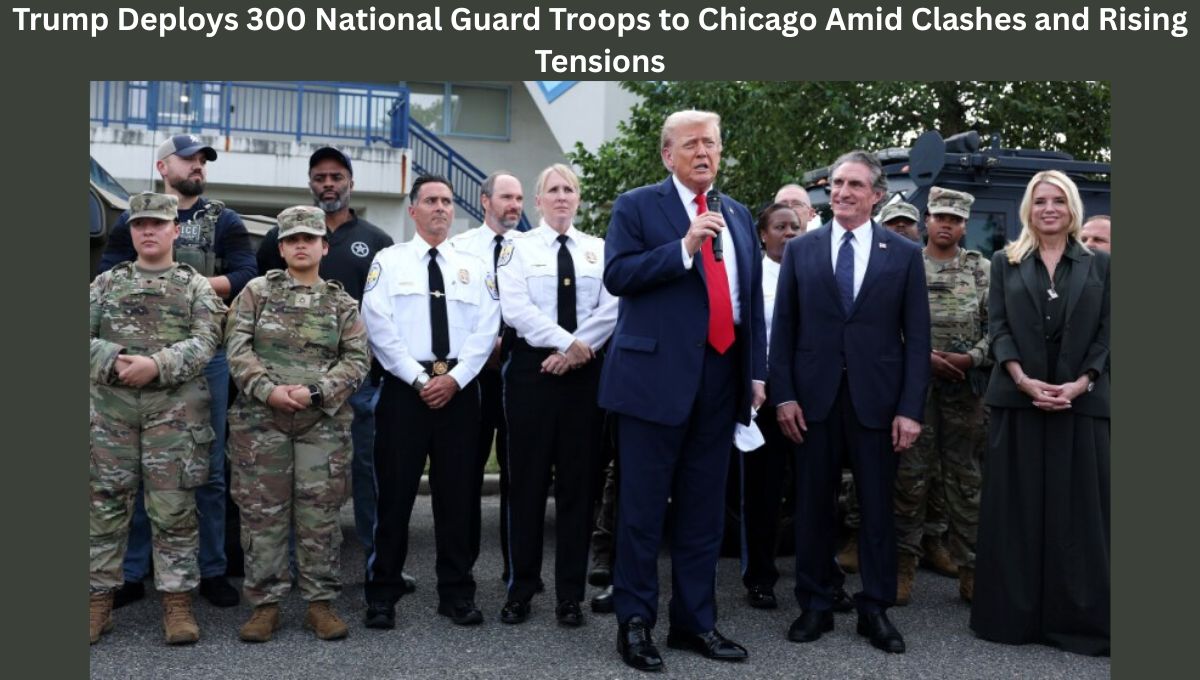
Trump Deploys 300 National Guard Troops to Chicago Amid Clashes and Rising Tensions between protesters and immigration agents. President Donald Trump has authorised the deployment of 300 National Guard troops to Chicago, escalating tensions with Illinois officials who have condemned the move as unconstitutional and politically motivated.
The order came just hours after a violent confrontation between protesters and federal immigration agents in the city left an armed woman wounded. White House spokeswoman Abigail Jackson said the deployment was intended to “protect federal officers and assets” amid what Trump described as “out-of-control crime” in the Democrat-led city.
“President Trump will not turn a blind eye to the lawlessness plaguing American cities,” Jackson said. The decision marks a dramatic escalation in Trump’s ongoing campaign to portray Democratic-led cities as unsafe, even as crime in Chicago has been declining overall.
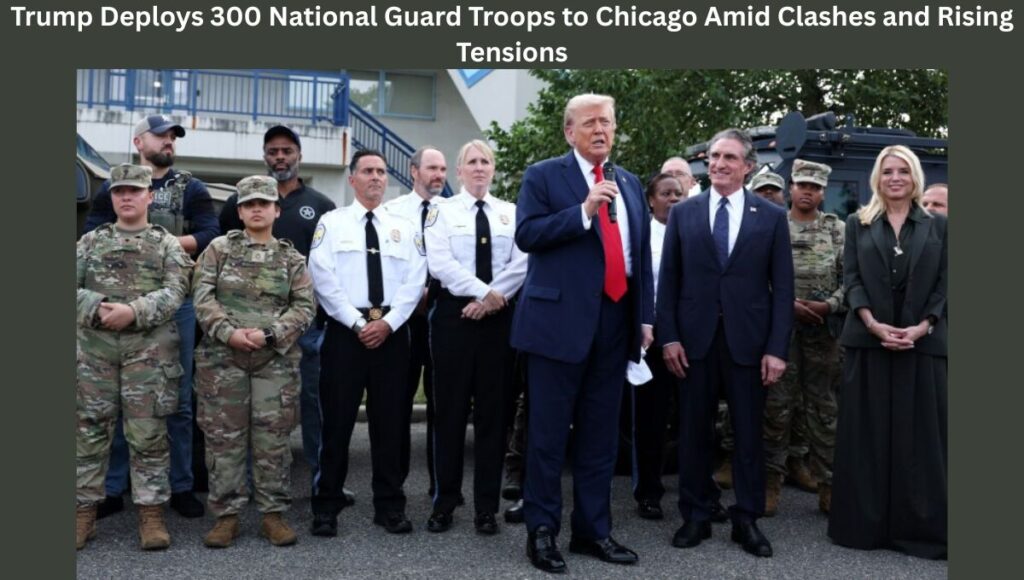
Trump Deploys 300 National Guard Troops to Chicago Amid Clashes and Rising Tensions
Clashes With Immigration Agents Spark Deployment
The order followed a chaotic night in Chicago’s Brighton Park neighbourhood, where US Border Patrol agents said they were “boxed in” by a group of protesters who rammed their vehicles into federal cars.
According to the Department of Homeland Security (DHS), one of the drivers, an armed woman, pointed a weapon at agents before they opened fire. She was later identified as a US citizen who drove herself to a hospital. Her condition remains unclear. No law enforcement officers were seriously injured.
DHS Assistant Secretary Tricia McLaughlin said the agents acted in self-defence.
“Law enforcement was forced to deploy defensive fire at an armed individual who posed a direct threat,” she said.
The Department of Homeland Security said the attack was “unprovoked and violent,” adding that “special operations teams” were being sent to reinforce security in Chicago.
Governor Pritzker Condemns the Move
Illinois Governor JB Pritzker, a Democrat, blasted the federal action as “un-American” and accused the White House of “manufacturing a crisis.”
“It is absolutely outrageous and un-American to demand that a governor deploy military forces within our own borders and against our will,” Pritzker said.
Pritzker added that the Trump administration’s Department of War had given him an ultimatum: “Call up your troops, or we will.”
He refused to issue the order, saying, “There is no need for military troops on the ground in the State of Illinois. This is about control, not safety.”
Local officials said they were not informed of when or where the National Guard would be deployed, but preparations appeared to be underway over the weekend.
Also Read: Trump Recruits Generals and Admirals for Political Agenda: Inside the Quantico Showdown
Rising Protests in Chicago
The deployment follows weeks of escalating protests in Chicago over increased immigration enforcement by ICE and Border Patrol agents. Demonstrations outside detention centres have turned violent at times, with protesters blocking federal vehicles and agents responding with pepper spray and rubber bullets.
On Friday, hundreds gathered outside an ICE facility in Broadview, a suburb west of the city. Police pushed back demonstrators who attempted to prevent detainee transport. Federal officers reported arresting 13 protesters.
Videos shared on social media show heavily armed ICE agents confronting protesters, drawing criticism from human rights groups who accused federal authorities of “militarising civilian spaces.”
Trump’s Broader Anti-Crime and Immigration Crackdown
President Trump’s order in Chicago is part of a wider law-and-order campaign aimed at sending federal forces into what he calls “crime-ridden” cities run by Democrats. Similar deployments or proposals have been made in Los Angeles, Washington, DC, Memphis, and Portland.
At a recent meeting with senior military leaders, Trump reportedly said he wanted to use American cities as “training grounds” for troops to “combat the enemy from within.”
“They’re very unsafe places and we’re going to straighten them out one by one,” Trump said.
The White House has portrayed the moves as a response to rising crime, but statistics from the Council on Criminal Justice show that homicides in Chicago have fallen by about one-third in the first half of the year compared with the same period last year.
However, violent incidents remain significantly higher than the national average. Over the Labor Day weekend, at least 58 people were shot, eight fatally, across the city.
Legal and Constitutional Challenges Ahead
Legal experts and civil rights groups have questioned the constitutionality of Trump’s deployment orders, noting that National Guard troops are typically under state control and that the Posse Comitatus Act limits the federal use of the military for domestic law enforcement.
When the National Guard is “federalized” under Title 10 of the US Code, it shifts from state to federal command — a process typically reserved for national emergencies or wars.
Professor Michael Gerhardt, a constitutional law expert at the University of North Carolina, said the move “blurs the line between civil and military authority.”
“If the president can federalize state troops at will, without consent, it erodes state sovereignty,” Gerhardt said.
Democrats in Congress have also voiced alarm. Senator Dick Durbin of Illinois accused the president of “terrorising families” and “writing a shameful chapter in American history.”
Judge Blocks Portland Deployment
While the Chicago deployment moves ahead, the Trump administration suffered a setback in Oregon, where a federal judge temporarily blocked the deployment of 200 National Guard troops to Portland.
US District Judge Karin Immergut ruled that the administration’s justification was “untethered to the facts” and that it violated the Constitution by sending troops without state consent.
Immergut wrote that the use of the military to quell unrest “risked blurring the line between civil and military power — to the detriment of the nation.”
The decision follows months of tension between Trump and Portland officials, who accused the administration of using outdated or misleading footage from 2020 protests to exaggerate the level of unrest.
Also Read: Judge temporarily blocks use of National Guard in Portland
Escalating Political Divide
Trump’s move has deepened the political divide between federal and state governments. Democratic governors, including Gavin Newsom of California, have filed lawsuits or obtained restraining orders to block similar deployments.
Newsom won a temporary injunction preventing National Guard troops from being deployed to Los Angeles earlier this year, though the Justice Department has appealed.
Meanwhile, Tennessee National Guard troops are expected to assist police in Memphis, part of Trump’s expanded campaign to “restore order” in major urban centres.
The White House has defended the deployments as “law enforcement support missions” rather than military interventions, insisting that troops will operate only around federal buildings and assets.
Understanding “Federalizing” the National Guard
Under Title 10 of the US Code, the president can federalize National Guard units, placing them under the control of the Department of Defense instead of state governors.
This allows the president to deploy them across state lines and direct them as part of active-duty missions. However, such moves are rare and often controversial, as they override governors’ authority.
In contrast, under Title 32, National Guard members remain under state command but may receive federal funding.
Historically, federalization has been used during wartime or when states were unable to respond to major crises — for example, during Hurricane Katrina (2005) or the civil rights unrest of the 1960s.
Critics argue that Trump’s actions do not meet those criteria.
DHS and ICE Under Scrutiny
The Department of Homeland Security and Immigration and Customs Enforcement (ICE) have been at the centre of the controversy.
Over recent months, DHS agents have intensified immigration raids in Chicago under “Operation Midway Blitz”, focusing on individuals suspected of gang involvement.
According to Reuters, a recent raid in a Chicago apartment complex led to the detention of several US citizens, including parents separated from children.
Homeland Security Secretary Kristi Noem defended the actions, saying the operations were “lawful and necessary to maintain order.”
“Federal officers will not stand down in the face of mob violence or attacks on our personnel,” she said.
Public Reaction and Political Fallout
Public reaction in Chicago has been sharply divided. Some residents support stronger federal action against crime and unrest, while others see the deployments as an intimidation tactic ahead of the election season.
Protest organisers accused Trump of using federal power to score political points and suppress dissent.
Civil rights groups, including the ACLU, have warned of “dangerous precedents” being set for future administrations.
Meanwhile, Republican lawmakers have praised the move. Senator Tom Cotton said the president was “doing what weak governors won’t — restoring safety to American streets.”
What Comes Next for Chicago
As of Sunday evening, it remained unclear whether National Guard troops had arrived in Chicago. Local authorities said they were still seeking clarification from the Pentagon on the scope of their role.
Observers expect legal challenges in the coming days. Illinois officials may seek an injunction similar to Oregon’s, arguing that the federalization of state troops violates both state sovereignty and the Posse Comitatus Act.
For now, protests are expected to continue outside immigration detention facilities, and tensions remain high between residents and federal authorities.
Conclusion
President Trump’s decision to deploy 300 National Guard troops to Chicago marks one of the most significant tests yet of federal power over state authority in recent US history.
While the White House insists the move is necessary to “restore order,” critics warn that it represents an alarming precedent in the use of military force for domestic political purposes.
As federal troops prepare to take up positions and lawsuits loom, Chicago has become the latest flashpoint in the broader struggle over how — and by whom — America’s cities are governed.