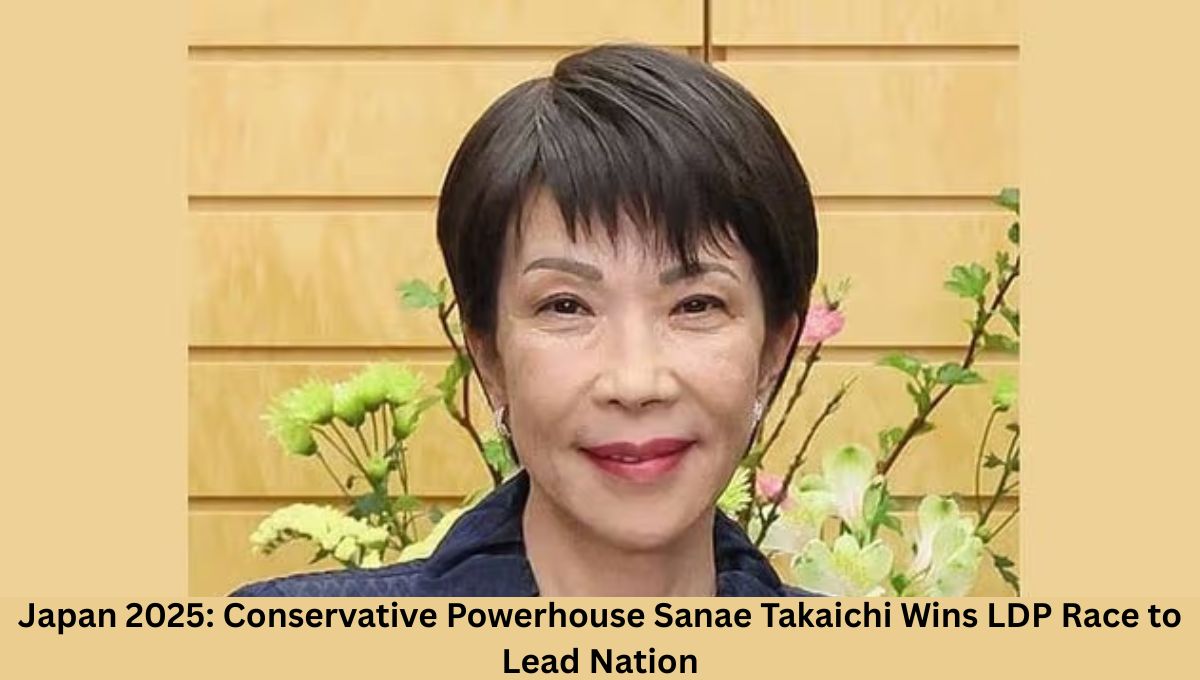
Tokyo, October 5, 2025 — Japan 2025: Conservative Powerhouse Sanae Takaichi Wins LDP Race to Lead Nation, marking a pivotal shift in Japan’s political direction. In a historic yet politically charged victory, former Internal Affairs Minister Sanae Takaichi, 64, has won Japan’s ruling Liberal Democratic Party (LDP) presidential election, setting her on course to become the country’s first female prime minister.
Her win, seen as a triumph for Japan’s conservative wing, comes amid deep voter frustration, shifting demographics, and rising geopolitical pressures.
Japan 2025: Conservative Powerhouse Sanae Takaichi Wins LDP Race to Lead Nation
Takaichi Defeats Koizumi in Runoff, Ending Ishiba’s Era
According to Kyodo News, Takaichi secured victory over Shinjiro Koizumi, 44, Japan’s agriculture minister and son of former prime minister Junichiro Koizumi, in a runoff vote held on Saturday.
She succeeds outgoing Prime Minister Shigeru Ishiba, who stepped down in early September after the ruling coalition’s poor performance in recent parliamentary elections.
With the LDP-Komeito coalition still holding the largest bloc in Japan’s parliament, Takaichi is expected to be confirmed as Prime Minister later this month, extending her leadership term until 2027.
A Veteran Conservative with a Long Political Career
Born in Nara Prefecture, western Japan, in 1961, Sanae Takaichi began her political career in 1993 and quickly earned a reputation as a sharp, disciplined policymaker.
She has held several key cabinet roles, including Minister for Economic Security (2022–2024), Minister for Internal Affairs, and Minister for Gender Equality.
Once a heavy-metal drummer and motorcycle enthusiast, Takaichi has long stood apart from Japan’s traditional political elite.
She often describes herself as an outsider who entered politics to challenge bureaucratic complacency and restore what she calls Japan’s “national confidence.”
Also Read: From heavy metal drummer to Japan’s first female PM in waiting: The rise of Sanae Takaichi
‘Japan First’ Politics and a Nationalist Legacy
A protégé of the late Shinzo Abe, Takaichi has been closely associated with the nationalist right-wing of the LDP.
She supports Abe’s “Free and Open Indo-Pacific” initiative, which seeks to strengthen defense ties with the U.S. and regional partners to counter China’s growing influence.
Her foreign policy vision, which she brands as “Japan First”, emphasizes national sovereignty and economic self-reliance.
“Tokyo must act foremost in its national interest,” she said during a recent campaign debate, while criticizing parts of Japan’s trade deal with the United States as “unequal.”
A Thatcher Admirer in Tokyo
Takaichi has often cited Margaret Thatcher as her political role model. Like the former British prime minister, she promotes strong leadership, fiscal conservatism, and national pride.
Observers note that her rhetoric blends economic pragmatism with moral traditionalism, appealing to conservative voters frustrated by years of political drift and economic stagnation.
During her campaign, she pledged to revive aspects of “Abenomics” — Shinzo Abe’s strategy of monetary easing and public investment — while promising to tackle inflation and wage stagnation.
Breaking Japan’s Political Glass Ceiling
Despite being the first woman to lead Japan’s ruling party, Takaichi is not viewed as a feminist icon. Analysts describe her rise as a political milestone rather than a social revolution.
“I wanted to turn people’s anxieties about their daily lives into hope,” Takaichi told supporters before the second-round vote, according to Reuters.
Her critics argue that while she symbolizes progress in gender representation, she has not championed feminist causes.
She opposes revising a 19th-century civil law that requires married couples to share the same surname — a rule that mostly affects women — and remains firmly against same-sex marriage.
Work Ethic and Personal Style
Known for her intense work ethic, Takaichi once remarked, “I will abandon the phrase ‘work-life balance.’ I will work, work, work and work.”
The comment quickly trended on Japanese social media, drawing both admiration and concern. Supporters hailed her dedication, while critics said it reinforced Japan’s notorious overwork culture.
She admits to being a workaholic who prefers studying policy documents to socializing. After two failed bids for the LDP leadership — in 2021 and 2024 — she reportedly worked hard to build alliances within the party, a strategy that paid off in her third attempt.
Policy Priorities: Security, Economy, and Demographics
As Japan faces mounting challenges — from an aging population to regional instability — Takaichi’s policy platform centers on national security, economic revival, and family support.
- Defense & Security:
Takaichi advocates amending Japan’s pacifist constitution, particularly Article 9, to allow greater military capabilities for the Self-Defense Forces.
She has called for a more assertive stance toward China and North Korea, stressing that “deterrence through strength” is vital for peace. - Economic Security:
She promises to strengthen supply chains, expand semiconductor manufacturing, and safeguard Japan’s technological edge.
Her approach mirrors Abe’s doctrine of economic nationalism, seeking to balance free trade with domestic protection. - Demographic Challenges:
Takaichi supports financial aid for fertility treatments, women’s health, and childcare incentives, while urging companies to adopt family-friendly policies.
Her policies, however, frame women’s roles largely within traditional family structures — emphasizing motherhood over workplace equality.
A Conservative Star in a Male-Dominated Party
The Liberal Democratic Party, founded in 1955, has ruled Japan almost continuously since World War II but has struggled with internal divisions and public fatigue.
By electing Takaichi, the LDP hopes to reenergize its conservative base and reclaim voters drifting toward the far-right Sanseito Party, which has grown in popularity with its anti-immigration platform.
“Takaichi’s rise reflects both a generational and ideological shift,” said Yuki Tsuji, a political scientist at Tokai University. “She offers strong leadership, but her views remain deeply conservative — especially on gender and immigration.”
Also Read: Shigeru Ishiba Resigns as Japan’s Prime Minister After Election Defeats: Who Will Replace Him?
Immigration, Identity, and National Security
Takaichi’s hardline immigration stance has resonated with voters concerned about crime and cultural change.
In her campaign speeches, she emphasized tightened border controls and selective immigration, arguing that Japan must “protect its social cohesion.”
Analysts say her position mirrors global conservative trends, where populist rhetoric around national identity often translates into electoral gains.
However, Japan’s shrinking workforce means Takaichi will eventually need to balance nationalism with pragmatism to sustain economic growth.
Foreign Policy and Regional Dynamics
As leader, Takaichi is expected to maintain Japan’s strategic partnership with the United States, while pursuing stronger ties with India, Australia, and ASEAN nations under the Indo-Pacific framework.
Her foreign policy outlook prioritizes deterrence and diplomacy in equal measure.
She remains a frequent visitor to the Yasukuni Shrine, which honors Japan’s war dead — including convicted war criminals — a practice that often provokes anger from China and South Korea.
Her office has not confirmed whether she will continue those visits as prime minister, though she once said she intends to “honor those who sacrificed their lives for the nation.”
A Symbolic Victory for Women — with Caveats
Japan ranks among the lowest in the OECD for gender equality, with women holding fewer than 15% of parliamentary seats.
Takaichi’s ascent represents a symbolic breakthrough, yet experts caution that it may not translate into major policy changes.
“She’s not a feminist in the Western sense,” said Professor Sadafumi Kawato of the University of Tokyo.
“Her leadership will be a step forward for visibility, but not necessarily for reform.”
Nevertheless, Takaichi has pledged to appoint a cabinet with “Nordic levels” of female ministers, a dramatic shift from Ishiba’s government, which had just two women in top roles.
Reviving the Party, Rebuilding Trust
In her victory speech, Takaichi acknowledged the LDP’s slipping public support, calling for a “rebirth of trust and purpose.”
“Recently, people have said they don’t know what the LDP stands for anymore,” she said. “That sense of urgency drove me to act.”
Under her leadership, the LDP aims to restore confidence among disillusioned voters, many of whom feel left behind by stagnant wages and political scandals.
Her biggest challenge will be reconciling her nationalist rhetoric with Japan’s modern realities — an aging society, an innovation gap, and rising defense obligations.
Challenges Ahead: Economy, Aging, and Global Tensions
As Japan’s next prime minister, Takaichi inherits a fragile economy, an overburdened welfare system, and rising tensions in the East China Sea. Balancing fiscal discipline with social spending will test her ability to govern beyond ideology.
Domestically, she must navigate divisions within the LDP, where moderates worry her conservative tone could alienate urban voters. Internationally, her assertive posture may strain Tokyo’s delicate diplomacy with Beijing and Seoul.
A Nation at a Crossroads
Sanae Takaichi’s rise marks both continuity and change for Japan. She embodies the enduring strength of conservative politics, yet also symbolizes a society slowly evolving toward inclusion.
Her leadership will test whether Japan can embrace reform without losing its traditions — a delicate balance between progress and preservation.
As the parliament prepares to confirm her premiership on October 15, all eyes will be on how Japan’s new leader — part Iron Lady, part nationalist reformer — charts her course through the complex challenges ahead.
Related Posts:
- Shigeru Ishiba Resigns as Japan’s Prime Minister…

- Sanae Takaichi Becomes Japan’s First Female Prime…

- 12 Explosive Shifts as Japan’s Iron Lady Takaichi…

- Japan’s PM Shigeru Ishiba Faces Make-or-Break Upper…

- Shigeru Ishiba’s Leadership in Crisis After Japan…

- 7 Explosive Reasons Japan’s Winter Election Could…