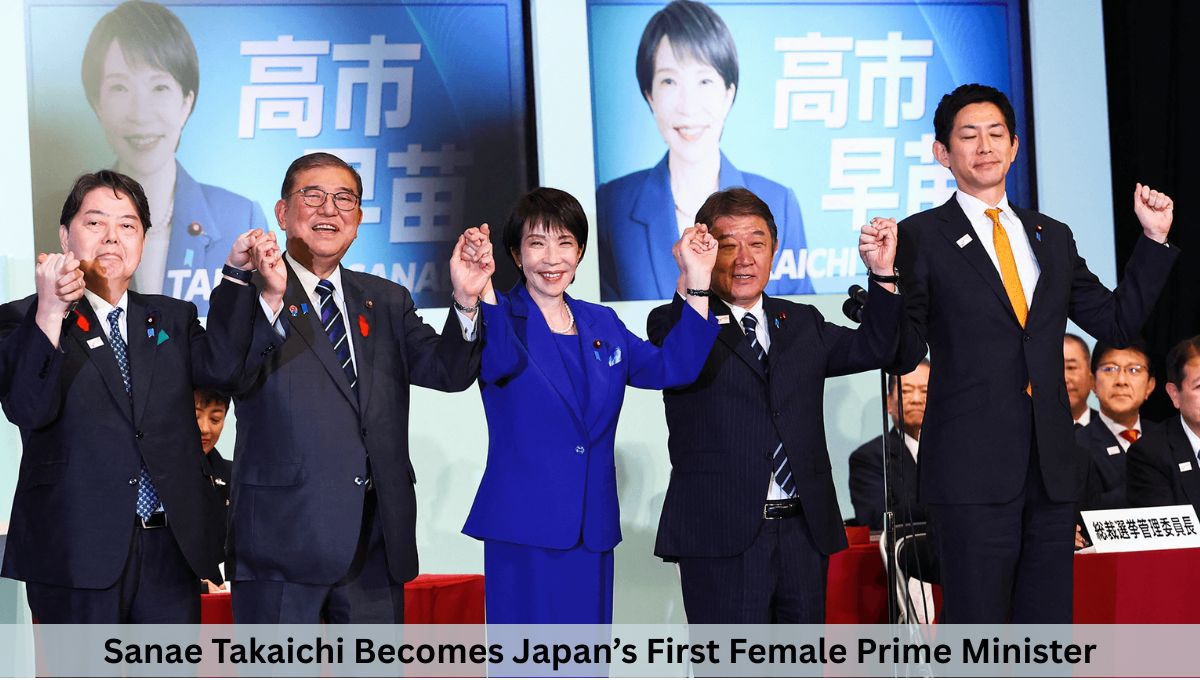
Sanae Takaichi Becomes Japan’s First Female Prime Minister 2025, breaking a historic gender barrier. Japan has entered a new political era as Sanae Takaichi, a hardline conservative, became the country’s first female prime minister, marking a historic moment for one of the world’s most patriarchal societies.
Elected by Japan’s parliament, Takaichi now faces immense challenges — a struggling economy, political fragmentation, regional tensions, and the pressure to prove that her leadership can transcend symbolism and deliver results.
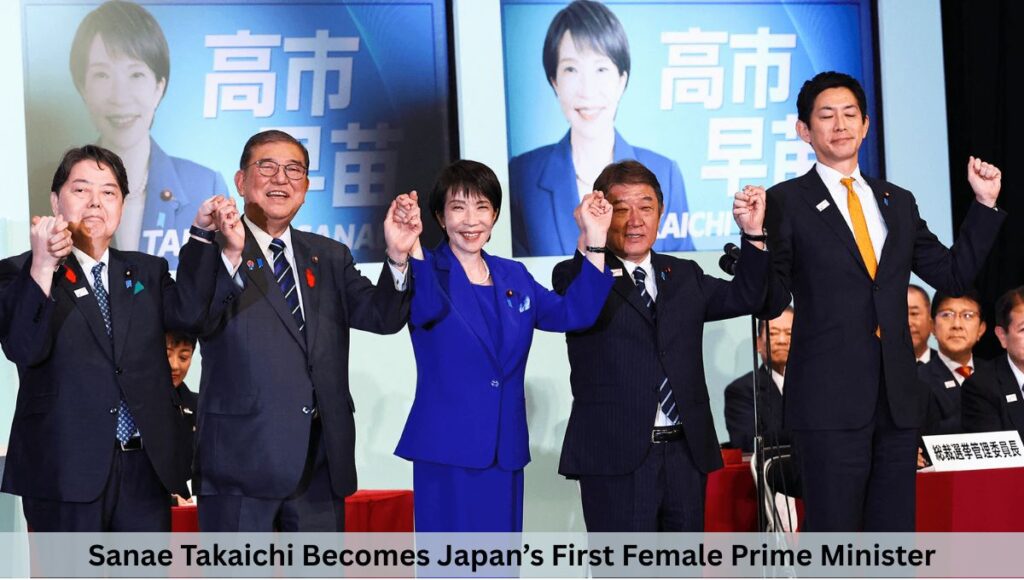
Sanae Takaichi Becomes Japan’s First Female Prime Minister 2025
A Landmark Moment for Japan’s Politics
Takaichi’s rise represents a seismic shift in Japan’s political landscape. For decades, the Liberal Democratic Party (LDP), Japan’s dominant conservative force, has been led almost exclusively by men.
But the election of the 64-year-old former cabinet minister signals not just a change in gender dynamics — it underscores a rightward ideological turn within the ruling party.
She replaces Shigeru Ishiba, who resigned last month following election losses and a devastating slush fund scandal that shattered public trust in the LDP.
Takaichi was elected by both houses of parliament after securing 237 votes in the 465-member lower house, paving her way to become Japan’s 104th prime minister. She is expected to be formally sworn in after meeting Emperor Naruhito.
A Conservative Trailblazer with Controversial Views
While her election breaks a long-standing gender barrier, Takaichi’s ideology is deeply conservative and nationalist.
She has long advocated for revising Japan’s pacifist constitution, strengthening defense capabilities, and visiting the Yasukuni Shrine — a controversial memorial that honors Japan’s war dead, including convicted World War II war criminals.
Takaichi has also opposed same-sex marriage, immigration expansion, and allowing married couples to use separate surnames — policies that many see as crucial for a modern, inclusive Japan.
These stances have raised eyebrows among moderates within her party and concern among Japan’s regional neighbors, especially China and South Korea.
Forming a New Coalition Amid Political Turmoil
Her path to power was far from straightforward.
After winning the LDP leadership on October 4, Takaichi faced an immediate setback when the Komeito Party, the LDP’s coalition partner for 26 years, walked out, citing discomfort with her far-right leanings and the party’s corruption scandals.
Desperate for support, the LDP struck a last-minute deal with the Nippon Ishin (Japan Innovation Party) — a conservative opposition party — securing a slim governing majority.
The coalition agreement includes a promise to cut the number of lawmakers by 10%, introduce stricter immigration rules, and promote Osaka as Japan’s second capital.
Despite forming a minority government, Takaichi’s ability to maintain this alliance will be critical to pushing legislation through Japan’s notoriously gridlocked parliament.
Also Read: Japan 2025: Conservative Powerhouse Sanae Takaichi Wins LDP Race to Lead Nation
Economic Challenges: Inflation, Debt, and Decline
Japan’s new prime minister inherits a fragile economy plagued by inflation, stagnant wages, and an aging population.
Prices of essential goods — including rice, a staple food — have almost doubled in the past year.
Takaichi has proposed a combination of large-scale spending and tax cuts to stimulate growth, echoing the economic nationalism of her mentor, the late Shinzo Abe.
However, critics warn that such policies could worsen Japan’s already severe national debt, which stands at more than 260% of GDP, one of the highest in the world.
The Gender Barrier Finally Broken
Takaichi’s election represents a milestone in Japan’s long struggle with gender inequality.
Despite being the world’s third-largest economy, Japan ranks 118th out of 148 countries in the World Economic Forum’s Global Gender Gap Report 2025.
Women occupy only 10% of seats in Japan’s House of Representatives and fewer than 1% of CEO positions in top listed companies.
In contrast, Takaichi has promised to form a cabinet with “Nordic levels” of female representation, aiming for about 50% women ministers — a bold departure from the previous administration’s tokenism.
She is also expected to appoint Satsuki Katayama as Japan’s first female finance minister, further breaking gender barriers at the highest level of government.
PM Modi and Global Leaders Congratulate Takaichi
World leaders were quick to recognize the significance of Takaichi’s appointment.
Indian Prime Minister Narendra Modi congratulated her on X (formerly Twitter):
“Heartiest congratulations, Sanae Takaichi, on your election as the Prime Minister of Japan. I look forward to working closely with you to further strengthen the India–Japan Special Strategic and Global Partnership.”
India and Japan share deep defense and economic ties, and both nations collaborate in forums like the Quad Alliance alongside the United States and Australia to ensure a free and open Indo-Pacific.
Takaichi’s hawkish stance on China aligns closely with India’s and could strengthen this strategic partnership.
Regional Implications: A Hawk on China, a Stiff Diplomat with Korea
Takaichi’s foreign policy is expected to be tough on China, continuing Japan’s pivot toward deterrence and regional assertiveness.
Her repeated visits to the Yasukuni Shrine have drawn criticism from Beijing and Seoul, where memories of Japan’s wartime aggression still fuel resentment.
Experts fear that her election could strain relations with China and South Korea, complicating cooperation on trade, technology, and security.
At the same time, her willingness to align more closely with the United States under President Donald Trump, who is scheduled to visit Japan soon, underscores her commitment to maintaining Japan’s alliance with Washington.
Japan’s Domestic Problems: Aging, Birthrates, and Immigration
Beyond the economy, Takaichi faces Japan’s existential demographic crisis.
The country’s birthrate continues to plummet, its population is shrinking, and nearly 30% of citizens are over 65.
While many economists argue that relaxing immigration policies could help fill labor shortages, Takaichi’s government is expected to maintain tight immigration controls, aligning with conservative voter sentiment.
Her challenge will be balancing demographic reality with nationalist rhetoric — a task that has eluded her predecessors.
The Global Perspective: Why the U.S. Still Lags Behind
Takaichi’s rise has reignited conversations about gender and leadership worldwide.
Despite its low gender equality rankings, Japan has now joined the list of advanced economies led by women — a milestone the United States still has not achieved.
Among G20 countries, only the U.S., China, Russia, and Saudi Arabia have never been led by a woman.
Studies suggest that Japanese society is actually more accepting of female leaders than the U.S., where 16% of citizens still express discomfort about a woman president.
In contrast, a 2023 Tokyo Foundation study found that only 10% of Japanese respondents opposed the idea of a female prime minister.
This cultural shift may help sustain Takaichi’s leadership — even if her conservative values clash with feminist ideals.
A Polarizing Figure, Yet a Role Model
While critics accuse Takaichi of being anti-feminist, her mere presence at the helm of Japan’s government sends a powerful message.
Political analysts argue that representation itself can reshape public perception, even when policy positions remain conservative.
Her tenure may encourage greater female participation in politics and corporate leadership — long overdue in Japan’s male-dominated systems.
As one political scholar noted:
“Even if Takaichi is not a feminist by ideology, her visibility as a capable leader could change how millions of Japanese women see themselves in politics.”
Cabinet Formation and Future Agenda
Takaichi’s immediate task is to form her cabinet, which she promised will include “competent leaders regardless of gender.”
She is expected to unveil her ministerial lineup soon, with a focus on stabilizing the yen, controlling prices, and rebuilding public confidence in the LDP.
Her government also plans to negotiate new trade deals, increase defense spending, and modernize Japan’s energy infrastructure.
But with a fragile coalition and mounting domestic issues, Takaichi’s honeymoon period is likely to be short.
The Road Ahead: A Test of Leadership and Legacy
Takaichi inherits a nation at a crossroads — an economy struggling under inflation, a populace disillusioned with politics, and allies watching her every move.
She must balance economic pragmatism with ideological conviction, gender symbolism with political reality, and national identity with global expectations.
Her leadership will determine whether Japan can reclaim its stability and global influence — or whether her tenure will add another name to the revolving door of short-lived Japanese prime ministers.
Conclusion: A Historic Yet Uncertain Future
Sanae Takaichi’s election as Japan’s first female prime minister is nothing short of historic. It breaks centuries of male dominance and offers a new chapter in Japan’s modern history.
Yet, she faces towering challenges: uniting a divided parliament, reviving a sluggish economy, managing tense regional relations, and delivering tangible progress on gender equity.
Whether history remembers her as Japan’s “Iron Lady” or as another short-term leader will depend on her ability to govern effectively, reform boldly, and inspire confidence in a skeptical public. For now, the world watches — as Japan, at last, joins the ranks of nations led by a woman.
Also Read: Meet Sanae Takaichi: Japan’s First Female PM Is A China Hawk And A Heavy Metal Drummer