7 Shocking Moments from Trump’s ‘Destroy You’ Ultimatum to Ukraine, urging Kyiv to accept Russia’s terms. In one of the most explosive diplomatic encounters in recent memory, United States President Donald Trump confronted Ukrainian President Volodymyr Zelenskyy at the White House, issuing a blunt ultimatum: accept a deal proposed by Russian President Vladimir Putin—or face destruction.
The meeting, which reportedly featured shouting, map-throwing and profanity, has sent shockwaves through Western capitals and raised profound questions about the future of Ukraine’s war with Russia.
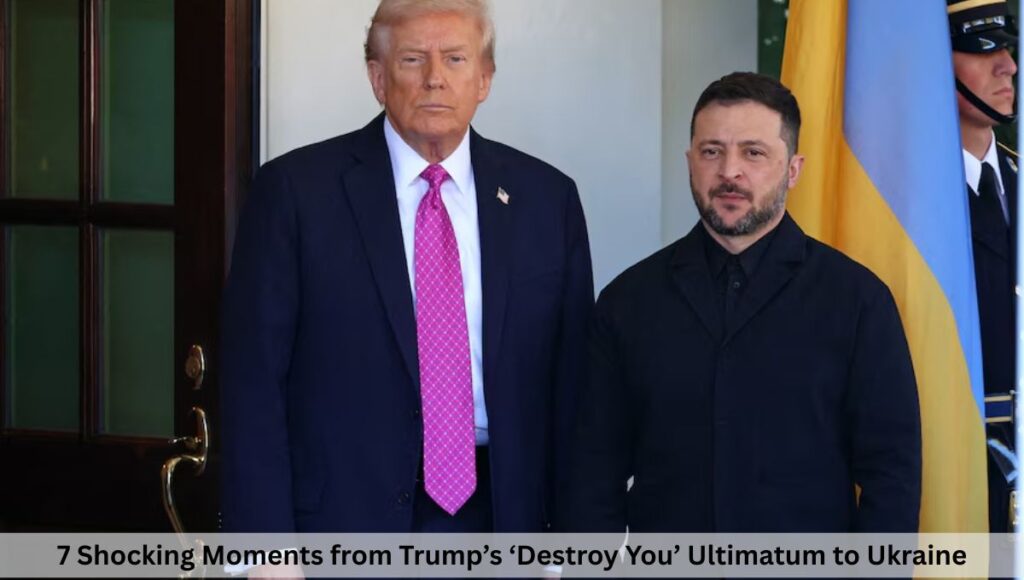
7 Shocking Moments from Trump’s ‘Destroy You’ Ultimatum to Ukraine
The Setting – A White House Meeting on the War
President Trump invited President Zelenskyy to the White House for a working lunch on Friday, October 17, 2025, following a phone call the previous day with President Putin. European officials who were briefed on the encounter described the atmosphere as “tense” and “frank”—a sharp departure from earlier meetings in which U.S. support for Ukraine appeared more firmly anchored.
Why the meeting was called
- Following the war in Ukraine, Russia launched a full-scale invasion in February 2022.
- Trump has made ending the war a top priority after his role in the Israel-Hamas cease-fire.
- Ukraine was pressing the U.S. for long-range Tomahawk cruise missiles; Trump appeared unwilling to authorise them.
- Russia’s latest proposal reportedly asked Ukraine to cede large parts of the Donbas region and small parts of Kherson and Zaporizhzhia in return for a peace deal. Kherson and Zaporizhzhia are in southern Ukraine.
The Explosive Exchange
Maps thrown aside and “destroy you” warning
According to the report by the Financial Times, during the meeting Trump brushed aside maps of the Ukrainian front line, declaring he was “sick” of seeing them. He reportedly told Zelenskyy: “If (Putin) wants it, he will destroy you.” One official quoted:
“The message was, ‘Your country will freeze, and your country will be destroyed’ if Ukraine doesn’t make a deal with Russia.” Such remarks underscore the high-stakes pressure Ukraine now faces—not only militarily, but diplomatically and politically.
Demand for major territorial concessions
President Trump reportedly pressed Zelenskyy to concede the entire Donbas region to Russia—a move Kyiv views as unacceptable. Trump later softened that to a freeze on current lines, but the initial demand raised eyebrows among Ukraine’s European backers.
Refusal to supply long-range missiles
Zelenskyy had come to Washington seeking U.S. approval for long-range Tomahawk cruise missiles that could hit deep inside Russia. But Trump declined to authorise the supply. The message: Ukraine must seek a diplomatic settlement, rather than escalate militarily.
Trump’s Public Position After the Meeting
After the private meeting, President Trump went public with his position:
- He called for an immediate cease-fire and freezing the front lines where they currently stand. “Leave it the way it is right now,” he said.
- He denied he had told Zelenskyy to surrender the entire Donbas, saying: “I never said they would win it. I said they could win.”
- He acknowledged that Russia’s economy was “doing great” during the meeting—contradicting his earlier claims of Moscow being near collapse.
- He reaffirmed his intention to meet Putin in Budapest within a few weeks to advance a peace deal.
Ukraine and Europe’s Reaction
Kyiv’s cautious stance
President Zelenskyy, in a statement after the meeting, called for “decisive steps” from the U.S., Europe and G7 nations. He insisted Ukraine would never voluntarily give up any territory that is still contested. Kyiv’s delegation reportedly left the meeting disappointed, having expected stronger U.S. weaponry support instead of pressure to negotiate.
European allies push back
European officials reacted with concern that pressure was being placed on the victim (Ukraine) to make concessions. For example, the EU’s foreign policy chief stated that Ukraine should not be put under pressure to give up territory. Some flagged that Moscow may be using diplomacy to legitimise its territorial gains rather than truly end the war.
Russia’s New Proposal and What It Means
Vladimir Putin’s latest peace proposal reportedly asked Ukraine to surrender the remaining parts of Donbas it controls in exchange for limited parts of southern Kherson and Zaporizhzhia regions.
While a step back from Moscow’s earlier demand (in Alaska) for the entire Donbas plus Kherson and Zaporizhzhia, it is still a major territorial loss for Kyiv.
Ukrainian officials view such a deal as a non-starter: giving up western Donetsk and Luhansk could leave the rest of Ukraine far more vulnerable.
If implemented, the deal could:
- Recognise Russia’s military gains in Donbas.
- Freeze the conflict but leave Kyiv with diminished strategic territory.
- Undermine Ukraine’s constitutional commitment to reclaim all its territory.
- Set a precedent for Moscow that aggressive invasion yields de facto results.
The Strategic Stakes for Ukraine and the U.S.
For Ukraine
- Surrendering Donbas would reduce depth of Ukrainian defence in the east.
- Morale and public opinion: Ukrainians have repeatedly said they will give up “nothing” to the aggressor.
- Long-term risk: A frozen front may buy peace, but could institutionalise the Russian occupation.
For the United States
- Trump’s pivot signals a possible shift from unconditional U.S. backing of Ukraine’s full recovery toward a negotiated settlement.
- The refusal of Tomahawk missiles suggests Washington is wary of escalation or widening the war.
- Diplomatically, the U.S. risks alienating its European partners if it appears to be aligning with Russia’s terms.
- Trump also appears influenced by his bilateral relationship with Russia and his desire for a “deal” rather than prolonged conflict.
For Europe
- European allies must reconcile differing positions: some favour stronger support for Ukraine; others are fatigued by the long war.
- Pressure on Ukraine to negotiate could create rifts among NATO and EU members.
- If Washington pulls back, Europe may need to assume a greater security burden for Ukraine.
What Comes Next — Key Questions
Below are the major questions on the horizon following this dramatic meeting:
- Will Ukraine agree to freeze the front lines, and under what terms?
- Will President Trump and President Putin meet soon in Budapest as planned, and will Ukraine be included?
- Will the U.S. ultimately approve long-range missile supplies such as Tomahawks to Ukraine?
- How will Russia respond to a proposed freeze? The Kremlin has signalled it still insists on full Donbas control.
- Can Europe hold a unified position behind Ukraine if U.S. policy shifts?
- What will be the human cost if a cease-fire is imposed under unfavourable terms to Kyiv?
Conclusion
The meeting between Presidents Trump and Zelenskyy marks a pivot point in the Ukraine war diplomacy. The United States, under Trump’s leadership, appears increasingly willing to press Ukraine toward a negotiated settlement—even one involving major territorial concessions—while at the same time limiting military escalation by denying long-range missiles.
For Ukraine, the stakes could not be higher: retain its territorial integrity and war aim of full recovery, or accept a freeze that may leave large swathes of its land under Russian control. European allies look on with unease, afraid that Ukraine is being pressured to swallow a “peace” that legitimises aggression.
As the fog of diplomacy deepens, the ultimate outcome may hinge not just on what happens in Washington, but on what happens soon in Vienna, Brussels, Budapest—and on the battlefield.
Also Read: Trump calls for Ukraine to be carved up with Russia after tense meeting with Zelenskyy
Related Posts:
- 9 Explosive Revelations as Trump Declares His Health…

- 5 Powerful Highlights as Trump Lands Second Nobel…

- US President Donald Trump Fuels Third-Term…

- Trump–Zelensky Meeting 2025: Stylish Yet Strategic…

- Trump’s 2025 Gaza Peace Plan Signing and Historic…

- Impacts of the Trump-Putin Call on Ukraine’s 2025 Strategy