Setting a two-week deadline, Trump Weighs Sanctions or Inaction on Ukraine War, Says Putin–Zelensky Talks Are Like “Oil and Vinegar.” US President Donald Trump has once again set a two-week deadline to decide on the future of peace efforts aimed at ending the war in Ukraine.
Speaking from the Oval Office on Friday, Trump said Russia could face massive sanctions, tariffs, or both but left open the possibility that the US might “do nothing” if Russian President Vladimir Putin and Ukrainian President Volodymyr Zelensky fail to sit down for direct negotiations.
The remarks mark the latest twist in Trump’s unorthodox approach to the Russia–Ukraine conflict, which has already claimed thousands of lives. While he expressed frustration over Russia’s latest military strike on a US-owned factory in Ukraine, Trump stopped short of outlining concrete consequences, instead insisting that the next move depends on whether Moscow and Kyiv agree to meet.
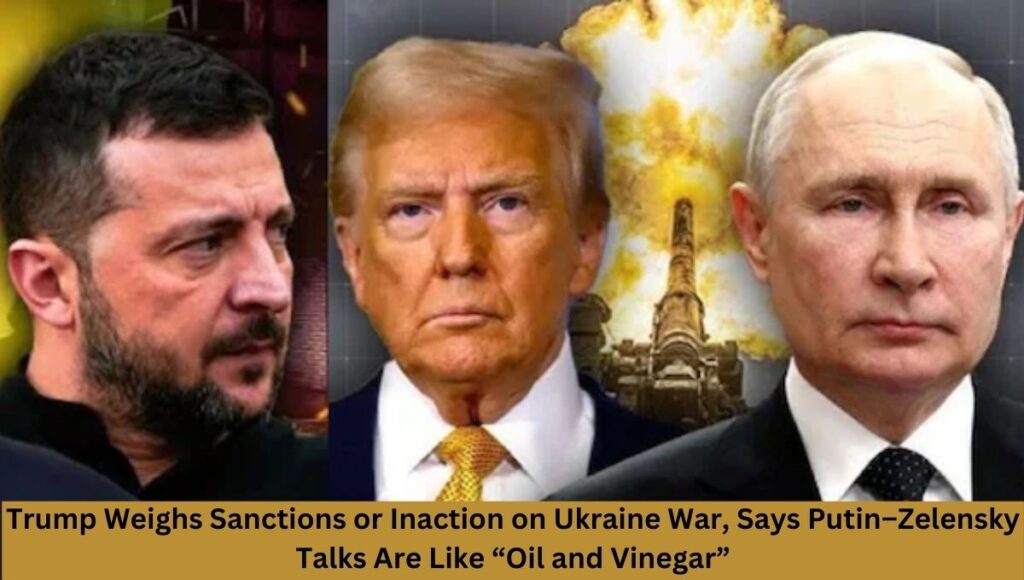
Trump Weighs Sanctions or Inaction on Ukraine War, Says Putin–Zelensky Talks Are Like “Oil and Vinegar”
Trump’s Two-Week Deadline for Decision
Trump told reporters that he wanted to observe the willingness of both Putin and Zelensky before deciding Washington’s next steps.
“I think I’ll know the attitude of Russia, and, frankly, of Ukraine. It takes two,” Trump said when asked about the timeframe.
He added that his options include heavy sanctions, steep tariffs, a combination of both—or potentially doing nothing at all.
“Then I’m going to make a decision as to what we do and it’s going to be a very important decision. That’s whether or not it’s massive sanctions or massive tariffs or both. Or do we do nothing and say it’s your fight.”
This is not the first time Trump has given a “two-week window” for a critical foreign policy decision. Similar deadlines in the past have often passed without concrete results.
Comparing Putin and Zelensky to “Oil and Vinegar”
Trump candidly described the difficulty of arranging a summit between the two warring leaders, likening it to mixing substances that naturally resist blending.
“We’re going to see if Putin and Zelensky will be working together. You know, it’s like oil and vinegar, a little bit. They don’t get along too well, for obvious reasons,” Trump said.
The metaphor underlined the deep mistrust between Moscow and Kyiv, which has been at the heart of failed negotiations over the years.
While Trump expressed hope that the two leaders might eventually find common ground, he acknowledged that progress was far from guaranteed.
Meetings With Putin and Zelensky
Over the past week, Trump has positioned himself at the center of potential peace efforts. On August 15, he met Vladimir Putin in Anchorage, Alaska, in what he described as a “very good” meeting.
While no ceasefire agreement was reached, Trump claimed progress was made in understanding Russia’s position.
A few days later, on August 18, Ukrainian President Volodymyr Zelensky visited the White House, accompanied by several European leaders.
The display of unity was meant to demonstrate to Trump that Kyiv and its allies remained aligned in resisting Russian aggression.
Zelensky, for his part, said he would be willing to meet directly with Putin to end the war, though he cautioned that Russia’s proposed terms might be impossible for Ukraine to accept.
According to reports, Moscow has suggested surrender of significant portions of eastern Ukraine in exchange for minor territorial concessions an offer that Zelensky has so far resisted.
Trump Shows Off Alaska Summit Photo
During his Oval Office press conference, Trump produced a photograph of himself with Putin at their recent Alaska meeting.
He told reporters the image had been sent to him by the Russian leader, noting that Putin has been “very respectful” toward him personally.
“I was just sent a picture from someone who wants to be there very badly,” Trump said, referring to Putin. “He’s been very respectful of me and of our country, but not so respectful of others.”
Trump added that he intended to sign the photo and return it to Putin, hinting that the Russian president could visit the United States later this year for the World Cup draw event.
Russia Rejects Immediate Meeting
Despite Trump’s insistence that a Zelensky–Putin summit was imminent, Moscow appeared to rule out such a meeting in the near term.
Russian Foreign Minister Sergey Lavrov said there were “no plans” for the two leaders to meet, contradicting Trump’s earlier claims that arrangements were underway.
Putin himself described his meeting with Trump as “very good” and expressed interest in ending the fighting in Ukraine, but offered no timeline or commitment to face-to-face talks with Zelensky.
War Casualties and Trump’s “Seven Wars” Claim
In his remarks, Trump highlighted the human toll of the ongoing conflict, citing figures of up to 7,000 deaths per week, mostly soldiers.
“They continue to fight and they continue to kill people, which is very stupid because they’re losing 7,000 people a week. Think of that, they’re losing 7,000 people on average a week. Mostly soldiers.”
The president went on to boast of his past record in conflict resolution, claiming he had already “stopped seven wars” during his presidency.
“So, we want to see if we could stop it. I’ve stopped seven wars. I want to make this one… I thought it would have been in the middle of the pack in terms of difficulty, and it’s turning out to be the most difficult.”
Trump’s Approach: Pressure, Patience, or Inaction?
Analysts note that Trump’s strategy appears to oscillate between threats of punitive action and a willingness to step back entirely.
By framing the conflict as potentially Ukraine’s “own fight,” Trump is signaling a possible shift away from deep US involvement in the conflict.
This posture has raised concerns in European capitals, where leaders fear that Washington may retreat from its role as Kyiv’s most important backer.
At the same time, Trump’s frequent praise of Putin has sparked criticism from opponents who accuse him of being too accommodating toward Moscow.
Obstacles Ahead for Peace Talks
Even if a summit between Putin and Zelensky takes place, significant obstacles remain:
- Territorial demands: Russia continues to insist on holding large parts of eastern Ukraine, a non-starter for Kyiv.
- Trust deficit: Both leaders have little confidence in each other’s commitments.
- External pressure: European nations want a negotiated settlement but are wary of concessions that could reward Russian aggression.
- US role: Trump’s willingness to engage or disengage will heavily influence the momentum of talks.
What Comes Next
For now, Trump’s two-week deadline places pressure on both Moscow and Kyiv to consider direct engagement. Yet with Russia publicly ruling out an immediate meeting, the likelihood of a breakthrough appears slim. The world will be watching whether Trump follows through with his threat of sanctions and tariffs, or whether his option of “doing nothing” becomes reality.
Either way, his characterization of Putin and Zelensky as “oil and vinegar” reflects the deep and perhaps irreconcilable rift between the two nations. As Trump himself acknowledged, “We’ll see what happens. I think in two weeks, we’ll know which way I’m going.”
Also Read: Kremlin plays down Zelensky talks as Trump warns Putin may not want to make deal
Related Posts:
- Can the EU and NATO Impose Tariffs on India and…

- Donald Trump’s 24-Karat Gold White House Makeover:…

- Trump–Zelensky Meeting 2025: Stylish Yet Strategic…

- Trump’s 2025 Gaza Peace Plan Signing and Historic…

- 5 Powerful Highlights as Trump Lands Second Nobel…

- 9 Explosive Revelations as Trump Declares His Health…