While adopting a wait-and-see approach, Trump Gives 2 Weeks to Assess Russia-Ukraine Peace Prospects Amid Stalled Negotiations. US President Donald Trump has set a two-week deadline to determine whether ongoing efforts to end the Russia–Ukraine war can make meaningful progress, warning that if no headway is achieved, his administration may be forced to “take a different tack.”
The announcement comes after back-to-back high-profile meetings with Russian President Vladimir Putin in Alaska and Ukrainian President Volodymyr Zelensky at the White House. Despite renewed diplomatic activity, the war now well into its third year remains without a clear path toward resolution.
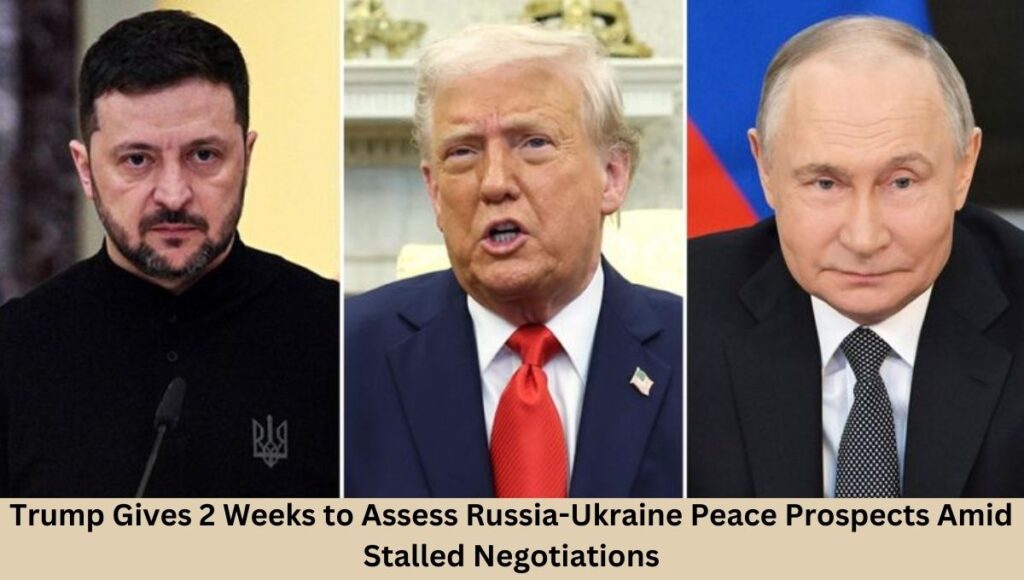
Trump Gives 2 Weeks to Assess Russia-Ukraine Peace Prospects Amid Stalled Negotiations
Trump’s Two-Week Deadline
In a Thursday interview with Newsmax host Todd Starnes, Trump said:
“I would say within two weeks we’re going to know one way or the other. After that, we’ll have to maybe take a different tack.”
This is not the first time Trump has issued short-term deadlines on Ukraine. Earlier this year, in May, he suggested he would reassess Putin’s seriousness about peace within two weeks. At the time, no breakthrough followed.
Trump had campaigned on the promise to end the war in one day, but more than a year into his presidency, his administration has yet to deliver a major breakthrough.
Alaska Summit with Putin: No Ceasefire, No Deal
Last week, Trump met Putin in Alaska at what was billed as a pivotal moment for peace efforts. The three-hour summit produced no formal accord.
While some observers expected Trump to secure an initial ceasefire, he instead abandoned the idea, telling reporters afterward that more groundwork was needed before a meaningful agreement could be reached.
Sources familiar with the meeting told Reuters that Putin pushed his core demands:
- Ukraine must surrender the entire Donbas region.
- Kyiv must renounce ambitions to join NATO.
- Ukraine must remain neutral and exclude Western troops.
Trump has not publicly endorsed those conditions, but US officials acknowledged they formed the bulk of discussions.
Zelensky Meeting at the White House
On Monday, Trump hosted Zelensky and European allies in Washington. The Ukrainian leader had hoped for clarity on US support and future security guarantees.
However, Trump stressed that the United States will not commit troops to Ukraine under any peace settlement.
“You have my assurance, and I’m president. US troops will not be sent to Ukraine,” Trump said in an interview with Fox News after the talks.
The Pentagon echoed this line, with Elbridge Colby, undersecretary of defense for policy, telling European partners that the US military’s role would be “limited” in any post-war security arrangement.
This assurance reflects Trump’s broader stance that Europe must shoulder more responsibility for Ukraine’s long-term security, while Washington plays only a supporting role.
A “Wait-and-See” Approach
Administration officials told The Guardian that Trump is deliberately stepping back from direct mediation until Putin and Zelensky meet face-to-face.
“The next stage in Trump’s eyes to end the war in Ukraine remains a bilateral meeting between Vladimir Putin and Volodymyr Zelenskyy,” one official said.
Trump himself confirmed the approach in an interview with WABC host Mark Levin:
“I just want to see what happens at the meeting. They’re in the process of setting it up and we’re going to see what happens.”
For now, Washington appears to be outsourcing the next step to the warring parties themselves, with Trump signaling he will step back in later if progress emerges.
Sticking Points: Security Guarantees and Territorial Demands
Despite renewed diplomacy, deep divisions remain:
- Ukraine’s position: Zelensky insists that any deal must include robust international security guarantees, continued Western backing, and eventual NATO membership.
- Russia’s position: Putin demands Ukraine renounce NATO, accept permanent neutrality, and cede occupied territories in the east.
- US stance: Trump rejects committing American troops but has not clarified whether Washington supports NATO expansion for Ukraine under his presidency.
These gaps remain significant, making the prospect of a quick resolution highly uncertain.
Zelensky and Moscow Exchange Accusations
On Thursday, Zelensky accused Moscow of “trying to avoid the necessity to meet”, saying Russia was not truly committed to ending the war.
Russia countered by accusing Kyiv of blocking progress with demands it described as “completely incompatible” with Moscow’s conditions.
The Kremlin insists that Ukraine’s security ambitions amount to a long-term obstacle to peace. This mutual blame game reflects the entrenched mistrust that has defined negotiations since 2022.
Europe’s Concerns
European leaders remain deeply invested in the outcome of US-led diplomacy. While many welcome Trump’s efforts to revive talks, they are wary of his wait-and-see strategy.
For allies like Poland and the Baltic states, Trump’s refusal to commit US troops fuels fears that Europe may be left to manage security guarantees largely on its own.
Pentagon officials tried to calm those concerns this week, but tensions linger as NATO allies brace for potential compromises that could reshape Europe’s security architecture.
Trump’s Political Calculus
For Trump, the Ukraine war is not only a foreign policy challenge but also a domestic political test.
- He repeatedly cites his campaign promise to end the war quickly.
- Yet his strategy so far has yielded few concrete results.
- Deadlines like the new two-week timeframe may serve more to project urgency than to enforce actual accountability.
As the 2024 campaign season heats up, Trump’s handling of Ukraine will remain a central issue for both critics and supporters.
Outlook: Will Two Weeks Change Anything?
While Trump has set a two-week deadline, history suggests progress will be slow. Russia and Ukraine remain miles apart on the fundamental questions of territory, NATO membership, and security guarantees.
If Putin and Zelensky do not agree to meet, Trump’s “different tack” may involve greater pressure on Kyiv, more engagement with Moscow, or renewed trilateral talks under US mediation.
For now, the White House is adopting patience, waiting to see if either side shows flexibility.
Conclusion
Trump’s latest move marks a critical moment in the Russia–Ukraine conflict. By giving the process two weeks, he is setting a short timeline for what is essentially a long war with deep-rooted disputes.
- If Putin and Zelensky meet, momentum could shift.
- If they don’t, Trump may be forced to choose between deeper US involvement or stepping back further.
Either way, the next fortnight could prove pivotal in shaping whether peace talks gain traction or stall once again, prolonging Europe’s deadliest war in decades.
Also Read: Trump-Putin Alaska Summit: Will Zelensky Join?
Also Read: Trump says Russia, Ukraine agree to immediate ceasefire talks, Kremlin offers no timeframe