Historic Trump-Putin Alaska Summit: Will Zelensky Join? The diplomatic stage is set for August 15, 2025, as U.S. President Donald Trump prepares to host Russian President Vladimir Putin in Alaska for one of the most anticipated political encounters of the year. Now, a potential twist adds even more intrigue: the White House is weighing an invitation to Ukrainian President Volodymyr Zelensky.
If Zelensky attends, it could reshape the dynamics of the meeting transforming it from a U.S.-Russia negotiation into a trilateral discussion that places Ukraine directly at the center of the peace process.
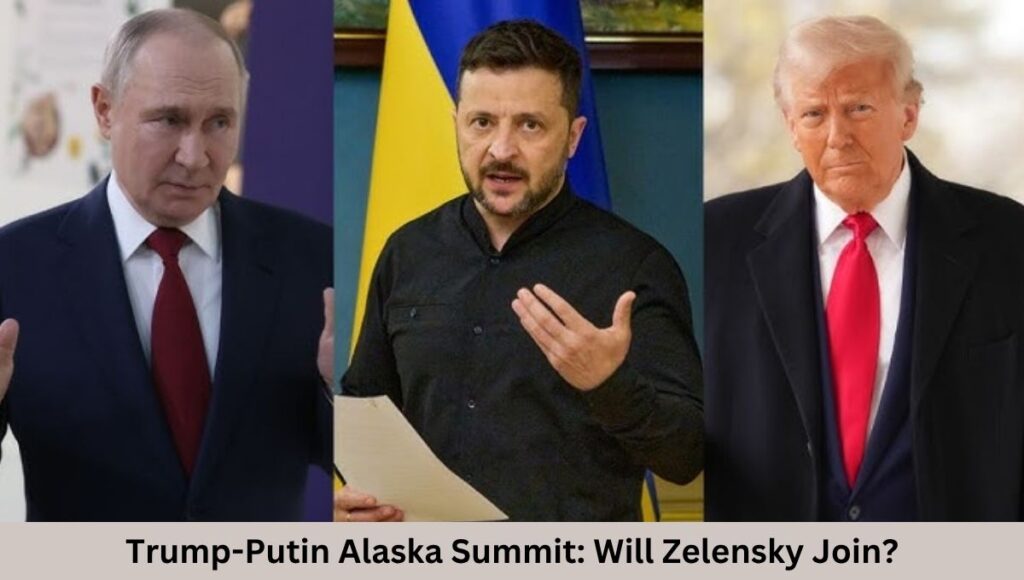
Trump-Putin Alaska Summit: Will Zelensky Join?
White House Considers Zelensky Invitation
According to NBC News, senior U.S. officials have confirmed that the possibility of Zelensky joining the Trump-Putin Alaska Summit is “being discussed” internally.
The Ukrainian leader’s participation is not yet confirmed, but the idea alone has sparked intense global speculation.
While the potential benefits of including Ukraine’s voice are clear, the risks are equally significant.
Zelensky could face immense pressure to compromise especially if Trump and Putin push for a land-swap deal.
Zelensky’s Firm Stand on Territorial Integrity
Addressing the Ukrainian people, Zelensky accused Putin of seeking to “legalise the occupation” of Ukrainian territory.
He reaffirmed Ukraine’s refusal to cede land in exchange for peace, rejecting any proposal that would hand over Donetsk, Luhansk, or other occupied regions.
“First and foremost, there must be a just end to the war, and it depends on Russia. It is Russia that must end the war it started,” Zelensky declared. “Ukrainians will not give their land to the occupier. Any decisions without Ukraine are decisions against peace.”
This message was as much for Washington and Moscow as it was for the Ukrainian public a clear line drawn ahead of any Alaska negotiations.
India’s Support for the Alaska Summit
In a notable diplomatic move, India’s Ministry of External Affairs welcomed the Trump-Putin meeting.
Quoting Prime Minister Narendra Modi’s oft-repeated phrase, “This is not an era of war,” India expressed hope that the Alaska Summit could pave the way for an end to the Russia-Ukraine conflict.
The endorsement came just days after Trump imposed a 25% tariff on Indian imports of Russian oil a calculated move aimed at pressuring Moscow into negotiations.
The juxtaposition of economic pressure and diplomatic outreach underscores the complex geopolitical chessboard surrounding the summit.
Putin’s First U.S. Visit in a Decade
The Alaska meeting will be Putin’s first trip to the United States since 2015, when he met President Barack Obama.
Both the Kremlin and the White House have confirmed that discussions will focus on achieving a “long-term peaceful resolution” to the war in Ukraine.
Yet even Trump has hinted that territorial adjustments could be on the table. “We’re going to get some back, and we’re going to get some switched,” he said a comment that sparked immediate backlash from Kyiv.
Ukraine Rejects Land Swap Proposals
Zelensky has flatly rejected any constitutional deviation regarding Ukraine’s borders. On Telegram, he reminded his followers that the country’s territorial boundaries are already defined and cannot legally be altered to appease an occupier.
Reports from Moscow indicate that Trump’s special envoy, Steve Witkoff, discussed a proposal with Putin for Ukraine to cede the rest of Donetsk and Luhansk in exchange for a ceasefire.
Kyiv views this as dangerously tilted in Russia’s favor potentially rewarding aggression without addressing the root causes of the conflict.
Alaska’s Symbolism in the Summit
For Trump, Alaska is more than a neutral venue it’s a statement. Purchased from Russia in 1867 for $7.2 million, Alaska is often hailed as the “real estate deal of the century.”
Trump, a real estate mogul before his political career, has drawn parallels between the Alaska Purchase and his vision of resolving the Russia-Ukraine war through pragmatic bargaining.
The setting subtly reminds both parties of shifting geopolitical fortunes and for Trump, it creates a media-friendly narrative steeped in history.
Military Realities on the Ground
The battlefield situation heavily influences the summit’s context. Russian forces are reportedly close to encircling Pokrovsk and Kostiantynivka in Donetsk.
Military analysts warn that such gains could give Moscow a stronger bargaining position in Alaska.
While Ukraine may eventually have to withdraw from certain towns for tactical reasons, voluntarily handing over strategic hubs like Kramatorsk or Sloviansk without a fight would deliver Putin a symbolic and strategic victory.
Risks of a One-Sided Peace
Critics caution that entering peace talks from a position of weakness could lead to a “slow defeat” for Ukraine. There is a fear that Putin could agree to a ceasefire, regroup his forces, and later resume the offensive a pattern seen before in the conflict.
European leaders have invoked the lessons of 1938, warning against appeasement without enforceable guarantees. For them, a rushed deal risks undermining the credibility of NATO and international law.
Economic and Geopolitical Pressures
Putin’s willingness to attend the summit may be influenced by his diplomatic ties with India and China nations that depend on Russian energy exports and could be affected by Trump’s secondary sanctions.
For Trump, the Alaska Summit represents a chance to strengthen his geopolitical legacy.
Ending the war could boost his standing domestically and internationally potentially even positioning him for a Nobel Peace Prize nomination before the January 2026 deadline.
Political Stakes for Trump
With U.S. approval ratings around 38%, Trump could use a foreign policy win to bolster his re-election prospects.
His handling of the Russia-Ukraine war polls lower among his base than his stances on immigration and economic issues, making a diplomatic breakthrough in Alaska all the more politically valuable.
However, failure to stand firm against Putin could damage Trump’s credibility and invite comparisons to the widely criticized 2018 Helsinki summit.
Possible Summit Scenarios
Analysts outline four main potential outcomes for the Trump-Putin Alaska Summit:
- Full Ceasefire Agreement – Immediate de-escalation and a diplomatic victory for all parties.
- Partial Deal with Territorial Concessions – Reduced fighting but significant political costs for Ukraine.
- Symbolic Progress Only – No substantive changes, but increased legitimacy for Putin.
- Complete Breakdown – Talks collapse, leading to intensified hostilities.
Zelensky’s presence could tip the scale toward or away from these outcomes.
Why Zelensky’s Attendance Matters
If Zelensky attends, it would prevent the perception of a “Ukraine deal without Ukraine.” His presence would reassure European allies that Kyiv’s interests are not being sidelined.
Yet it could also expose him to intense diplomatic pressure.
If faced with a united Trump-Putin front on a land swap, Zelensky would be in a politically precarious position risking backlash from both his people and political opponents at home.
Historical Parallels: Seward’s Folly and Real Estate Politics
The Alaska Purchase, once mocked as “Seward’s Folly,” became one of the most profitable land acquisitions in U.S. history.
Trump appears to see the same potential for a controversial decision to be vindicated by history.
The August 15 date adds another symbolic layer marking 80 years since Japan’s surrender in World War II, when a devastating war came to a sudden end. The historical echoes are impossible to ignore.
Beyond Symbolism: Alaska’s Strategic Role
Alaska offers practical advantages as well. It’s U.S. territory, but geographically closer to Russia than any other state, making it a convenient meeting point.
Hosting the summit there also plays well with Trump’s political base and subtly reminds Moscow of lost imperial territory.
The Road to August 15
With just days until the summit, anticipation is building. The Trump-Putin-Zelensky triangle represents a mix of high personal stakes, military realities, and historic symbolism.
For Trump, this is an opportunity to prove his famed deal-making skills on the world stage. For Putin, it’s a chance to consolidate gains without further costly fighting. For Zelensky, it’s about defending Ukraine’s sovereignty not just on the battlefield, but in the negotiating room.
Whether August 15 is remembered as a diplomatic breakthrough or a geopolitical misstep will depend on what happens behind closed doors and in the months that follow.
Also Read: Trump-Putin Alaska Summit: High-Stakes Peace Talks Set for August 15
Also Read: Zelenskyy Rejects Suggestions Of Land Swap As Trump Announces Alaska Summit With Putin