

President Donald Trump to host Trump-Putin Alaska Summit: High-Stakes Peace Talks Set for August 15. In a move set to reshape the geopolitical landscape, US President Donald Trump has announced he will host Russian President Vladimir Putin in Alaska on August 15, 2025, for high-stakes Ukraine peace talks. The summit, confirmed by both Washington and the Kremlin, comes amid growing international pressure to end the three-and-a-half-year war in Ukraine.
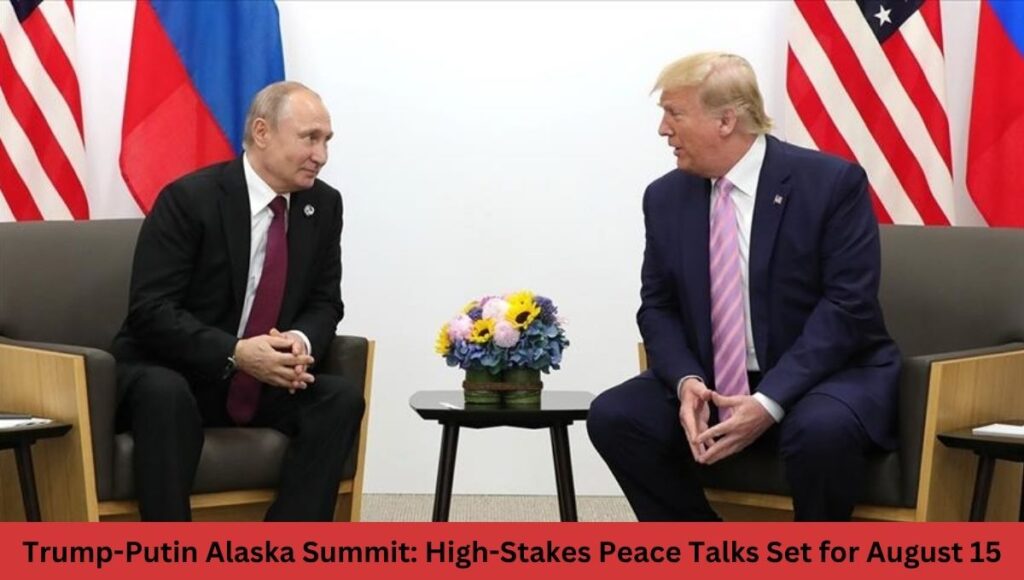
Trump-Putin Alaska Summit: High-Stakes Peace Talks Set for August 15
A Historic and Strategic Location
The choice of Alaska is no accident. Sitting just 55 miles from Russia across the Bering Strait, it is the closest US state to Moscow’s eastern frontier.
Hosting the meeting in Alaska serves multiple purposes:
- Symbolic proximity to Russia without stepping onto Russian soil.
- Avoiding legal risks for Putin, who faces an International Criminal Court (ICC) arrest warrant.
- Projecting US sovereignty while offering a neutral backdrop for sensitive negotiations.
The US is not an ICC member, meaning Putin can attend without fear of arrest. This will be his first visit to the United States since 2015 and the first time he meets Trump face-to-face since 2018.
Trump Hints at a Territorial Swap Proposal
Trump’s announcement followed remarks suggesting a territorial swap could be part of a peace plan. Speaking from the White House, he said:
“There’ll be some swapping of territories to the betterment of both.”
Reports indicate that the proposal, first floated by Putin to Trump’s envoy Steve Witkoff, would see Russia retain Crimea and the Donbas region, while giving up Kherson and Zaporizhzhia, which it only partially controls.
Such an arrangement, however, faces fierce opposition from Ukrainian President Volodymyr Zelenskyy, who has repeatedly ruled out any deal involving territorial concessions.
Zelenskyy’s Strong Pushback
In a televised address, Zelenskyy stated:
“We will not give our land to the occupier. Any decisions without Ukraine are decisions against peace.”
Ukraine’s constitution also prohibits ceding sovereign territory without a national referendum or parliamentary approval, adding another legal barrier to any agreement.
Zelenskyy emphasized that while he supports peace talks, Ukraine must be an active participant in all negotiations, not a bystander to decisions made between Washington and Moscow.
European Allies Voice Concern
European leaders, particularly in Poland and the Baltic states, have warned that recognizing territory taken by force could set a dangerous precedent.
A senior European official said:
“If territory can be gained through aggression without consequences, it sends the wrong signal to the world.”
The US has been working to rally European support for the Alaska talks, but divisions remain over how far to compromise with Russia.
Diplomatic Build-Up: Calls with Xi and Modi
In the lead-up to the summit, Putin held calls with Chinese President Xi Jinping and Indian Prime Minister Narendra Modi.
- Xi expressed support for a “long-term solution” to the Ukraine war.
- Modi discussed the talks in the context of recent US tariffs on Indian goods, imposed after New Delhi’s continued purchase of Russian oil.
Putin also extended an invitation for Trump to visit Russia, suggesting a desire for ongoing dialogue beyond Alaska.
From Sanctions Threat to Peace Table
Earlier this month, Trump had set an August 8 deadline for Russia to agree to a ceasefire or face harsher sanctions.
That deadline passed without action, but instead of escalating, Trump pivoted to inviting Putin for direct talks.
“My instinct tells me we have a shot at peace,” Trump told reporters, signaling cautious optimism ahead of the meeting.
Steve Witkoff’s Behind-the-Scenes Role
Trump’s special envoy Steve Witkoff has been central to shaping the current proposal. Having met with Putin in Moscow earlier this year, Witkoff has described the Russian leader’s offer as “a step in the right direction.”
However, critics note that Moscow has previously used negotiations to buy time on the battlefield, raising fears that the talks could simply delay further offensives.
Unresolved Questions Before the Summit
While the Alaska summit is being billed as a potential breakthrough, key issues remain unresolved:
- Zaporizhzhia and Kherson – Will Russia halt offensives or push for full control?
- NATO membership – Will Ukraine be asked to abandon its aspirations?
- Military limits – Will Ukraine face restrictions on its armed forces?
- Sanctions relief – Will the West ease measures in exchange for concessions?
Why Alaska Matters Symbolically
Alaska’s choice as the venue carries deep symbolic weight:
- Historical ties – Once Russian territory, Alaska was sold to the US in 1867.
- Neutral ground – Far from the battlefields but geographically linked to both nations.
- Legal safety – As the US is not part of the ICC, Putin avoids the threat of arrest.
For Trump, Alaska also offers a political backdrop that blends American strength with diplomatic openness.
Risks of a Territorial Swap Agreement
While some argue a territorial swap could end the war sooner, critics warn it would reward Russian aggression and undermine international law.
Proponents see it as a practical solution to save lives and stabilize the region. Opponents fear it could embolden Moscow to attempt future land grabs.
Failed Peace Efforts That Came Before
The Alaska summit follows several unsuccessful peace initiatives:
- March–April 2022 – Talks in Istanbul collapse.
- Mid-2023 – Ceasefire attempts fail amid intensified fighting.
- Early 2024 – Russia rejects a Western-backed troop withdrawal proposal.
- 2025 – Witkoff’s Moscow visit revives hopes of a deal.
Putin’s ICC Warrant and Travel Challenges
Putin’s attendance is notable given his 2023 ICC arrest warrant for alleged war crimes, including the forcible transfer of Ukrainian children.
Many countries could not host him without risking arrest, making Alaska a rare viable option.
What’s on the Table in Alaska
While details are under wraps, analysts expect talks to focus on:
- Ceasefire terms and monitoring mechanisms.
- Territorial control and recognition agreements.
- Security guarantees for Ukraine.
- Humanitarian aid and reconstruction funding.
- Sanctions relief in exchange for Russian concessions.
It is still unclear whether President Zelenskyy will attend, though the White House has not ruled out Ukrainian participation in some capacity.
Global Stakes of the Alaska Summit
The outcome could determine:
- Ukraine’s future borders and sovereignty.
- The balance of power in Europe.
- Whether the US can reclaim diplomatic leadership on the global stage.
A successful agreement could mark the end of Europe’s bloodiest conflict since World War II. Failure, however, risks prolonging the war and deepening geopolitical divides.
Conclusion: A Defining Moment in Modern Diplomacy
As the world counts down to August 15, the Alaska summit stands as a defining test of diplomacy. With Trump positioning himself as a peacemaker and Putin seeking to secure gains without further losses, the talks will unfold under intense global scrutiny.
Whether the meeting ends with a fragile truce or another missed opportunity will shape not only the future of Ukraine but also the credibility of international conflict resolution in the years ahead.
Also Read: No ceasefire, no deal: What summit means for Trump, Putin and Ukraine
Also Read: Trump-Putin Alaska Summit: Will Zelensky Join?
Related Posts:
- 5 Powerful Highlights as Trump Lands Second Nobel…

- Trump’s 2025 Gaza Peace Plan Signing and Historic…

- Putin’s Shocking Risks Ahead of Trump–Hungary Summit 2025

- Dramatic Moments Behind Trump’s Gaza Peace Push and…

- 7 Shocking Reasons FIFA’s Peace Prize for Trump…

- Trump’s 20-Point Gaza Peace Plan Gains Urgent Global…
