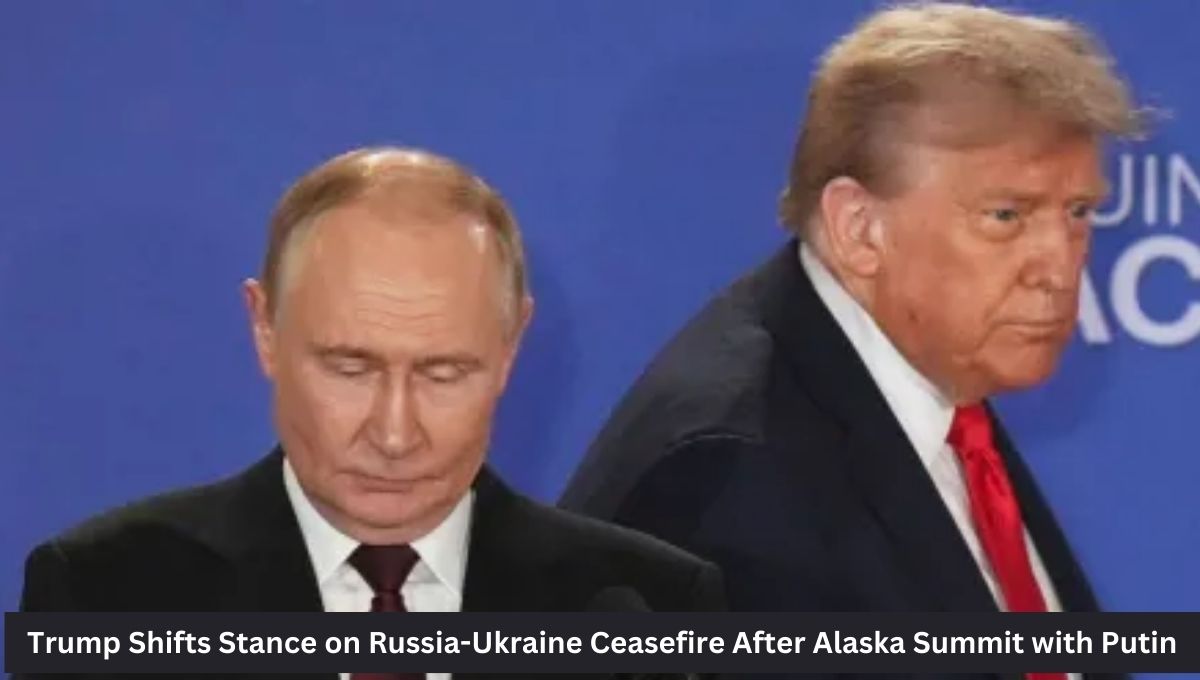
A policy U-Turn that shook Kyiv and Europe: Trump Shifts Stance on Russia-Ukraine Ceasefire After Alaska Summit with Putin. The highly anticipated Trump-Putin Alaska summit has ended with no deal but with a dramatic shift in American foreign policy.
For months, President Donald Trump had pressed for an immediate ceasefire in the Russia-Ukraine war, arguing it was the only way to halt the bloodshed. But after nearly three hours of closed-door talks with Russian President Vladimir Putin, Trump announced that the future path should not be a temporary truce but a comprehensive peace deal.
This pivot stunned Kyiv and European allies, many of whom had spent weeks lobbying Washington to support Ukraine’s demand for a ceasefire first. Instead, Trump appeared to embrace Moscow’s framing of the conflict, raising alarms over Ukraine’s sovereignty and Europe’s fragile unity.
Trump Shifts Stance on Russia-Ukraine Ceasefire After Alaska Summit with Putin
No Deal in Alaska: Why “Nothing” Was the Outcome
The Alaska talks produced no breakthrough agreement. President Volodymyr Zelensky of Ukraine was not present, a fact that already tempered expectations.
But for Ukraine’s allies, a lack of immediate compromise may have been the best possible outcome.
Trump’s post-summit statement, however, shook Kyiv. Writing on Truth Social, he declared:
“The best way to end the horrific war between Russia and Ukraine is to go directly to a Peace Agreement, not a mere Ceasefire Agreement, which often times do not hold up.”
This was a U-turn in US foreign policy. Where Trump once demanded a ceasefire “without conditions,” he now dismissed it as unreliable an argument Putin has long used to avoid halting fighting without concessions.
Russia’s Narrative Echoed in Washington
For years, the Kremlin has insisted that any ceasefire must be tied to a larger settlement including recognition of Russian territorial gains and security guarantees. Trump’s new stance aligns closely with this narrative.
According to reports, Putin’s team pressed for:
- Withdrawal of Ukrainian forces from parts of Donetsk still under Kyiv’s control
- Freezing the front lines in Zaporizhzhia and Kherson, locking in Russia’s hold
Analysts warn that these terms amount to de facto capitulation by Ukraine. Matthew Savill of the Royal United Services Institute argued:
“If Putin’s aim was to buy more time on the battlefield, Trump’s pivot has effectively delivered it.”
Kyiv’s Reaction: Shock, Defiance, and Determination
In Kyiv, the reaction was one of shock and urgency. President Zelensky reiterated that an unconditional ceasefire must come before any negotiations over territory.
“Killings must stop as soon as possible. The fire must cease both on the battlefield and in the sky, as well as against our port infrastructure,” Zelensky said after a tense phone call with Trump and European leaders.
Ukraine’s constitution prohibits ceding sovereign territory, and for many Ukrainians, any concession would be viewed as a betrayal. Former British diplomat Ian Bond was blunt:
“If Trump thinks that Zelensky is going to give up fortress cities like Donetsk just to get Putin to stop making war, he’s out of his mind.”
Europe Holds Its Breath: A United Front at Risk
Across Europe, Trump’s pivot triggered alarm. European capitals had poured resources into diplomacy ahead of the Alaska meeting, hoping to ensure Washington would back Kyiv’s ceasefire-first stance.
Instead, Trump’s Truth Social post immediately upended those plans. For European leaders, the prospect of Ukraine being cornered into concessions is now a real risk.
Putin, sensing momentum, warned Ukraine and its allies not to “throw a wrench” into the “progress” he claimed to have made with Trump.
But in Europe’s eyes, Trump’s shift represented exactly that a major setback to Western unity.
Trump’s Pattern: Echoing Putin’s Positions
Observers see a familiar pattern. Trump has a history of echoing Putin’s arguments after face-to-face meetings.
The Alaska summit recalled the 2018 Helsinki summit, when Trump sided with Putin over US intelligence agencies regarding election interference.
European allies fear the same susceptibility is now shaping US policy on Ukraine, with grave consequences for Kyiv’s negotiating position.
The Zelensky Call: Europe Joins In
Immediately after the summit, Trump phoned Zelensky. The hour-long call soon included European leaders, turning into a mini-summit by phone.
Zelensky described the conversation as “long and substantive” and announced he would travel to Washington on Monday.
European officials including figures like Finnish President Alexander Stubb or NATO Secretary General Mark Rutte are considering accompanying Zelensky to Washington.
Their mission: serve as diplomatic buffers to prevent Trump from ambushing Kyiv with demands for territorial concessions.
Europe’s Balancing Act: Praise and Pragmatism
Despite their alarm, European leaders have been careful to mix criticism with praise for Trump. UK Prime Minister Sir Keir Starmer lauded Trump’s “openness” as bringing the sides “closer than ever” to ending the war.
At the same time, European leaders stressed the need for ironclad security guarantees for Ukraine.
German Chancellor Friedrich Merz confirmed that Washington had signaled willingness to be part of such guarantees, hinting at a system “outside NATO but inspired by Article 5.”
Yet former US Ambassador to NATO Ivo Daalder warned:
“I don’t believe that President Trump is willing to go to war against Russia to protect Ukraine.”
Putin’s Win in Alaska: Optics and Legitimacy
Even without a deal, the summit was a symbolic victory for Putin. For the first time in more than a decade, he was hosted on US soil complete with ceremonial receptions at Elmendorf-Richardson Airbase in Alaska.
The optics restored a measure of international legitimacy to a leader widely shunned since the 2022 invasion.
Meanwhile, Trump’s earlier threats of new sanctions seemed to evaporate. He suggested he would hold off on fresh tariffs or penalties for “two or three weeks,” easing immediate pressure on Moscow.
What Awaits Zelensky in Washington
As he heads to Washington, Zelensky faces one of the most perilous visits of his presidency.
Reports suggest Trump has floated a Russian proposal requiring Ukraine to cede Donetsk and Luhansk in exchange for freezing other front lines.
For Zelensky, such terms are non-negotiable. Yet he must avoid a repeat of his February Oval Office encounter, when Trump publicly scolded him for being “intransigent” and warned that Ukraine risked “World War III.”
Ian Bond warned:
“Zelensky risks being ambushed again in DC. His challenge is to defend Ukraine’s red lines without breaking with his most powerful ally.”
Battlefield Realities: The Front Shapes Diplomacy
The situation on the battlefield continues to shape negotiations. Russia has advanced in Donetsk, closing in on the strategic town of Pokrovsk.
Moscow claimed new territorial gains on Saturday, while Ukraine reported pushing Russian forces back near Sumy, close to the Russian border.
For Putin, territorial progress strengthens his bargaining hand. For Zelensky, the urgency of securing Western support and security guarantees grows with every lost settlement.
Trump Floats a Trilateral Summit: Still Uncertain
After Alaska, Trump hinted at a possible trilateral summit involving himself, Putin, and Zelensky.
While Zelensky cautiously welcomed the idea, the Kremlin quickly denied it had been discussed, leaving the prospect uncertain.
Trump later told Fox News: “There’s no deal until there’s a deal.” But he added that Europe might also participate in future talks. For now, the idea remains only speculation.
Trump’s Foreign Policy Gamble: Risks and Consequences
Trump’s foreign policy gamble carries enormous risks. If Ukraine rejects his terms, it could lose critical US backing. If it agrees, it risks losing territory, sovereignty, and political stability at home.
For Europe, Trump’s pivot threatens transatlantic unity at the very moment when solidarity is most needed. For Russia, it opens the door to locking in territorial gains under the label of “peace.”
The coming week, with Zelensky’s Washington visit, may prove decisive in shaping the next phase of the Russia-Ukraine war.
Conclusion: A Defining Moment for Ukraine and the West
The Trump-Putin Alaska summit ended without a deal but with a seismic policy shift. By pivoting from a ceasefire to a comprehensive peace deal, Trump aligned more closely with Moscow’s demands than with Kyiv’s pleas.
As Zelensky prepares to enter the White House on Monday, the stakes could not be higher. Ukraine must defend its sovereignty while navigating the volatile currents of US politics and European diplomacy. The question now is whether Trump’s gamble will bring peace or deliver Moscow the strategic advantage it has sought since the war began.
Also Read: Trump Softens Stance on India, China Tariffs After Putin Meeting