On imposing secondary tariffs, Trump Softens Stance on India, China Tariffs After Putin Meeting. In a high-stakes meeting at Joint Base Elmendorf-Richardson in Anchorage, Alaska, US President Donald Trump and Russian President Vladimir Putin sat down for nearly three hours to discuss the ongoing Russia-Ukraine war and its global economic implications.
While no breakthrough was reached on ending the war, Trump’s remarks after the summit indicated a softer stance on tariffs against countries such as India and China for buying Russian oil.
Speaking to Fox News host Sean Hannity shortly after the meeting, Trump suggested that he did not need to impose additional secondary tariffs “right now.” He added, “Maybe in two weeks or three weeks I’ll have to think about it, but not at this moment. The meeting went very well.”
This shift in tone stands in contrast to Trump’s earlier hardline position, where he had threatened to slap 100% secondary tariffs on countries doing business with Moscow if Russia did not move toward ending the Ukraine conflict.
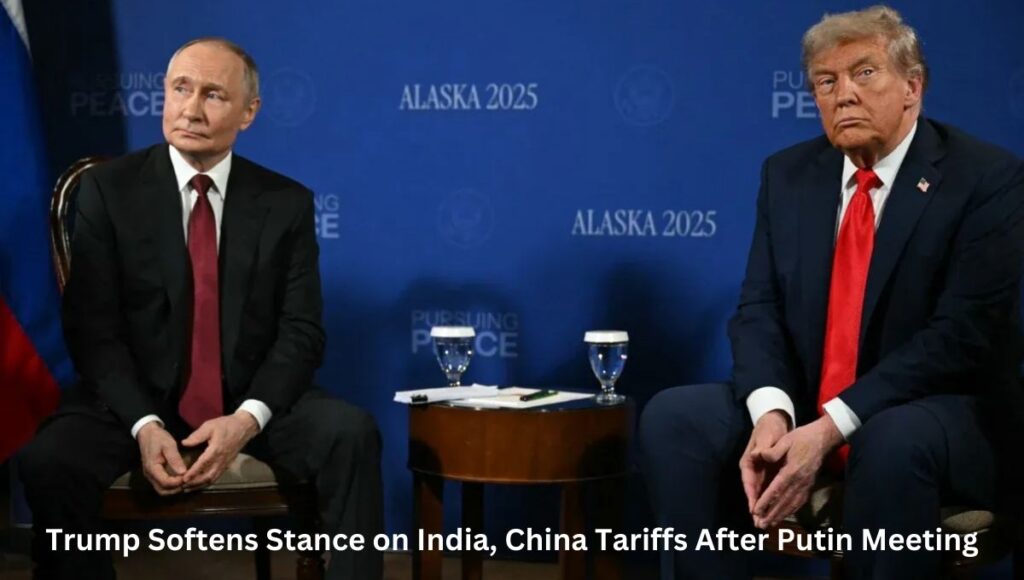
Trump Softens Stance on India, China Tariffs After Putin Meeting
Trump’s Previous Threats: Tariffs and Sanctions on India
Trump has repeatedly singled out India in his tariff policy due to New Delhi’s continued purchase of Russian crude oil.
Last month, he announced a 25% retaliatory tariff on Indian goods, later doubling it to 50%. Half of these tariffs are already in effect, with the remainder scheduled to kick in on August 27.
The President justified these tariffs by accusing India of indirectly funding Russia’s war in Ukraine through oil imports. “We’re very unhappy with them.
And we’re going to be doing very severe tariffs if we don’t have a deal in 50 days,” Trump said earlier, referring to India’s crude imports from Russia.
However, following the Alaska summit, Trump hinted that such aggressive measures might no longer be necessary at least in the immediate future.
India Pushes Back: “Unfair, Unjustified and Unreasonable”
India has strongly opposed Washington’s punitive measures. Prime Minister Narendra Modi described the tariffs as “unfair, unjustified, and unreasonable.”
The Ministry of External Affairs stressed that India’s relationship with the United States is much broader than just trade and should not be reduced to the prism of a third country.
Indian officials have also emphasized that their oil purchases are driven by economic considerations, not geopolitics.
Indian Oil Corporation chairman AS Sahney recently confirmed that India continues to import Russian oil, even as some state-owned refiners have reportedly scaled back due to the US tariffs.
According to the State Bank of India, stopping Russian oil imports could raise India’s crude bill by $9 billion this financial year and $12 billion next year.
Russia’s Oil Clients: India and China in Focus
The US sanctions threat largely targets India and China, the two biggest buyers of Russian crude since Western nations stopped purchases in 2022 after Moscow’s invasion of Ukraine.
Before the Alaska meeting, Trump told Fox News that Russia had “lost an oil client” in India, suggesting that tariffs had already curtailed New Delhi’s imports.
He added, “China, as you know, is doing a lot. If I have to do a secondary sanction, it will be devastating from their standpoint. If I have to do it, I’ll do it. Maybe I won’t have to do it.”
This ambiguity signals a strategic pause from Trump, possibly leaving room for future negotiations with both Moscow and Washington’s trade partners.
Democrats Slam Trump: “Tariffing India Won’t Stop Putin”
Trump’s approach has drawn sharp criticism from Democrats in Congress. The House Foreign Affairs Committee, led by Democrats, said that punishing India with tariffs would not deter Russia.
“Tariffing India won’t stop Putin. If Trump really wanted to address Russia’s illegal invasion of Ukraine, maybe punish Putin and give Ukraine the military aid it needs. Everything else is smoke and mirrors,” the panel tweeted.
They argue that Trump’s strategy unfairly targets allies like India while allowing Moscow to maneuver diplomatically. Instead, they advocate for direct sanctions on Russia and military aid to Ukraine.
The Role of US Treasury Secretary Scott Bessent
US Treasury Secretary Scott Bessent has been at the forefront of signaling tariff escalations. In multiple interviews, Bessent suggested that if the Trump-Putin talks in Alaska failed, additional secondary tariffs on India would be “on the table.”
“We’ve put secondary tariffs on Indians for buying Russian oil. And if things don’t go well, then sanctions or secondary tariffs could go up,” Bessent said in a Bloomberg TV interview.
But after the summit, Trump’s comments suggested that the immediate threat of new tariffs has been delayed, easing market fears.
Market Impact: India’s Stock Market Awaits Monday’s Reaction
The Trump-Putin meeting, combined with Prime Minister Narendra Modi’s announcement of GST reforms in his Independence Day speech, is expected to influence India’s stock market when trading resumes on Monday.
Analysts predict a positive opening for Dalal Street, buoyed by the perception that Trump is holding off on harsher tariffs. However, the upside may be limited due to lingering uncertainty.
“The Indian stock market may have a positive opening on Monday, but the rise will be limited and the Nifty 50 index may find it tough to break above the 24,800 hurdle,” said Avinash Gorakshkar, a SEBI-registered analyst.
Why Trump’s Tariffs May Not Hit India Hard
Despite Washington’s tough rhetoric, experts believe India’s economy is resilient enough to withstand Trump’s tariff threats.
“Domestic consumption-driven sectors like banking, finance, telecom, aviation, hotels, FMCG, and cement will not be impacted by Trump’s tariffs,” said Dr. VK Vijayakumar, Chief Investment Strategist at Geojit Investments.
Additionally, strong support from domestic institutional investors (DIIs) continues to shield the Indian stock market from global shocks. DIIs bought over ₹67,000 crore in May, ₹72,000 crore in June, and over ₹60,000 crore in July.
Experts estimate that even if the full 50% tariffs take effect, the impact on India’s GDP would be less than 0.2%.
What Lies Ahead: A Delicate Balance
The Trump-Putin summit did not produce a ceasefire in Ukraine, but it did signal a willingness to keep negotiating. For India, the outcome provides temporary relief, with Trump postponing immediate tariff escalations.
However, the threat of secondary sanctions still looms. Trump himself said he may revisit the issue in “two or three weeks,” depending on Moscow’s actions.
India, meanwhile, continues to balance its energy needs with geopolitical pressures. While some refiners have slowed Russian imports, officials maintain that purchases are based on affordability and national interest.
For China, the stakes are equally high. If Trump eventually enforces secondary tariffs, Beijing could face significant economic pressure.
Conclusion: A Pause, Not an End
Donald Trump’s softened stance after the Alaska summit with Vladimir Putin suggests a pause in Washington’s tariff offensive against India and China. However, the broader strategy remains unclear.
India has resisted US pressure, defending its right to buy affordable energy. Democrats in Washington argue that punishing India won’t stop Russia, urging Trump to focus directly on Moscow.
As of now, Trump has left the door open: “If I have to do it, I’ll do it. Maybe I won’t have to do it.” The coming weeks will reveal whether this pause turns into a permanent climbdown or a prelude to harsher trade measures.
Also Read: Trump Caught off Guard as India Exposes US-Russia Trade Amid Tariff Tensions