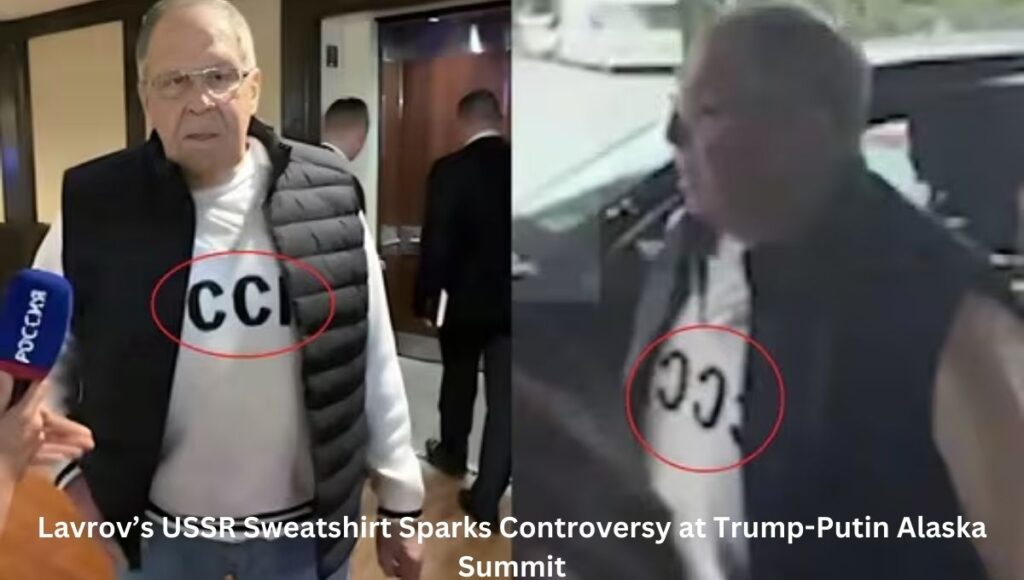
A veteran diplomat and one of Putin’s closest aidesSergei Lavrov’s USSR Sweatshirt Sparks Controversy at Trump-Putin Alaska Summit. The much-anticipated Trump-Putin Alaska Summit took place against a backdrop of high-stakes diplomacy, symbolic gestures, and unexpected theatrics. While the summit was expected to focus on the Russia-Ukraine war and the possibility of de-escalation, it was Russian Foreign Minister Sergei Lavrov’s sartorial choice that caught global attention.
Lavrov, arrived in Anchorage wearing a sweatshirt emblazoned with the letters “CCCP” – the Russian initials for the Soviet Union (USSR). The move was interpreted by many as a not-so-subtle political statement, underscoring the Kremlin’s long-running narrative of reclaiming Soviet-era influence.
Lavrov’s USSR Sweatshirt Sparks Controversy at Trump-Putin Alaska Summit
A Fashion Choice Loaded with Meaning
On Russian social media platform Telegram, fashion bloggers quickly identified the $120 sweatshirt as the work of Selsovet, a Chelyabinsk-based brand that specializes in “Soviet heritage” clothing.
For Kremlin critics, Lavrov’s outfit was more than a quirky fashion choice. The USSR lettering symbolized nostalgia for Soviet times, and many observers saw it as a provocative message: a reminder of Moscow’s imperial ambitions in Ukraine and beyond.
Former Lithuanian Foreign Minister Gabrielius Landsbergis commented on X (formerly Twitter):
“‘Just give us half of Ukraine and we promise we will stop,’ says negotiator wearing USSR sweatshirt.”
Similarly, Belarusian politician Franak Viačorka said the sweater reflected the Putin regime’s obsession with the past:
“They’re stuck in the past and want to pull Ukraine and Belarus back with them forgetting we are free nations that will never return to their ‘brotherhood’. Dictators cannot be appeased.”
Why the USSR Symbol Matters
The Union of Soviet Socialist Republics (USSR) spanned much of Eurasia between 1922 and 1991 before its dissolution created independent states like Ukraine, Belarus, Estonia, Latvia, Lithuania, Georgia, Kazakhstan, and others.
For many in Eastern Europe, the USSR represents repression, forced collectivization, and lost sovereignty.
In Ukraine specifically, memories of the Holodomor famine of the 1930s, which killed millions, remain a painful reminder of Soviet rule.
In areas of Ukraine currently under Russian occupation, pro-Moscow authorities have removed monuments that honor Ukrainian victims of Soviet oppression.
These moves echo the mindset critics accuse Lavrov and other Kremlin insiders of clinging to – a belief that Ukraine’s independence is temporary and illegitimate.
Trump and Putin Meet in Alaska
Beyond Lavrov’s sweatshirt, the Trump-Putin summit itself carried historical significance. Held at Joint Base Elmendorf-Richardson in Anchorage, it was the first U.S.-Russia summit in four years.
The meeting began with roaring jet flyovers and ceremonial welcomes reminiscent of Cold War–era superpower pageantry. Both leaders sought to project strength, but the outcome of the summit left much to be desired.
After more than two hours of closed-door discussions, Donald Trump and Vladimir Putin admitted no breakthrough had been reached on the Ukraine conflict.
Trump told reporters:
“We had an extremely productive meeting, and many points were agreed to; there are just a very few that are left. We didn’t get there, but we have a very good chance of getting there.”
No joint press conference or Q&A session followed, signaling lingering differences.
Mixed Signals from Moscow
Ahead of the summit, Lavrov told Russian state media that “Russia never plans ahead”, in what many saw as a dismissive jab at U.S. expectations.
He insisted Moscow had a “clear, understandable position”, which would be presented firmly during talks.
For observers, Lavrov’s statement paired with his USSR sweatshirt reinforced the Kremlin’s strategy of symbolic trolling and mockery, tactics it has frequently employed in international diplomacy.
Alaska: A Stage Rich with Symbolism
The choice of Alaska as the summit venue added another layer of symbolism. The U.S. purchased Alaska from Russia in 1867 for $7.2 million, and no Russian leader had ever visited the state before.
Anchorage residents reacted with a mix of curiosity, hope, and skepticism.
- Galina Tomisser, a Russian-American former teacher, called the moment historic: “I understand the historical moment. It’s kind of exciting… I just hope there will be fruitful results from this meeting.”
- Others, like local resident Helen Sharratt, were more skeptical: “This is just grandstanding for Donald Trump. He likes to look good, but he’s not doing anything.”
Adding to the surreal atmosphere, a bear and a moose wandered across a live television feed during coverage of the summit a bizarre reminder of Alaska’s rugged wilderness intruding on high diplomacy.
Protests and Divided Opinions
The summit also drew protests. Pro-Ukrainian demonstrators unfurled a giant banner reading “ALASKA STANDS WITH UKRAINE”, while others expressed concern that Trump might strike a deal behind Ukraine’s back.
In Kyiv, skepticism ran deep. Ukrainian resident Konstantyn Shtanko said:
“I don’t think anything good will come of it. There won’t be a positive outcome; the conflict will continue. At best, it will be a frozen conflict, nothing else.”
Meanwhile, in Moscow, matryoshka dolls featuring Trump and Putin sold briskly, reflecting the Kremlin’s interest in portraying the summit as a diplomatic spectacle, regardless of its limited results.
The Broader Message Behind Lavrov’s Sweatshirt
The controversy over Lavrov’s USSR sweatshirt illustrates how even small gestures can carry outsized political weight.
In an era of information warfare, propaganda, and symbolism, clothing and appearances are no longer just personal choices they are tools of statecraft.
For critics, Lavrov’s attire reinforced the image of a Kremlin stuck in Soviet nostalgia and unwilling to acknowledge Ukraine’s sovereignty.
For supporters, it may have been a bold show of defiance against the West.
Either way, the sweatshirt has now become part of the broader narrative of the Trump-Putin Alaska Summit, overshadowing some of the actual diplomatic discussions that took place.
What’s Next for U.S.-Russia Relations?
Despite the theatrics, the core issue remains unresolved: Ukraine’s sovereignty and the ongoing war.
- Trump signaled optimism that talks could still yield progress.
- Putin floated the possibility of a nuclear arms limitation deal, potentially linking it to concessions on Ukraine.
- Ukraine and its European allies remain wary, fearing any deal struck without their input.
The summit may not have delivered a breakthrough, but it offered a window into the geopolitical chess game between Washington and Moscow one where symbols like sweatshirts can sometimes matter as much as signed agreements.
Conclusion
The Trump-Putin Alaska Summit ended without a deal, but its imagery will linger: a bear and moose crossing a live broadcast, matryoshka dolls of the two leaders selling in Moscow, and most memorably, Sergei Lavrov in a USSR sweatshirt.
For many, that sweatshirt encapsulated the Kremlin’s enduring view of the world – one rooted in Soviet-era dominance and denial of Ukraine’s independence. It was a provocative reminder that for Russia’s leadership, the past is never really past.
As the war in Ukraine grinds on, such symbols continue to shape perceptions as much as policy decisions, leaving the world to wonder whether real progress is possible or if future summits will be remembered more for their pageantry and symbolism than for genuine breakthroughs.
Also Read: Putin’s Viral Alaska Summit Moment with Trump: Shrug, Memes, and Mystery
Also Read: Putin’s right-hand man drops key sign Trump is about to walk into trap
Related Posts:
- 5 Major Takeaways from the US Supreme Court's…

- 7 Critical Reasons the Donbas Is the Most Explosive…
- 7 Powerful Measures: Trump Sanctions Russian Oil…

- 7 Heartbreaking Facts About Venezuela's Earthquake Disaster
- 7 Powerful Facts About Ayatollah Ali Khamenei’s…

- 7 Explosive Claims as Lavrov Accuses US of Waging…