After Trump-Putin talks, Zelensky in Washington: Trump, European Leaders Push for Ukraine Peace Deal. Just days after the high-stakes Alaska summit between US President Donald Trump and Russian President Vladimir Putin, the spotlight has now shifted to Washington. Ukrainian President Volodymyr Zelensky arrived in the US capital on Sunday night, expressing his strong desire to end the war with Russia “quickly and reliably.”
His bilateral meeting with Donald Trump is scheduled at the White House at 10:45 p.m. IST on Monday, followed by a multilateral session that will also include a wide array of European leaders. This Washington meeting could prove to be more consequential than the Trump-Putin discussions in Alaska.
For Zelensky, the stakes are enormous: ensuring that Ukraine’s sovereignty and borders are not traded away in backroom deals, while securing lasting security guarantees against future Russian aggression. For Trump, it is an opportunity to showcase his deal-making credentials on the world stage. For Europe, it is about proving unity and ensuring that Ukraine is not abandoned.
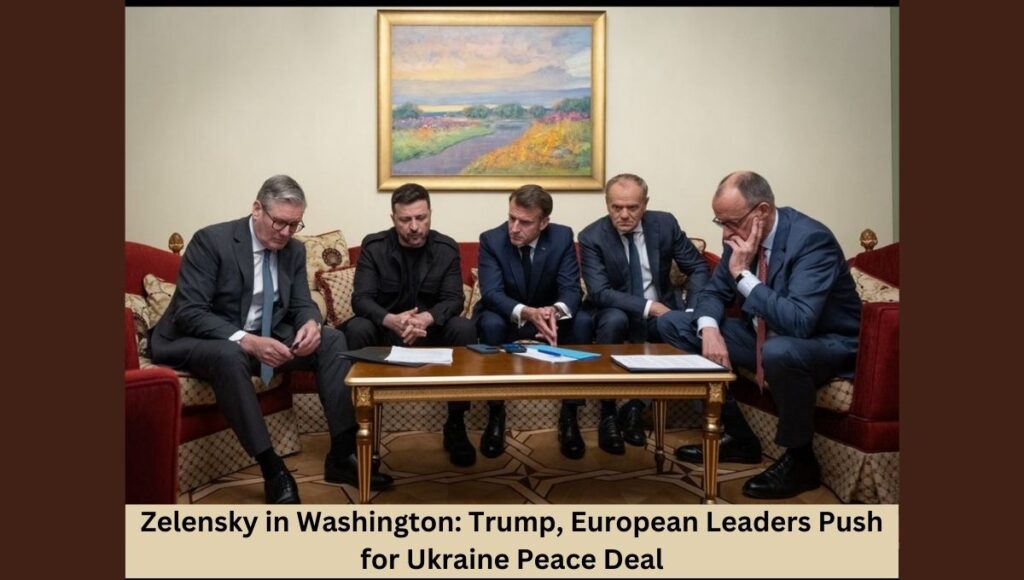
Zelensky in Washington: Trump, European Leaders Push for Ukraine Peace Deal
Zelensky’s Message: “Peace Must Be Lasting”
Upon his arrival, Zelensky took to X (formerly Twitter) to emphasize that Ukraine is committed to peace but not at the cost of sovereignty.
“We all share a strong desire to end this war quickly and reliably,” Zelensky said. “Peace must be lasting.
Not like it was years ago, when Ukraine was forced to give up Crimea and part of Donbas and Putin simply used it as a springboard for a new attack.”
He also made clear that Ukraine would not repeat the mistakes of the past, where supposed “security guarantees” like the 1994 Budapest Memorandum failed to protect Ukraine.
“Of course, Crimea should not have been given up then, just as Ukrainians did not give up Kyiv, Odesa, or Kharkiv after 2022,” Zelensky wrote. “Our soldiers are fighting and succeeding in Donetsk and Sumy.
We will defend Ukraine, and we will guarantee real security. Our people will always be grateful to President Trump, to America, and to every partner and ally for support.”
The message was unmistakable: Zelensky wants peace, but he refuses to sacrifice Ukraine’s independence or territory.
Trump-Zelensky Meeting Itinerary: A Crucial Timeline
According to the White House press guidance, the Monday schedule is packed:
- 9:30 p.m. IST (5:00 p.m. local time): European leaders arrive at the White House.
- 10:30 p.m. IST (5:15 p.m. local time): Trump greets President Zelensky.
- 10:45 p.m. IST (5:30 p.m. local time): Bilateral meeting between Trump and Zelensky.
- 12:30 a.m. IST (7:00 p.m. local time): Multilateral meeting including European leaders.
Trump has teased on Truth Social that “BIG PROGRESS ON RUSSIA” has been achieved, but has offered few details.
His envoy to Russia, Steve Witkoff, claimed that the Alaska talks resulted in a Russian concession to provide “robust security guarantees” for Ukraine, comparable to NATO’s Article 5.
European Leaders Join Washington Talks
Unlike the Alaska summit, this time Zelensky will not be alone. A formidable lineup of European leaders is joining him in Washington, signaling that Europe will not allow Trump and Putin to decide Ukraine’s fate without its direct involvement.
Confirmed attendees include:
- European Commission President Ursula von der Leyen
- German Chancellor Friedrich Merz
- French President Emmanuel Macron
- UK Prime Minister Keir Starmer
- NATO Secretary-General Mark Rutte
- Finnish President Alexander Stubb
- Italian Prime Minister Giorgia Meloni
The presence of so many leaders serves two purposes. First, it bolsters Zelensky’s negotiating hand and prevents him from being cornered. Second, it sends a powerful signal of Western unity.
British Prime Minister Keir Starmer, who has emerged as a trusted voice for Trump, said on Sunday:
“Trump has brought us closer than ever before to ending Russia’s illegal war in Ukraine. The next step must now involve President Zelensky directly.”
The Shadow of Alaska: Trump and Putin’s “Understanding”
The Alaska summit between Trump and Putin ended without any major breakthroughs no ceasefire, no sanctions relief, no dramatic announcement.
But behind closed doors, reports suggest that the two leaders discussed a framework involving land concessions in exchange for security guarantees.
According to sources briefed on Moscow’s thinking, the proposal being floated would see Russia give up control of small, marginally strategic territories while Ukraine formally cedes swathes of Donbas, freezing the current frontlines.
Crimea, which Russia annexed in 2014, would remain under Moscow’s control.
Trump later told Zelensky over the phone that Putin had offered to freeze the conflict if Ukraine ceded all of Donetsk. Unsurprisingly, Zelensky rejected the demand.
The proposal highlights a deep divide:
- Putin’s red line: Russia will not return Crimea and demands control of Donbas.
- Zelensky’s red line: Ukraine cannot cede territory, as its constitution forbids it.
- Trump’s position: Seeking a quick deal, even if it means Kyiv makes concessions.
Europe’s Position: No Peace Without Ukraine
European leaders have been adamant that there can be no peace without Ukraine’s direct consent and that international borders cannot be redrawn by force.
A joint communique issued by Britain, France, and Germany declared:
“No limitations should be placed on Ukraine’s armed forces or on its cooperation with third countries.
Russia cannot have a veto against Ukraine’s pathway to the EU and NATO. International borders must not be changed by force.”
Von der Leyen also stressed: “Security guarantees for Ukraine must be practical delivering protection on land, in the air, and at sea with Europe’s full participation.”
Security Guarantees: NATO-Like Protection for Ukraine?
One of the most significant developments emerging from the Trump-Putin talks is Russia’s tentative acceptance of security guarantees for Ukraine.
Trump’s envoy Steve Witkoff said the United States could offer Ukraine “Article 5-like protection,” in effect a mutual defense pledge, even if Ukraine is not formally admitted into NATO.
This is a dramatic shift, as Moscow has long opposed Ukraine’s NATO membership. However, whether Ukraine trusts such guarantees is another question.
After all, similar assurances were provided in 1994 when Ukraine surrendered its nuclear arsenal, only for Russia to invade twenty years later.
Zelensky himself has dismissed the notion of “Russian-backed guarantees,” insisting only Western-led security commitments matter.
Ceasefire or Peace Deal: Trump’s Shifting Stance
Initially, Trump claimed he was pressing Putin for a ceasefire. But after Alaska, he shifted toward supporting direct peace talks without first halting hostilities an approach rejected by many Europeans.
Poland’s foreign ministry warned bluntly:
“You cannot negotiate peace under falling bombs.”
This divergence is key:
- Trump’s focus: A quick, symbolic peace deal to stop the war.
- Europe’s focus: A lasting settlement with enforceable guarantees.
- Ukraine’s focus: Sovereignty, independence, and no territorial surrender.
Risks of a Fragile Peace
Even if some kind of deal is reached in Washington, experts warn it may only provide a temporary pause.
Military analysts believe that if Russia gets a deal now, Putin will simply rebuild his forces and prepare for another offensive in three to four years.
As former Estonian Prime Minister and EU diplomat Kaja Kallas once said:
“Victory for Ukraine does not have to be exclusively about reconquering land. It can mean securing strong deterrents so Russia never dares attack again.”
The question remains: Can Ukraine and its allies build a system of guarantees strong enough to prevent a repeat invasion?
Coalition of the Willing: Europe’s Role
European leaders have been working on plans for a “reassurance force” once hostilities end. The joint statement by Britain, France, and Germany pledged to help “secure Ukraine’s skies and seas and regenerate its armed forces.”
The so-called “Coalition of the Willing,” led by Macron and Merz, envisions robust European involvement in Ukraine’s long-term security.
But not all EU states are ready to commit troops, and the scope of military support remains under debate.
Trump’s Calculations: Balancing Putin and Zelensky
For Trump, the Washington summit is a delicate balancing act. He has cultivated a personal rapport with Putin but also wants to present himself as the peacemaker who ends Europe’s deadliest war in 80 years.
He has hinted that Ukraine must “make a deal because Russia is a very big power,” a statement that unsettles Kyiv and Europe. He also posted on Truth Social that there will be “NO NATO for Ukraine” and “NO getting back Crimea.”
This puts him closer to Moscow’s position than to Kyiv’s, at least in public.
Conclusion: A Defining Moment for Ukraine and Europe
The Washington summit is shaping up as a defining moment not just for Ukraine but for all of Europe. The presence of top European leaders alongside Zelensky ensures that Trump cannot sideline Kyiv in negotiations with Putin.
But the dilemmas remain unresolved:
- Will Trump push Ukraine into concessions?
- Can Europe secure cast-iron guarantees?
- And will Russia honor any deal it signs?
As thousands continue to die on the battlefield, the urgency for peace has never been greater. Yet, for Zelensky, peace cannot mean surrender. For Trump, a “deal” is paramount. For Europe, unity and sovereignty are non-negotiable.
The world is watching Washington. The outcome of these talks could redraw the future of Ukraineand redefine security for the entire continent.
Also Read: Putin Praises Trump’s Ukraine Peace Push, Eyes Nuclear Arms Deal at Alaska Summit
Also Read: Zelensky-Trump meeting: European leaders to join Ukraine President in Washington for talks
Related Posts:
- Trump-Putin Alaska Summit: High-Stakes Talks on…
- Putin’s Shocking Risks Ahead of Trump–Hungary Summit 2025

- Trump’s 2025 Gaza Peace Plan Signing and Historic…

- Trump’s 20-Point Gaza Peace Plan Gains Urgent Global…

- 10 Explosive Facts About Donald Trump’s $1 Billion…

- What’s Next for Donald Trump After Court Rules His…