Spotlight on South Asia: US Monitors India-Pakistan “Every Single Day,” says Rubio Amid Trump’s Ceasefire Claim. The United States has once again put the spotlight on South Asia, with Secretary of State Marco Rubio declaring that Washington keeps an eye on the India-Pakistan situation “every single day.”
His comments came during interviews with NBC News and Fox Business, where he stressed the challenges of maintaining ceasefires and reiterated President Donald Trump’s claims of helping prevent a nuclear escalation between New Delhi and Islamabad.
Rubio’s remarks revive a contentious debate. While Pakistan has echoed Trump’s version of events, India has consistently rejected any third-party intervention, particularly during the May ceasefire following Operation Sindoor. Prime Minister Narendra Modi and External Affairs Minister S. Jaishankar have categorically denied US mediation, underscoring that India’s military decisions remain sovereign and bilateral.
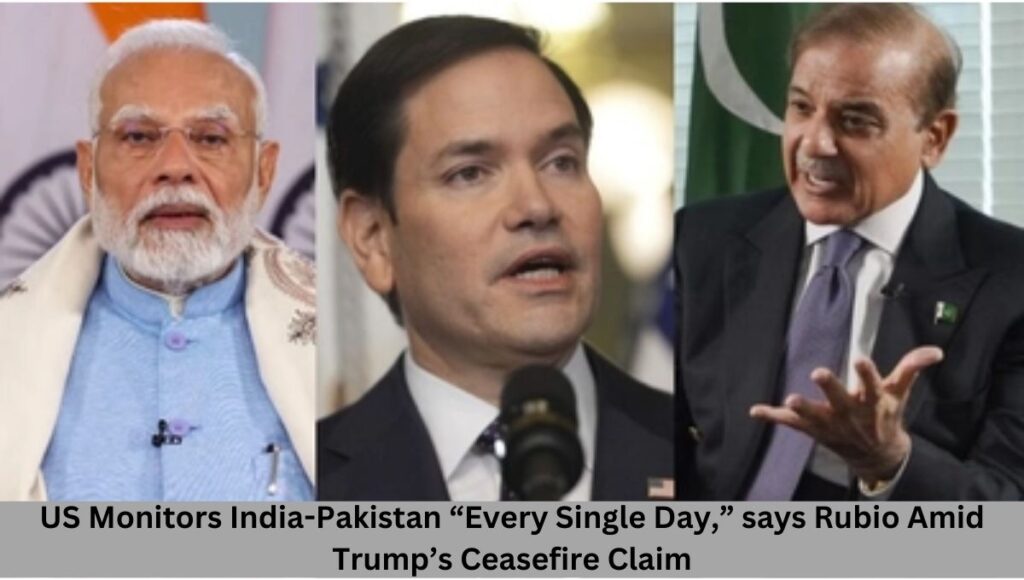
US Monitors India-Pakistan “Every Single Day,” says Rubio Amid Trump’s Ceasefire Claim
Marco Rubio’s Remarks: Ceasefires Are Fragile
Speaking to NBC News’ Meet the Press, Rubio highlighted the fragile nature of truce agreements.
“One of the complications of ceasefires is maintaining them, which is very difficult. Every single day, we are keeping an eye on what is happening between Pakistan and India,” he said.
Drawing parallels with the ongoing Russia-Ukraine conflict, Rubio emphasized that the only way a ceasefire works is if both sides agree to stop firing.
“Ceasefires can fall apart very quickly, especially after a three-and-a-half-year war like what we’re facing now,” Rubio explained, adding that the ultimate goal should be a peace deal that prevents future conflicts, not just a temporary pause.
Linking South Asia to Ukraine Peace Talks
Rubio’s comments were made in the context of the US push for a Russia-Ukraine settlement. He noted that Washington was not aiming for just a ceasefire in Ukraine but for a lasting peace deal.
“What we’re aiming for here is not some permanent ceasefire. What we’re aiming for here is a peace deal so there’s not a war now and there’s not a war in the future,” he said.
The Secretary of State drew direct comparisons to South Asia, suggesting that the US watches India and Pakistan daily because of the risks posed by two nuclear-armed neighbors.
Trump’s Ceasefire Claim: “I Got It Done”
Donald Trump has repeatedly claimed credit for securing peace between India and Pakistan earlier this year. On May 10, he announced that the two countries had agreed to a “full and immediate” ceasefire after a “long night” of talks allegedly mediated by Washington.
Since then, Trump has mentioned his role nearly 40 times, telling supporters and the media that he “helped settle” the tensions. He even suggested that America promised “a lot of trade” with both countries if they stopped fighting.
At his Alaska summit with Russian President Vladimir Putin, Trump again highlighted his supposed intervention:
“Look at India. Take a look at India and Pakistan. They were shooting down aeroplanes already, and that would have been maybe nuclear. I was able to get it done. Wars are very bad, and if you can avoid them, I seem to have an ability to end them.”
India’s Firm Rebuttal: “No Third-Party Role”
Despite Trump’s repeated assertions, India has firmly rejected claims of US mediation. In Parliament, Prime Minister Narendra Modi made it clear that Operation Sindoor was a unilateral decision.
“No leader of any country asked India to stop Operation Sindoor,” Modi said, emphasizing that India’s actions were designed to be non-escalatory.
External Affairs Minister S. Jaishankar reinforced this stance, stating categorically:
- There was no third-party intervention in the ceasefire with Pakistan.
- The decision to halt military operations was not linked to trade negotiations.
- India has always managed its issues with Pakistan bilaterally.
Pakistan’s Response: Echoing Trump’s Narrative
In contrast, Pakistan has embraced Trump’s narrative. Islamabad credited Washington for averting further escalation, with military officials suggesting that Trump’s intervention helped bring about the ceasefire.
Since then, Pakistan Army Chief Asim Munir has made two visits to the United States, with Washington even announcing an oil deal with Islamabad a move seen by many analysts as diplomatic signaling.
By aligning with Trump’s claims, Pakistan appears to be currying favor in Washington while attempting to internationalize its conflict with India.
The Shadow of Operation Sindoor
The backdrop to these claims is Operation Sindoor, India’s military campaign launched after escalating cross-border tensions.
The operation reportedly inflicted heavy damage on Pakistan, prompting Islamabad to seek a ceasefire in May.
For India, Operation Sindoor was proof of its capability to respond decisively. For Pakistan, however, admitting to seeking a truce was diplomatically costly, which perhaps explains why Islamabad has leaned on Trump’s mediation claims to soften the narrative.
Rubio Credits Trump: “Peace as a Priority”
In his Fox Business interview, Marco Rubio credited Trump for making peace a central theme of his administration’s foreign policy.
“We are very fortunate and blessed to have a President who has made peace and the achievement of peace a priority of his administration.
We’ve seen it in Cambodia and Thailand. We’ve seen it in India-Pakistan. We’ve seen it in Rwanda and the DRC,” Rubio said.
By placing India-Pakistan alongside other conflict zones, Rubio amplified Trump’s role as a global mediator a message consistent with the administration’s narrative.
India’s Core Principle: Bilateralism
At the heart of India’s pushback is its long-standing policy: no third-party mediation in disputes with Pakistan.
Since the Simla Agreement of 1972, New Delhi has maintained that all issues must be resolved bilaterally.
This principle has been reaffirmed across governments, regardless of political party. By rejecting Trump’s claim, India was not only defending its sovereignty but also sending a signal to the international community that it does not accept external interference in its security matters.
Washington’s Strategic Calculus
For the US, invoking India-Pakistan tensions serves multiple purposes:
- Geopolitical leverage: Highlighting America’s role in “mediating” helps position Washington as an indispensable global player.
- Domestic politics: Trump’s repeated references appeal to his supporters by showcasing him as a dealmaker who prevents wars.
- Regional strategy: Keeping a close eye on South Asia helps the US balance ties with both India (a strategic partner against China) and Pakistan (useful for regional stability and Afghanistan).
Ceasefires and Their Fragility
Rubio’s remarks also shed light on a broader issue: the fragility of ceasefires worldwide. Whether in Ukraine, Cambodia-Thailand, or India-Pakistan, ceasefires are often temporary, vulnerable to provocations, and difficult to maintain without strong enforcement mechanisms.
This is why Washington, while crediting Trump, continues to “monitor” India and Pakistan daily.
Any resumption of hostilities between two nuclear-armed nations could have catastrophic global consequences.
India’s Sovereignty vs. US Narrative
The clash between India’s official position and the US narrative highlights a key diplomatic tension:
- India’s stance: No foreign leader influenced its decision; Operation Sindoor was halted for strategic and military reasons alone.
- US stance: Trump’s intervention was decisive in preventing a nuclear escalation.
- Pakistan’s stance: Trump deserves credit for “settling” tensions.
This triangular dynamic underscores how global powers and regional actors frame conflicts differently for domestic and international audiences.
Trump’s Broader Peace Pitch
Trump has repeatedly positioned himself as a global peacemaker. From Ukraine to Africa to South Asia, he insists he has a unique ability to “get deals done.”
In his speeches, India-Pakistan is often cited as one of his foreign policy successes. By claiming to have stopped a war between two nuclear-armed nations, Trump bolsters his image as a leader who prioritizes peace over endless conflict.
The latest remarks by Marco Rubio highlight Washington’s continued interest in South Asia’s stability.
His acknowledgment that the US monitors India and Pakistan “every single day” reflects the seriousness with which Washington views the region’s risks.
Yet the contrasting narratives remain stark:
- Trump and Rubio claim US diplomacy ended the conflict.
- India insists there was no mediation, reinforcing its policy of bilateralism.
- Pakistan aligns with the US version to gain diplomatic advantage.
As the global order shifts, South Asia remains a flashpoint where perception and reality diverge. Whether or not Washington played a role in Operation Sindoor’s ceasefire, one fact is undeniable: the India-Pakistan equation continues to draw global attention, and the US will keep watching “every single day.”