10 Explosive Facts About Donald Trump’s $1 Billion Lawsuit Threat Against the BBC for distorting his January 6 speech. US President Donald Trump has launched a fiery legal battle against the BBC, threatening to sue the British broadcaster for $1 billion over what he calls a “defamatory and malicious” edit of his January 6, 2021 speech.
The dispute — centered around a BBC Panorama documentary titled Trump: A Second Chance? — has plunged the BBC into one of its deepest crises in decades, prompting top-level resignations and reigniting global debates about media ethics, impartiality, and press freedom.
Here’s a deep dive into everything you need to know — the allegations, the fallout, and what’s really at stake for both Trump and the BBC.
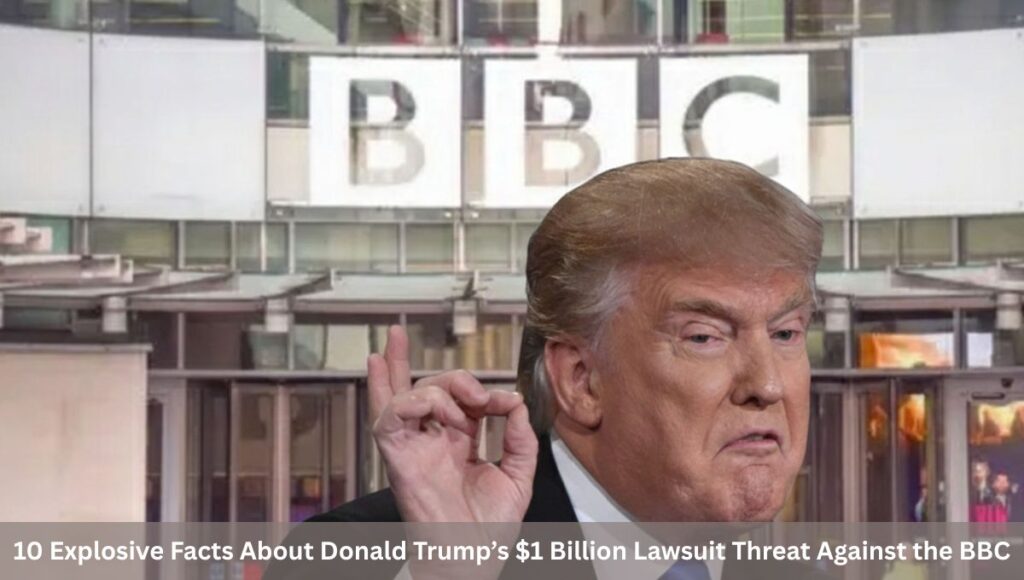
10 Explosive Facts About Donald Trump’s $1 Billion Lawsuit Threat Against the BBC
1. Trump’s $1 Billion Threat: “I Have an Obligation to Sue”
In an interview with Fox News’s Laura Ingraham, President Trump declared that he has an “obligation” to take legal action against the BBC.
“They actually changed my January 6 speech, which was a beautiful and calming speech, and they made it sound radical,” Trump said.
“What they did was incredible. I think I have an obligation to do it, because you can’t allow people to do that.”
Trump’s lawyers have demanded that the BBC:
- Issue a “full and fair retraction” of the documentary
- Publish a public apology
- Provide “appropriate compensation” for the harm caused
If these demands are not met by the Friday deadline, Trump says he will file a lawsuit in Florida, seeking no less than $1 billion in damages.
2. The Controversy: What the BBC’s Panorama Documentary Showed
At the heart of the scandal is an edited clip in the BBC’s Panorama documentary, which aired in October 2024, just before the U.S. presidential election.
In the broadcast version, Trump appears to say:
“We’re gonna walk down to the Capitol… and I’ll be there with you. And we fight. We fight like hell.”
However, in reality, the two portions of the speech were spoken nearly an hour apart.
Trump’s actual words were:
“We’re going to walk down to the Capitol, and we’re going to cheer on our brave senators and congressmen and women.”
Fifty-four minutes later, he said:
“If you don’t fight like hell, you’re not going to have a country anymore.”
The spliced version implied that Trump was urging supporters to storm the Capitol, which his lawyers say amounted to defamation and “intentional manipulation.”
3. How the Scandal Came to Light
For nearly a year after the documentary aired, the controversy remained unnoticed.
That changed when The Daily Telegraph published a leaked internal BBC memo written by Michael Prescott, a former independent adviser to the broadcaster’s editorial standards committee.
In his memo, Prescott blasted the documentary’s producers for creating a “completely misleading” version of Trump’s speech:
“If BBC journalists are to be allowed to edit video in order to make people ‘say’ things they never actually said, why should the BBC be trusted?”
The memo’s leak unleashed a political firestorm, exposing months of internal disagreement within the BBC and calls for accountability from lawmakers and journalists alike.
4. BBC Leaders Resign Amid Mounting Pressure
The fallout was swift and severe.
Both Tim Davie, the BBC’s Director-General, and Deborah Turness, the CEO of BBC News, resigned days after the memo’s publication, admitting that “serious editorial mistakes” had been made.
Davie told staff in an emotional address:
“We have made mistakes that have cost us. But this is not our end — we have to fight for our journalism.”
Turness added that while the error was regrettable, the allegations of “institutional bias” were “simply wrong.”
Their resignations have left the BBC leaderless at a time when it faces a government review of its Royal Charter, which expires in 2027 — a crucial moment for its funding and independence.
5. BBC’s Official Response and Apology
BBC Chair Samir Shah issued a public apology, describing the edit as an “error of judgment” that gave the impression of a “direct call for violent action.”
In a letter to Parliament, Shah said:
“The edit in question did not meet the BBC’s standards for fairness. I deeply regret that this has occurred.”
While the BBC has confirmed it will respond to Trump’s legal letter, it has so far refused to comment further on whether it will issue a full retraction or settlement.
6. Trump’s Legal Case — and the $1 Billion Question
Trump’s legal threat may sound dramatic — but can he actually win?
His team, led by Florida-based lawyer Alejandro Brito, argues that the BBC’s documentary was “false, defamatory, malicious, disparaging, and inflammatory.”
They claim the edit damaged Trump’s reputation, interfered with the 2024 presidential election, and caused “overwhelming financial and reputational harm.”
However, legal experts say the case faces major hurdles.
7. The Legal Challenges: Can Trump Really Sue the BBC?
Trump plans to sue the BBC in Florida, where the statute of limitations for defamation is two years.
In the UK, such cases must be filed within one year — meaning Trump is already out of time there.
Even in the U.S., Trump would need to prove:
- The documentary was factually false and defamatory
- He suffered measurable harm
- The BBC acted with “actual malice” — knowingly publishing false material or showing reckless disregard for the truth
This last standard, established by the 1964 U.S. Supreme Court case New York Times v. Sullivan, sets a very high bar for public figures like Trump.
As George Freeman of the Media Law Resource Center notes:
“All of them create difficulties for a plaintiff. The First Amendment provides strong protections for the press.”
Still, some experts disagree.
8. Legal Experts Divided: “Not Innocent Splicing”
Burt Neuborne, a professor at NYU School of Law and former ACLU legal director, believes Trump has a case.
“The actual malice here is the knowing dissemination of something that was purported to be verbatim, but which is not,” Neuborne said. “This was not innocent splicing — it was misleading editing.”
Yet even Neuborne admits that winning $1 billion in damages would be “unlikely,” since Trump would have to prove real financial losses — a tough ask for a sitting U.S. president who just won re-election.
9. Trump’s Broader War on the Media
This isn’t Trump’s first clash with the press — nor will it likely be his last.
In the past year alone, he has sued multiple U.S. networks, often securing large settlements:
- ABC News paid $15 million after anchor George Stephanopoulos falsely claimed Trump had been found liable for rape.
- Paramount (CBS News) agreed to $16 million over a 60 Minutes interview with Kamala Harris that Trump alleged was edited to favor her.
- He also filed a $15 billion suit against The New York Times, though it was dismissed for procedural reasons.
Media analysts argue that Trump’s lawsuits serve a strategic purpose:
“He doesn’t care if he wins or not,” said Seth Stern of the Freedom of the Press Foundation.
“The point is to intimidate and punish those who criticize him.”
10. What This Means for the BBC — and the Future of Public Media
The timing couldn’t be worse for the BBC.
With its Royal Charter up for renewal in 2027, the broadcaster is already under scrutiny from both politicians and the public.
Culture Secretary Lisa Nandy told Parliament the controversy should lead to a “renewed mission for the modern age” and ensure a “genuinely accountable BBC.”
Meanwhile, the Reform UK party, led by Nigel Farage, has announced it will cut ties with a BBC documentary team following the Trump row.
Farage criticized the broadcaster as “institutionally biased for decades”, adding that Trump had asked him:
“Is this how you treat your best ally?”
The scandal also reignites the global debate over media impartiality, fake news, and the limits of press freedom in the digital age.
BBC’s Crisis of Trust
The BBC, once seen as the gold standard of global journalism, now faces a trust deficit.
According to a Reuters Institute survey, 62% of Britons still consider it “trustworthy,” but that number has been declining — and public opinion is deeply polarized.
A YouGov poll found:
- 31% believe the BBC favors left-wing views
- 19% say it leans right
- 50% say it is either neutral or they don’t know
Among Reform UK voters, distrust is particularly high — with 73% perceiving a left-wing bias.
Inside the BBC’s Internal Turmoil
Following the memo leak, internal BBC meetings reportedly grew tense.
Outgoing Director-General Tim Davie told staff:
“We need to fight for our journalism. The BBC just does good work — that speaks louder than any weaponization.”
He urged staff not to let critics “define the narrative,” a remark widely interpreted as a defiant stand amid external attacks.
Yet others within the BBC privately expressed frustration that the leadership acted too slowly, allowing the controversy to spiral.
Could the BBC Afford a $1 Billion Loss?
Unlikely.
The BBC’s total annual revenue stands at around £5.9 billion ($7.8 billion) — most from the license fee paid by 24 million UK households.
It currently holds just £477 million ($627 million) in cash reserves — less than two-thirds of what Trump is demanding.
Even a fractional settlement could severely impact its budget, programming, and journalistic independence.
Political Implications: UK Government Keeps Distance
Downing Street has declined to intervene, calling it “a matter for the BBC.”
However, Prime Minister Keir Starmer’s government will inevitably play a role in shaping the BBC’s future funding model — and the Trump scandal could influence the tone of upcoming charter renewal negotiations.
Critics warn that a weakened BBC might face greater political pressure, particularly from right-leaning voices demanding market competition or license fee reforms.
The Broader Context: Free Speech vs. Accountability
The Trump–BBC dispute underscores a growing global tension — the line between press freedom and editorial accountability.
In the U.S., the First Amendment fiercely protects journalists, even when they make mistakes.
In the U.K., broadcasters face stricter impartiality rules, especially under Ofcom regulation.
The question now is whether the BBC’s misstep represents an isolated lapse or a systemic failure in upholding neutrality.
Trump’s Legal Playbook — Politics and Public Relations
Analysts suggest Trump’s threat may be as much political theater as legal strategy.
By targeting the BBC — an institution symbolic of the liberal establishment — Trump reinforces his anti-media narrative and energizes his base ahead of key political milestones.
Still, with previous settlements from major U.S. networks, his threat carries real financial risk for the broadcaster.
Conclusion: A Transatlantic Media Earthquake
Whether Trump’s $1 billion lawsuit materializes or not, the episode has already shaken two democracies — testing the boundaries of media accountability, political power, and public trust.
For Trump, it’s another opportunity to reassert dominance over a media landscape he has long accused of bias.
For the BBC, it’s a moment of reckoning — a test of whether the world’s oldest public broadcaster can maintain credibility in an era of partisanship and digital scrutiny.
Whatever happens next, one thing is clear: this is more than a lawsuit — it’s a battle for truth itself.
Also Read: Does Trump have a defamation case against the BBC?