

7 Key Global Takeaways from the G7 Foreign Ministers’ Meet in Canada Amid Rising Tensions and fresh challenges for Trump’s peace efforts. The world’s top diplomats are meeting this week in southern Ontario as the Group of Seven (G7) foreign ministers gather to tackle some of the most pressing global crises — from the grinding war in Ukraine to the fragile Middle East peace efforts and mounting trade tensions with Washington.
Hosted by Canadian Foreign Minister Anita Anand, the two-day summit — held in the scenic Niagara region near the U.S. border — brings together ministers from the G7 nations of Canada, the United States, the United Kingdom, France, Germany, Italy, and Japan, alongside invited representatives from Ukraine, India, Brazil, Saudi Arabia, South Africa, Mexico, Australia, and South Korea.
The talks come amid growing global unease over U.S. President Donald Trump’s diplomatic and trade agenda, as his administration grapples with international skepticism toward his ceasefire plans in Gaza and his approach to Russia’s ongoing war in Ukraine.
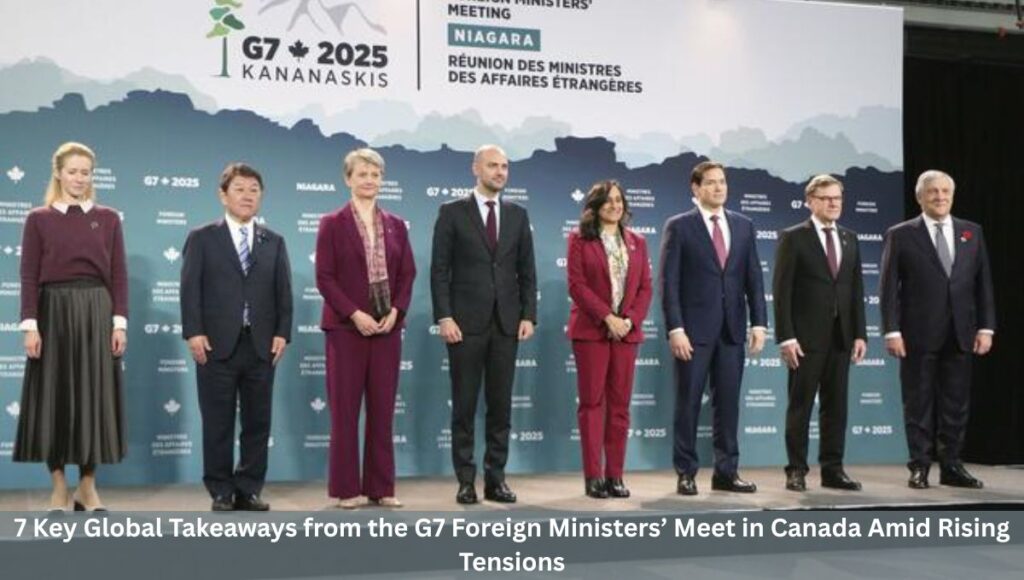
7 Key Global Takeaways from the G7 Foreign Ministers’ Meet in Canada Amid Rising Tensions
1. Ukraine Conflict Dominates G7 Agenda
The war in Ukraine remains the central issue overshadowing the G7 gathering. Nearly four years into the conflict, the international community continues to struggle to find a lasting resolution.
U.S. Secretary of State Marco Rubio arrived in Canada facing questions from allies about Trump’s efforts to secure an immediate ceasefire between Kyiv and Moscow.
Washington has recently intensified its pressure campaign on the Kremlin. In late October, the Trump administration imposed sweeping sanctions on Rosneft and Lukoil, Russia’s two largest oil companies — a move seen as an attempt to financially squeeze Moscow and push it toward a negotiated peace.
President Vladimir Putin, however, remains defiant, demanding additional Ukrainian territorial concessions before agreeing to any ceasefire terms.
Canada’s Foreign Minister Anita Anand emphasized the G7’s shared responsibility to sustain support for Ukraine through the winter months.
“We have to be ambitious for the objective of long-lasting peace,” Anand said. “As winter arrives, Canada and the G7 are exploring how best to support the people of Ukraine — from energy infrastructure to food supply and long-term reconstruction.”
The United Kingdom also announced new support ahead of the meeting. British Foreign Secretary Yvette Cooper pledged £13 million ($17 million) in emergency aid to repair Ukraine’s power, heating, and water systems following weeks of Russian strikes.
“Putin is trying to plunge Ukraine into darkness and cold as winter approaches,” Cooper said. “This funding will help keep the lights and heating on.”
2. Trump’s Ceasefire Plan in Gaza Faces Resistance
While Ukraine dominates the headlines, Trump’s Middle East peace initiative remains a critical discussion point.
After a U.S.-brokered ceasefire in Gaza took effect on October 10, hopes for advancing toward a durable peace have faltered.
Secretary Marco Rubio is expected to brief his G7 counterparts on the second phase of the Gaza peace deal, aimed at stabilizing the region and addressing Hamas militants still entrenched in tunnels.
However, the plan has encountered diplomatic headwinds, with several European governments — including Britain, France, and Canada — signaling plans to recognize a Palestinian state even without a comprehensive settlement.
Canadian Foreign Minister Anita Anand reaffirmed her commitment to the peace framework despite the challenges.
“The peace plan must be upheld,” she said, adding that the G7 “has to be ambitious and unified” in pursuit of Middle East stability.
Rubio has reportedly urged Anand to help organize a future Gaza reconstruction conference, seeking Canada’s role in bringing regional actors to the table.
3. Trade Tensions Strain U.S.-Canada Relations
Beyond the geopolitical crises, the U.S.-Canada trade dispute has cast a shadow over this year’s G7 summit.
President Trump abruptly ended trade talks with Ottawa last month after an Ontario government advertisement critical of his tariffs aired in the United States.
The ad quoted former U.S. president Ronald Reagan on the economic harm of protectionist policies — a move that infuriated Trump.
Although Canadian Prime Minister Mark Carney has since apologized, trade negotiations remain frozen.
Minister Anita Anand confirmed that she will meet Secretary Rubio for bilateral discussions but indicated that trade issues are being handled by other officials.
“Every complex relationship has numerous touch points,” Anand said. “On trade, there is continued work to be done — just as there is work to be done across a range of global issues.”
The Trump administration has prioritized trade realignment as part of its broader strategy, often clashing with allies over tariffs, defense contributions, and industrial subsidies.
4. G7 Fractures Over Defense Spending Demands
President Trump’s push for NATO members to spend 5% of GDP on defense — more than double the current alliance target — remains a point of contention within the G7.
All members of the bloc except Japan belong to NATO, and several are struggling to meet even the 2% threshold. Canada and Italy are among those farthest from Trump’s goal.
Anand defended Canada’s efforts, noting that Ottawa’s latest budget includes C$80 billion (US$57 billion) in new defense investments.
“We will reach 2% this year and 5% of GDP by 2035,” she said.
The issue highlights deeper divisions between the U.S. and its partners over security burden-sharing, as Washington continues to pressure allies to shoulder more responsibility for global defense.
The summit opened on a tense note as France’s Foreign Minister Jean-Noel Barrot warned of rising instability in the Caribbean region, following the deployment of a U.S. aircraft carrier strike group.
“We have observed, with concern, military operations in the Caribbean because they disregard international law,” Barrot told reporters.
The remarks came after the USS Gerald R. Ford, the world’s largest aircraft carrier, entered U.S. Southern Command waters as part of an anti-drug and maritime security campaign.
Venezuela has accused Washington of “fabricating a war” under the guise of counter-narcotics operations, heightening regional tensions.
Barrot said it was essential for the G7 to act “in concert” to avoid escalation, particularly given the large French population living in the Caribbean who could be affected by potential unrest.
6. Spotlight on Critical Minerals and China’s Supply Chain Dominance
Another major issue dominating the Niagara meeting is China’s control over global critical mineral supply chains — essential to industries ranging from electronics to defense technology.
The G7 foreign ministers are meeting just two weeks after the group’s energy ministers agreed on new steps to diversify and secure access to critical minerals, particularly rare earth materials crucial for magnets, semiconductors, and renewable energy systems.
Beijing currently controls a commanding share of refining and processing capabilities for these minerals, sparking fears across industrialized democracies.
A U.S. State Department official said ahead of the summit that the G7’s objective is to strengthen “economic security as national security.”
“There’s a growing global consensus among partners and allies that economic security and supply chain resilience are vital to our collective security,” the official said.
Canada, home to 34 critical minerals, is positioning itself as a key player in reshaping these supply chains. A working lunch at the summit will focus on energy transition and critical mineral partnerships, with the Pentagon reportedly eager to invest in Canadian projects for national defense applications.
7. Beyond Ukraine and Gaza: Focus on Sudan, Haiti, and Arctic Security
The G7 foreign ministers are also turning their attention to several other global flashpoints — including Sudan, Haiti, and Arctic security.
Minister Anita Anand confirmed that Tuesday’s working dinner on global security will address the worsening humanitarian crisis in Sudan, which she described as “absolutely horrifying.”
“We will work to support those who are suffering and dying needlessly,” she said.
Canada and its allies are also expected to discuss ongoing efforts to stabilize Haiti, where gang violence and political instability have plunged the country into chaos.
In addition, Arctic security — a growing concern for northern nations as melting ice opens new strategic routes — will feature in closed-door discussions.
A Divided G7 Struggles for Unity
The G7 bloc, representing some of the world’s largest democracies and economies, has struggled to maintain unity in recent years amid a series of crises and diverging priorities.
At the June leaders’ summit, the group failed to agree on a unified position on Ukraine, with differences emerging over the pace and scale of sanctions on Russia.
Analysts say this week’s foreign ministers’ meeting could be more productive, given the absence of President Trump himself.
“The fact that President Trump won’t be there will definitely help,” said John Kirton, founder of the G7 Research Group at the University of Toronto. “They won’t have to watch every facial expression or be careful of any rants he might unleash.”
However, with major differences on trade, defense spending, and recognition of Palestinian statehood, the G7 remains a forum of shared frustration as much as shared purpose.
Looking Ahead: Can Diplomacy Prevail?
As the G7 foreign ministers wrap up their sessions in Niagara-on-the-Lake, the question remains whether the world’s leading democracies can coordinate effectively amid overlapping crises.
Trump’s unpredictable diplomacy has reshaped the global stage — from tariff disputes to sanction regimes — forcing allies to navigate a delicate balance between cooperation and confrontation.
Minister Anand struck an optimistic tone, emphasizing Canada’s commitment to multilateralism and “continued dialogue despite the turbulence.”
“For Canada, it is important to foster a multilateral conversation, especially now, in such a volatile and complicated environment,” she said.
With wars raging in both Eastern Europe and the Middle East, a fractured geopolitical landscape, and new economic challenges from China, the G7’s role as a stabilizing force has rarely been more critical — or more uncertain.
Also Read: G7 foreign ministers to tackle Ukraine, Middle East peace at meeting in Canada
Also read: G7 Reaches Deal to Exempt US Multinationals from Global Minimum Tax
Related Posts:
- Anita Anand Appointed Canada’s New Foreign Minister:…

- 7 Key Highlights That Will Shape the High-Stakes G20…

- 7 Powerful Measures: Trump Sanctions Russian Oil…

- 7 Powerful Facts About Ayatollah Ali Khamenei’s…

- Xi Jinping, Lula, and Jaishankar Call for BRICS…

- 7 Critical Twists in the US–South Africa G20 Showdown
