7 Explosive Developments as Pakistan Warns Afghanistan Over Terror Attacks, accusing it of harboring militants. In a dramatic escalation of regional tensions, Pakistan’s Defence Minister has issued a sharp warning to Afghanistan following two major terrorist attacks — one in Islamabad and another in South Waziristan.
With accusations flying and military options on the table, the situation between Pakistan and its western neighbour is more fraught than ever. Below are seven key developments that illustrate the seriousness of the moment, the underlying causes, and what they mean for the region.
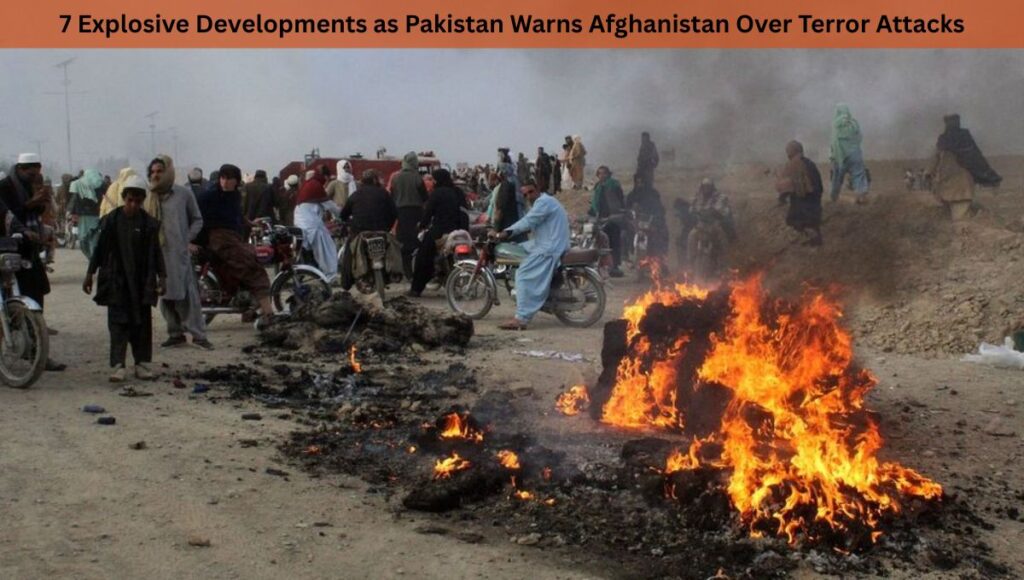
7 Explosive Developments as Pakistan Warns Afghanistan Over Terror Attacks
1. Pakistan’s Warning: “We Will Pay Back in the Same Coin”
Khawaja Asif, Pakistan’s Defence Minister, spoke in an interview with a Pakistani channel where he accused the Afghan Taliban regime of harbouring militants responsible for recent attacks in Pakistan. He warned both India and Afghanistan against any misadventure, declaring that Pakistan would “pay back in the same coin.”
He clarified that Pakistan would not initiate a military adventure unprovoked, but added that cross-border strikes inside Afghanistan “could not be ruled out” after the attacks targeting Cadet College Wana in South Waziristan and a car bombing outside the Islamabad judicial complex.
This warning marks a significant public shift in tone for Pakistan, signalling that attacks inside its major cities could open the door to retaliation beyond its borders.
2. The Attacks That Triggered the Response
Blast outside Islamabad court
On Tuesday, a powerful explosion in Islamabad killed at least 12 people and wounded more than 25, most of them lawyers. The blast occurred near the entrance of the Islamabad district court complex around 12:30 pm during peak hours. Officials said it was a suicide attack, and the explosion was audible up to six kilometres away.
Attack in South Waziristan
A separate incident in South Waziristan targeted a cadet college, further raising alarms about militant activity near the Afghan border. Pakistani authorities linked these attacks to militants operating from across the border and claimed India-backed proxies were involved.
Pakistan’s Prime Minister Shehbaz Sharif promptly blamed India for both attacks, alleging “Indian-backed militants operating from Afghan territory.” He said that attacking Pakistani citizens from Afghan soil under Indian patronage “cannot be condemned enough.”
The combination of these two high-profile attacks has triggered Islamabad’s mounting frustration and hardened its language towards Kabul and New Delhi.
3. The Pakistan-Afghanistan Border Flashpoint
The disputed frontier between Pakistan and Afghanistan, commonly referred to as the Durand Line, has long been a flashpoint. Pakistan insists on its validity and treats the border as international; Afghanistan has historically rejected it.
In recent months, cross-border violence has escalated. Pakistani sources accuse the Afghan Taliban of providing safe havens to militants including the Tehrik‑e Taliban Pakistan (TTP), the Balochistan Liberation Army (BLA), and the Islamic State Khorasan Province (ISKP).
According to analysts, a fragile 48-hour ceasefire brokered in October collapsed amid renewed clashes, illustrating how rapidly the border stability can unravel.
Pakistan’s warnings thus must be seen in the context of this broader low-intensity conflict. The Islamabad attack is being treated by officials as a “wake-up call” that the war is no longer confined to remote borderlands.
4. Pakistan Declares It Is “In a State of War”
In the wake of the Islamabad bombing, Defence Minister Khawaja Asif wrote on social media platform X that Pakistan was “in a state of war.” He said:
“Anyone who thinks that the Pakistan Army is fighting this war only in the Afghan-Pakistan border region or the remote areas of Balochistan should take today’s suicide attack in Islamabad … as a wake-up call: this is a war for all of Pakistan.”
This declaration underlines how the Pakistani leadership now views the threat not just as isolated border incidents, but as part of a nationwide security crisis. It signals a possible shift in posture — from reacting to internal terrorism to preparing for broader, cross-border operations.
5. India’s Role and the Pakistan Media Narrative
Pakistan has swiftly laid blame on India, alleging that “Indian-backed militants” operating from Afghanistan carried out the attacks on its soil. Prime Minister Shehbaz Sharif made the accusations hours after the Islamabad blast and the South Waziristan attack, though without presenting publicly verified evidence.
Indian officials responded by rejecting what they described as “baseless and unfounded allegations” from Islamabad, accusing Pakistan of using diversionary tactics to shift attention away from its internal security challenges.
The India dimension adds another layer of regional complexity — transforming a Pakistan-Afghanistan bilateral flashpoint into a broader triangular tension that involves New Delhi’s strategic interests.
6. Afghanistan’s Response and the Diplomatic Fallout
The Afghan Taliban government condemned the attacks in Pakistan, stating deep sorrow for the victims. But Pakistan and its leadership dismissed the condemnation, saying it cannot be “taken as proof of sincerity.” Defence Minister Asif said those sheltered by the Afghan Taliban were repeatedly attacking Pakistan.
Kabul’s own publicly stated policy is to stop any territory under its control from being used to attack neighbouring countries. Yet analysts point out that practical enforcement is extremely difficult given the porous border and the multiplicity of militant groups involved.
Diplomatically, Pakistan and Afghanistan are now locked in escalating blame, while regional players such as Qatar, Turkey and China watch closely. Pakistan’s government also faces pressure as its Royal Charter for public media funding is under review in the UK — a less widely reported but still consequential factor.
7. What’s Next: Military Escalation or Diplomatic Containment?
Possible Military Response
Pakistan has not formally announced immediate cross-border strikes inside Afghanistan, but it has kept that option open. Officials say any act of aggression will not go unanswered. Given the earlier airstrikes by Pakistan in Afghanistan in 2025 and renewed border skirmishes, the potential for escalation is real.
Diplomatic Efforts & Ceasefire Prospects
On the diplomatic side, a ceasefire signed in Doha and mediated by Qatar and Turkey aims to reduce violence and reopen negotiations. But analysts warn that unless militants are effectively controlled from Afghan soil, any ceasefire is fragile.
Broader Regional Implications
If Pakistan conducts strikes inside Afghanistan, this could inflate into a wider conflict involving India, regional powers and perhaps global actors. The existing complexity of Pakistan-Afghanistan ties, India’s relationship with Kabul, and the mantle of combating terrorism all mean that the stakes are high.
Internal Pakistani Dynamics
Pakistan faces multiple internal pressures: rising militant attacks in urban areas, economic strain, and questions about the effectiveness of its security policy. The “wake-up call” nature of the Islamabad bombing may push the government to adopt more aggressive measures — with consequences for its domestic politics and international standing alike.
Conclusion
The combination of deadly terror attacks, an explicit threat of cross-border retaliation, long-standing Pakistan-Afghanistan mistrust, and the involvement of India make this episode far more than a local border flare-up.
For Pakistan, the message is clear: the frontier has become national rather than peripheral. For Afghanistan, the pressure to act — or face unilateral Pakistani responses — has increased. And for the region, the risk of miscalculation and wider escalation looms large.
Whether the diplomacy holds or military options are triggered will shape South Asia’s security landscape for years to come.
Also Read: 5 Key Takeaways as Pakistan–Afghanistan Peace Talks Hit Deadlock
Also Read: Pakistan Warns of Possible Strikes on Terror Hideouts in Afghanistan
Related Posts:
- India Rejects Pakistan’s Claim on Waziristan Bombing…
- Afghanistan–Pakistan War 2025: Inside the 48-Hour Ceasefire

- 5 Major Takeaways from the US Supreme Court's…

- Pakistan–Afghanistan Border Conflict 2025: Ceasefire…

- 7 Heartbreaking Facts About Venezuela's Earthquake Disaster

- 9 Explosive Claims as Trump Says US Winning Iran War