

5 Major Revelations in the BBC–Trump Panorama Editing Scandal over the misleading speech clip. The BBC has formally apologised to US President Donald Trump for a misleadingly edited clip of his January 6, 2021 speech that appeared in a Panorama documentary—an edit that critics argue created the false impression that Trump directly incited violence ahead of the Capitol riots.
However, while acknowledging the error, the corporation has firmly rejected his threat of a $1 billion defamation lawsuit, stating that there is “no basis” for such a claim.
The controversy has escalated into one of the most serious editorial crises the BBC has faced in years, triggering high-level resignations, a wave of political reactions, and fresh scrutiny of media ethics at a time when global news organisations are increasingly vulnerable to political pressure. In this comprehensive report, we break down the major developments, legal arguments, political implications, and what this saga means for journalism going forward.
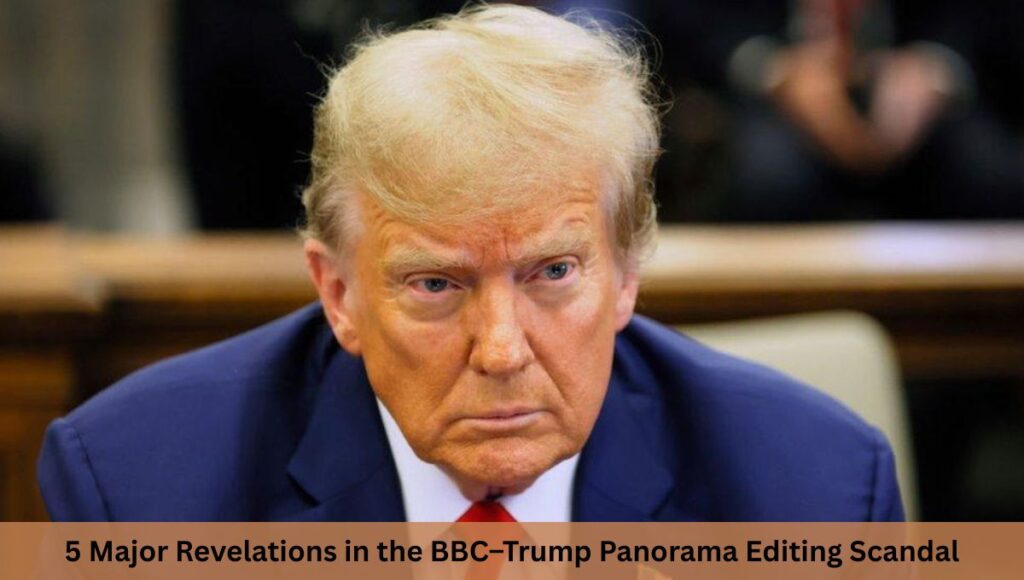
5 Major Revelations in the BBC–Trump Panorama Editing Scandal
What Sparked the BBC–Trump Editing Controversy?
The dispute began when the BBC’s flagship investigative programme, Panorama, aired a documentary titled Trump: A Second Chance? ahead of the 2024 US presidential election.
The film included a 12-second clip from Trump’s January 6 speech—hours before the Capitol was stormed—which stitched together two parts of his speech delivered nearly an hour apart.
What the Audience Saw
The Panorama edit made Trump appear to say:
“We’re going to walk down to the Capitol… and I’ll be there with you. And we fight. We fight like hell.”
What Trump Actually Said
In reality, the first part of that quote occurred early in his speech, while the “fight like hell” line came more than 50 minutes later.
The critical missing context: Trump also told supporters to protest “peacefully,” a line that was omitted in the documentary.
Why the Edit Was Wrong
The BBC later admitted that the clip unintentionally created the impression of a single continuous quote—one that placed two distant lines side by side in a way that implied Trump called for violent action.
The broadcaster said this was an “error of judgment,” not an act of malice. But the damage was already done.
BBC Issues Apology but Pushes Back Against Legal Threat
In its public retraction and apology, the BBC said it accepted that the edit:
“gave the mistaken impression that President Trump had made a direct call for violent action.”
BBC chair Samir Shah sent a personal letter to the White House apologising on behalf of the corporation.
But the BBC drew a hard line on defamation.
Despite apologising, the BBC stated:
“While the BBC sincerely regrets the manner in which the video clip was edited, we strongly disagree there is a basis for a defamation claim.”
According to the BBC’s lawyers, Trump’s threatened $1bn lawsuit cannot succeed for several reasons, including:
- the documentary did not air in the United States
- Trump suffered no demonstrable harm, since he was re-elected in 2024
- the edit lacked malicious intent
- political speech receives broad protection
- the clip was part of a longer, balanced documentary
Internally, BBC sources reportedly say the corporation believes it has a “strong defence” and is prepared to fight rather than settle.
Trump’s Legal Team: Deadline, Demands, and Accusations
Trump’s lawyers initially claimed the BBC had already been sued—an assertion the White House repeated to reporters.
That turned out to be incorrect.
No lawsuit has been filed yet.
Trump’s legal spokesperson clarified that:
- no case has yet been submitted
- they gave the BBC a deadline (Friday, November 14) to respond
- they reserve the right to sue at any time
Their demand letter accuses the BBC of:
- publishing “false, defamatory, disparaging” material
- engaging in “systemic bias”
- causing “overwhelming financial and reputational harm”
And threatens at least $1bn in damages unless the BBC retracts and compensates Trump.
Newsnight Accused of Similar Misleading Edit
Hours before the BBC published its retraction, a second misleading edit surfaced—this time from Newsnight in 2022.
The clip again stitched together parts of Trump’s January 6 speech, with a voiceover stating “and fight they did,” played over footage of the Capitol riots.
Even former Trump chief of staff Mick Mulvaney, speaking as a guest on that episode, pointed out that the excerpt had been “spliced together.”
The BBC says it is reviewing this second case as part of its broader editorial standards assessment.
This fresh revelation amplified accusations that the Panorama error wasn’t isolated—fueling what Trump’s team now calls “a pattern of defamation.”
Fallout Inside the BBC: Senior Resignations
The scandal proved so severe that two of the most senior BBC leaders resigned:
- Tim Davie, Director General
- Deborah Turness, Head of News and Current Affairs
Turness said in her resignation note that:
“as CEO of BBC News, the buck stops with me.”
Davie said he accepted “ultimate responsibility” for mistakes that “damaged the BBC.”
Their departures were met with shock across the media industry and reignited debates about:
- newsroom oversight
- editorial chain of command
- journalistic accountability
- political pressure on public broadcasters
Political Reactions: Calls for UK Government Intervention
The scandal has crossed national boundaries and triggered political responses.
Ed Davey’s Reaction
Liberal Democrats leader Sir Ed Davey urged the UK prime minister to:
“get on the phone to Trump”
and discourage him from suing the BBC—arguing that Britain must defend the broadcaster’s independence.
Department for Culture, Media and Sport
The UK government, however, declined to comment.
The silence reflects the delicate political position: balancing domestic media oversight with avoiding entanglement in foreign political battles.
Analysis: BBC Signals It Will Fight, Not Fold
According to CNN’s media analysis, at least six major US media companies have faced Trump-related legal threats this year.
Some have chosen to settle. Others have stood firm.
The BBC appears to be choosing confrontation rather than capitulation.
The corporation’s rapid release of a strongly worded rebuttal—combined with its insistence that a settlement would be publicly disclosed—signals a shift in strategy for a broadcaster often accused of excessive caution.
As journalist Joel Simon explained:
“This is a fight about stopping Trump from deploying his pattern of intimidation, bluster and threats against an organisation that sets the global media agenda.”
Why the BBC might resist settling
- It is publicly funded by licence fee payers
- A secret payout would ignite a political firestorm
- The legal case appears weak
- Capitulating could encourage future political coercion
- The BBC wants to protect its editorial independence
Trump Has Won Big Settlements Before
Although many legal experts doubt Trump could win a defamation suit against the BBC, history shows he has secured payouts from US media giants.
Recent settlements Trump has won:
- ABC (Disney) – paid $15 million
- CBS (Paramount) – paid $16 million
In both cases, the networks wanted to avoid protracted legal battles.
These settlements fuel speculation that Trump’s team is attempting a similar pressure campaign with the BBC.
A source inside the BBC emphasised, however, that the broadcaster “has made no such deal.”
Legal Reality: Why Trump’s Case Appears Weak
Defamation law differs significantly between the UK and the US. In this case, Trump faces obstacles on both fronts.
1. The programme did not air in the US
The BBC did not have US rights, and the documentary was UK-only.
Trump would need to prove that:
- US viewers saw the edit
- their opinion of him worsened because of it
This is extremely difficult.
2. UK deadline to sue has already passed
The statute of limitations for defamation in England has expired.
3. Award limits in the UK are low
Defamation damages rarely exceed £100,000, far from Trump’s demanded $1bn.
4. The clip was part of a long, balanced programme
Courts typically consider the full context, not a single extract.
5. Trump suffered no measurable harm
He was re-elected in 2024—weakening any claim of reputational or financial damage.
6. No evidence of malice
Negligent editing is not enough for a defamation win.
7. Political speech enjoys broad protection
US courts are particularly protective of political commentary, even if mistaken.
Legal experts widely agree that Trump’s case has little merit—though that does not guarantee he won’t file it.
Internal BBC Dynamics: Leaked Memo Fuels Allegations
The controversy intensified when The Telegraph published a leaked internal memo from a former external adviser to the BBC’s editorial standards committee.
The memo criticised:
- the Panorama edit
- BBC reporting on transgender issues
- BBC Arabic’s coverage of the Israel–Gaza war
This leak, combined with the Newsnight clip and senior resignations, created a narrative that critics describe as evidence of “systemic bias,” though the BBC rejects that claim.
BBC’s Defence: A Detailed Five-Point Argument
In its letter to Trump’s legal team, the BBC laid out five primary reasons it believes there is no valid defamation claim:
1. The documentary did not air in the US.
No distribution rights, no US broadcast, no US audience.
2. Trump suffered no harm.
He won the 2024 election shortly after—contradicting claims of reputational damage.
3. The edit lacked malicious intent.
It was part of a compression effort for a long speech, not designed to mislead.
4. The clip was part of a broader, balanced programme.
It cannot be isolated as a standalone defamatory statement.
5. Political speech is heavily protected under US law.
Courts routinely dismiss claims involving political interpretation and commentary.
What Happens Next?
Although Trump has not filed a lawsuit yet, his team has not ruled it out.
Several outcomes are possible:
1. Trump files the lawsuit
Even if the case is weak, he has pursued long-shot suits before to generate publicity.
2. Trump walks away
The BBC hopes the president becomes distracted by other political battles.
3. A symbolic settlement
Trump has previously accepted payments directed toward his future presidential library or charities.
4. A long legal battle
This would drain BBC resources but might strengthen its commitment to editorial independence.
The Bigger Picture: Journalism Under Pressure
This controversy sits at the crossroads of two major global issues:
1. Political pressure on journalists
Trump has applied legal and political pressure on multiple media outlets this year, sometimes successfully.
2. Declining trust in media institutions
Errors—especially involving politically charged topics—can accelerate erosion of public trust.
3. The challenge of editing in the age of instant scrutiny
Documentaries often compress hours of footage into minutes. Mistakes, even unintentional ones, now spark global political storms.
4. The rise of “weaponised” defamation threats
Lawsuits and threats of lawsuits are becoming tools to shape media coverage.
Joel Simon summarised the stakes:
“This battle is about the ability of the British public to determine what kind of media it wants, without Trump interfering.”
BBC’s Future: Damage Control and Editorial Reform
The broadcaster has pledged to:
- review editorial workflows
- reassess oversight structures
- reinforce training on political content
- thoroughly investigate the second Newsnight clip
- recommit to high editorial standards
Given rising tensions, the BBC knows its reputation—and possibly its funding model—is under pressure.
Conclusion: A Rare Public Apology, a Firm Rebuttal, and a High-Stakes Stand-off
The BBC’s apology to Donald Trump marks one of the most significant moments in recent media history: a public broadcaster acknowledging an editorial error while simultaneously refusing to bow to political or legal intimidation. The Panorama edit was a mistake—one the BBC admits plainly.
But the corporation’s refusal to accept Trump’s sweeping defamation claim shows an institution trying to hold its ground in an era when political leaders increasingly weaponise legal threats. Whether Trump follows through on his promise to sue remains to be seen.
But the BBC’s message is clear:
It will apologise for errors—but it will not be bullied into paying for them when the law does not support such claims. This showdown between a powerful public broadcaster and a powerful political figure will likely shape media–political relations for years to come.
Also Read: 10 Explosive Facts About Donald Trump’s $1 Billion Lawsuit Threat Against the BBC
Related Posts:
- 10 Explosive Facts About Donald Trump’s $1 Billion…

- 9 Explosive Revelations as Trump Declares His Health…
- 7 Explosive Revelations Behind Trump’s Move to…

- Trump to Host 2026 G20 Summit at His Florida Golf…

- Trump sues the Wall Street Journal over Epstein…

- Murdoch vs. Trump: A Media Feud with Press Freedom…
