7 Bold Policy Shifts: Trump’s Stunning Change of Heart on H-1B, Tariffs, and Foreign Students — An unexpected turn. Since returning to the Oval Office after his sweeping 2024 re-election victory, US President Donald Trump has taken an unmistakably pro-American approach across key areas of governance — immigration, trade, and education.
From rounding up undocumented immigrants to enforcing curbs on H-1B visas, Trump’s second-term policies have showcased his signature “America First” spirit. Yet, in a surprising series of interviews and policy announcements, the president has softened his stance, signaling what many are calling a “strategic recalibration.”
In a Fox News interview, Trump appeared to acknowledge that America cannot thrive in isolation — and that it needs skilled talent, global cooperation, and trade diplomacy to stay competitive.
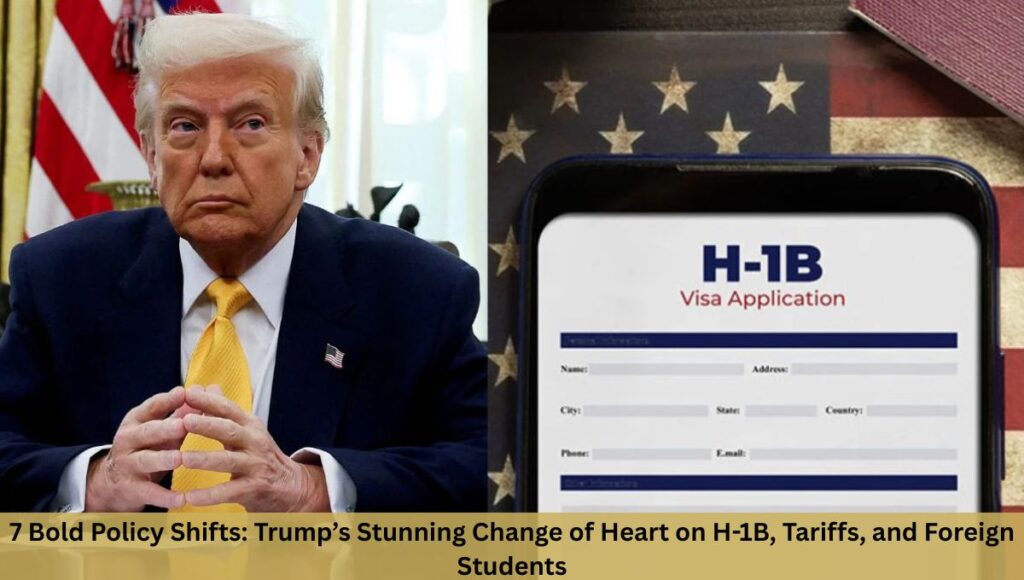
7 Bold Policy Shifts: Trump’s Stunning Change of Heart on H-1B, Tariffs, and Foreign Students
1. Trump Softens His Tone on H-1B Visas
From Restriction to Recognition
Trump, who once branded the H-1B visa program as a threat to American workers, now admits it plays a crucial role in filling gaps in the nation’s high-skilled labor market.
When asked whether tightening H-1B visa rules remained a priority, Trump responded candidly:
“You don’t have certain talents, and people have to learn. You can’t take people off an unemployment line and say, ‘I’m going to put you into a factory where we’re going to make missiles.’”
This pragmatic shift highlights Trump’s new recognition that foreign professionals, particularly in tech and defense sectors, are essential for sustaining America’s industrial competitiveness.
H-1B: The Backbone of US Innovation
The H-1B visa allows US companies to hire highly skilled foreign professionals for specialized roles in areas such as engineering, technology, and research. Traditionally, about 73% of H-1B visa holders come from India, followed by China at 12%.
Under Trump’s earlier stance, the program was accused of displacing American workers. In 2025, he imposed a $100,000 fee per H-1B visa, citing “systemic abuse.” However, his administration is now revisiting that policy, with advisers suggesting a “balanced reform” that retains talent while protecting domestic employment.
Trump’s Explanation: Skills Shortage is Real
In defending his reversal, Trump explained that certain sectors — especially manufacturing, defense, and semiconductors — require expertise not currently available in the domestic labor pool.
“You can’t just take people off the unemployment line and put them into highly technical roles. People have to be trained first,” Trump told Fox host Laura Ingraham.
This admission marks a departure from the hardline anti-immigration rhetoric of his first term and signals a willingness to prioritize economic realism over political slogans.
2. MAGA Base Revolts Over Trump’s Comments
Trump’s remarks have triggered fierce backlash from his own “Make America Great Again” (MAGA) base.
Right-wing commentator Mike Cernovich said,
“Trump broke everyone’s heart with this line about the American workforce and H-1Bs.”
Florida Republican Anthony Sabatini warned that such statements could cost the GOP dearly in the upcoming midterm elections:
“We’ve never seen an administration crash and burn so badly in its first year for no reason other than to appease donors.”
Even Rep. Marjorie Taylor Greene criticized Trump, posting on X:
“I believe in the American people. I’m solidly against being replaced by foreign labor. I am America First and America Only.”
The growing rebellion among his base reflects an ideological rift between economic nationalists and business-friendly conservatives within the Republican Party.
3. Trump’s Trade Turnaround: Lowering Tariffs on India
From 50% Tariffs to Trade Talks
After imposing 50% tariffs on India in 2024 — among the highest in the world — Trump has now announced that the US will lower those duties, citing India’s reduction in Russian oil imports as a positive step.
“Right now, the tariffs are very high on India because of the Russian oil… It’s being reduced very substantially. Yeah, we will bring the tariffs down at some point,” Trump said at a White House briefing.
The statement marks a sharp contrast from Trump’s earlier confrontational trade posture, signaling a reset in US-India economic relations.
India Welcomes the Move
An Indian trade official confirmed that negotiations were progressing smoothly:
“Talks are progressing well… India and the US are negotiating a comprehensive, WTO-compliant trade agreement. We’re now awaiting a response to India’s proposal.”
This thaw in trade relations could pave the way for greater defense collaboration, energy cooperation, and technology sharing between the two democracies.
4. Trump’s Surprising Support for Foreign Students
From Restriction to Realization
In another unexpected U-turn, Trump expressed strong support for foreign students studying in the United States. He acknowledged their vital role in sustaining America’s higher education system and economy.
“You don’t want to cut half of the students from all over the world — destroy our entire university and college system,” Trump said in the Fox interview. “You would have half the colleges in the United States go out of business.”
This admission comes as US universities face declining domestic enrollment and growing financial pressures.
Education as an Economic Engine
Trump pointed out that foreign students contribute trillions of dollars to the US economy and pay significantly higher tuition fees.
“Students from most foreign countries pay more than double when they come in. I want to see our school system thrive… I view it as a business,” he said.
By reframing education as an economic export, Trump appears to be aligning national policy with financial pragmatism — even if it risks angering his nationalist supporters.
5. “Train Americans, Then Go Home”: The Treasury’s Clarification
Scott Bessent Outlines the Vision
In an interview with Fox News, US Treasury Secretary Scott Bessent elaborated on the administration’s new H-1B visa philosophy — temporary expertise with a long-term American payoff.
“The President’s vision is to bring in overseas workers who have the skills that left with offshoring,” Bessent said. “Three, five, seven years — enough time to train US workers, then they can go home.”
Bessent described this as a “knowledge transfer” strategy aimed at rebuilding industries like semiconductors, shipbuilding, and defense manufacturing that have been hollowed out by decades of outsourcing.
“An American Can’t Have That Job — Not Yet”
Defending the plan against critics who claim foreign workers will displace Americans, Bessent was blunt:
“An American can’t have that job — not yet. We haven’t built ships or semiconductors here for years. Overseas partners coming in, teaching American workers — that’s a home run.”
This statement reinforces the idea that the H-1B program will now be used not for permanent labor substitution but as a training and transition mechanism to empower American workers.
Parallel Prosperity: Trump’s Economic Blueprint
Bessent hinted at broader economic initiatives under the president’s “Parallel Prosperity” framework — a vision of Wall Street and Main Street growing together.
He confirmed that the administration is exploring a $2,000 tariff rebate for middle-class families earning under $100,000 to cushion the impact of trade policies.
“The President’s talking about a $2,000 rebate,” Bessent said. “It’s part of ensuring families feel the benefits of strong trade policy.”
Also Read: Train US workers, then go home: Scott Bessent explains Trump’s new H-1B visa plan
6. The Controversy Over Chinese Students
Trump’s remarks about welcoming up to 600,000 Chinese students also drew criticism from conservatives who warned of intellectual property theft and espionage risks.
Fox host Laura Ingraham called it “not a pro-MAGA stance,” to which Trump responded:
“You would have half the colleges in the United States go out of business if we cut international students. We take in trillions of dollars from them.”
Trump’s comment underscores a realpolitik perspective — prioritizing economic benefits over ideological purity, even if it alienates segments of his base.
7. H-1B Controversy: Are Visa Holders Replacing Americans?
The Numbers and the Reality
According to Pew Research, nearly 73% of all H-1B visa holders come from India, with China at 12%. Critics argue the program is exploited by outsourcing firms to replace Americans with cheaper labor.
In September, Trump issued a presidential proclamation titled “Restriction on Entry of Certain Nonimmigrant Workers”, citing “systemic abuse” of the H-1B system. He claimed that this abuse “artificially suppresses wages” and undermines national security.
However, the American Immigration Council argues that H-1B visas do not displace American workers, as employers must legally prove that hiring foreign professionals does not harm domestic wages or conditions.
Who Supports and Who Opposes the H-1B Program
The H-1B system divides opinion across party lines:
- Supporters: Tech leaders like Elon Musk and the U.S. Chamber of Commerce argue that H-1B workers are vital for innovation. Musk said, “The reason I’m in America — along with so many who built SpaceX and Tesla — is because of H-1B.”
- Critics: Lawmakers like Sen. Bernie Sanders and Sen. Chuck Grassley believe the program has drifted from its purpose, calling for tighter regulations.
Even Musk admits the system needs “major reform,” proposing higher salaries and annual maintenance fees to prevent misuse.
A Balancing Act Between Nationalism and Pragmatism
Trump’s recent policy shifts — on H-1B visas, trade with India, and foreign student admissions — reveal a president grappling with competing imperatives: economic strength vs. nationalist identity.
His softened tone reflects an understanding that isolationism has limits, and that America’s long-term prosperity depends on strategic openness — attracting talent, rebuilding industries, and nurturing global partnerships.
The Political Cost
But this recalibration has come at a political cost. Within his MAGA movement, disillusionment is spreading fast. For many diehard supporters, Trump’s willingness to compromise feels like betrayal.
One viral post on X summed up the mood:
“When a president loses faith in his own people, he forfeits the nation’s soul.”
The Economic Gamble Ahead
As the US economy heads into 2026, the success of Trump’s “Parallel Prosperity” vision will hinge on whether foreign expertise truly translates into American self-reliance — or whether it deepens dependence on imported labor and global capital.
If successful, Trump’s second-term pivot could redefine “America First” as “America Smart.” If not, it could alienate the very base that powered his return to power.
Also Read: 7 Critical Facts About Trump’s New US Visa Rule Targeting Immigrants with Chronic Illnesses
Related Posts:
- 9 Explosive Revelations as Trump Declares His Health…
- 5 Powerful Highlights as Trump Lands Second Nobel…

- Donald Trump’s 24-Karat Gold White House Makeover:…

- Trump’s 2025 Gaza Peace Plan Signing and Historic…

- 11 Explosive Revelations From Ted Cruz’s Leaked…

- Trump Threatens Military Action in Nigeria Over…