5 Critical Developments as US Pushes New UN Plan for Gaza Security Force to shape the future of post-war Gaza. The United States is accelerating diplomatic efforts at the United Nations to secure approval for a sweeping new resolution aimed at reshaping governance and security in post-war Gaza.
The proposal centers on the creation of a 20,000-strong International Stabilization Force (ISF) and a two-year transitional body, the so-called Board of Peace, chaired by President Donald Trump.
But while Washington insists the plan is essential to sustain the fragile ceasefire, global reactions—from Russia’s counter-resolution to the UAE’s public withdrawal from the security mission—signal a turbulent diplomatic road ahead. Here are the five critical developments shaping the future of the UN effort, Gaza’s governance, and the region’s political landscape.
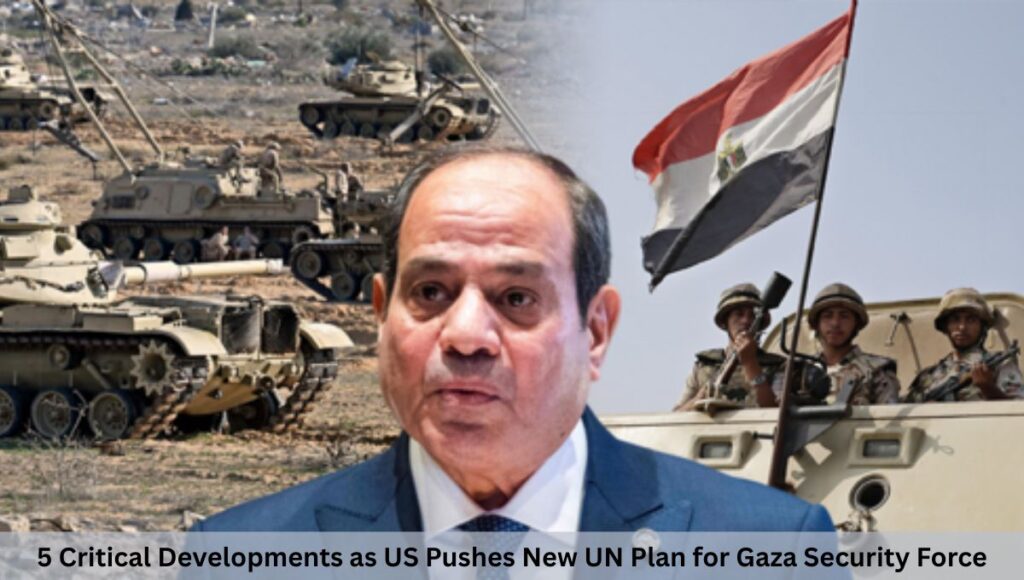
5 Critical Developments as US Pushes New UN Plan for Gaza Security Force
1. US Pushes Forward with New UN Resolution to Form Gaza Security Force
Speaking at a G7 summit in Canada, US Secretary of State Marco Rubio said Washington is “optimistic” about securing support for the new UN Security Council resolution that would authorize the International Stabilization Force in Gaza.
Rubio emphasized that the US is nearing consensus on the draft language and wants to move swiftly:
“We’re making good progress on the language of the resolution. We don’t want to lose momentum on this.”
A Western diplomat told The Times of Israel that the US hopes to bring the resolution to a vote within days, aiming for deployment by early 2026.
What the Draft Resolution Says
A leaked copy of the draft shows that the ISF would be tasked with:
- Demilitarizing the Gaza Strip
- Destroying Hamas’s military and offensive infrastructure
- Preventing the rebuilding of militant capabilities
- Decommissioning weapons belonging to non-state armed groups
The ISF’s mandate would run for two years, during which Gaza would be overseen by the Board of Peace, a transitional governance body chaired by Trump until a reformed Palestinian Authority (PA) can reassume control.
Rubio insists the ISF should not be seen as a combat mission—yet its mandate involves enforcement responsibilities that experts warn could lead to confrontation.
2. Confusion and Disputes Over Hamas’s Alleged Commitment to Disarm
One of the most contentious claims surrounding the US Gaza resolution is the assertion by American officials that Hamas agreed to disarm as part of negotiations preceding the October 9 ceasefire agreement.
Rubio reiterated this position, stating:
“That’s a commitment Hamas made. That’s a commitment all of our partners made.”
However, the publicly signed agreement between Israel and Hamas did not mention disarmament. It focused solely on:
- A temporary ceasefire
- Limited IDF pullbacks
- A hostage-prisoner exchange
- Humanitarian aid provisions
Hamas, for its part, has repeatedly denied any intention to disarm.
This discrepancy leaves significant ambiguity at the heart of the US proposal—and raises the stakes for any future ISF engagement on the ground in Gaza.
Also Read: Gazans warn: Hamas charging fees, silencing dissent and rebuilding its grip
3. The Board of Peace: A Transitional Gaza Governance Plan With Major Gaps
The US draft resolution envisions an unprecedented governing structure: a Board of Peace led by Donald Trump, with oversight of Gaza’s civilian administration until the PA completes a reform program and can “securely and effectively” take control.
A Novel Idea With Unanswered Questions
Despite support from several UNSC members for a transitional authority, major concerns remain:
- No oversight mechanism is defined for the Board.
- The PA’s future role is left vague.
- The process of transferring authority is undefined.
- The relationship between the ISF and local Palestinian forces lacks clarity.
AFP reported that many delegates questioned the absence of concrete details, even as Washington pushes for rapid adoption.
The “Yellow Line” Debate
Rubio was asked whether the ISF would deploy on the western side of the Yellow Line, areas still controlled by Hamas.
His response underscores the resolution’s ambition:
“Eventually, none of it should be under Hamas control… The goal is a civilian Palestinian organization that runs Gaza.”
Yet with no clear mechanism to achieve this transition, diplomats fear a governance vacuum or conflict with existing armed factions.
4. Russia Counters US Proposal With Its Own UN Resolution
Amid growing concerns over Washington’s text, Russia presented a counter-draft resolution to the Security Council.
According to a copy seen by Reuters, Moscow’s proposal:
- Urges a balanced and unified approach to securing a long-term ceasefire
- Does not include the US-backed Board of Peace
- Requests that the UN Secretary-General identify options for an international force
- Avoids endorsing the Trump-led governance structure
The Russian draft appears designed to attract support from countries skeptical of US dominance in post-war Gaza planning.
US Warns of “Grave Consequences” if Its Resolution Fails
A US mission spokesperson rejected Russia’s draft, saying attempts to “sow discord” could endanger Palestinians:
“The ceasefire is fragile. Any failure to unite around this resolution has grave, tangible, and entirely avoidable consequences.”
Despite the warning, negotiations remain fraught, and the division could delay a vote.
5. UAE Publicly Withdraws Support, Citing Lack of Clarity
In a significant diplomatic blow to the US effort, the United Arab Emirates announced that it will not participate in the proposed Gaza security force.
Speaking in Abu Dhabi, senior diplomat Dr. Anwar Gargash stated:
“The UAE does not yet see a clear framework for the stability force, and under such circumstances will probably not participate.”
Why the UAE Backed Out
Analysts point to several core reasons:
Ambiguous Mandate
Key Arab states argue the ISF’s legal authority, chain of command, and relationship to Palestinian governance are too vague.
No Guarantee of a Palestinian State
For months, the UAE has insisted that no post-war plan is credible without a real pathway to Palestinian statehood—which the US draft mentions only in aspirational terms.
Diplomatic Balancing Act
The UAE is navigating pressures from:
- Its strategic partnership with the US
- Its normalization with Israel under the Abraham Accords
- Its commitment to Arab public opinion and Palestinian sovereignty
Participating in an unclear security mission with potential for combat, without a political horizon for Palestinians, risks undermining its regional standing.
Regional Ripple Effects
The UAE’s announcement may discourage participation from:
- Egypt
- Qatar
- Indonesia
- Türkiye
- Azerbaijan
All of which Washington has approached for troop contributions.
Without regional buy-in, the ISF faces a steep uphill climb.
The Ceasefire Remains Fragile—and Criticism Mounts
Despite the Trump-brokered ceasefire taking effect on October 8—ending two years of devastating conflict—Israel has continued near-daily strikes in Gaza, killing hundreds.
The US mission warns that failure to approve the resolution could jeopardize the ceasefire entirely, putting Palestinians at serious risk.
But critics argue that the current plan:
- Places too much power in American hands
- Lacks Palestinian consent
- Risks enabling a prolonged Israeli presence
- Does not resolve core issues of sovereignty
As negotiations continue, these unresolved tensions could determine the fate of both the resolution and Gaza’s long-term stability.
Also Read: Hamas Executes 50 Rivals After Ceasefire – Inside Gaza’s Deadly Power Struggle
What Happens Next?
The coming days at the UN Security Council will be decisive. The US wants a quick vote, but with the UAE withdrawing, Russia advancing an alternative, and widespread uncertainty over the mandate of the ISF and the Board of Peace, member states are hesitant.
For the mission to gain regional legitimacy, experts argue that three conditions must be met:
- A clear legal and operational framework for the international force
- A credible role for a reformed Palestinian Authority
- A genuine pathway to Palestinian self-determination and statehood
Without these, the plan risks faltering—and Gaza’s future remains uncertain.
Related Posts:
- 7 Key Takeaways as the UN Approves Trump’s Gaza Peace Plan
- Trump’s 20-Point Gaza Peace Plan Gains Urgent Global…

- 7 Powerful Facts About Ayatollah Ali Khamenei’s…
- 5 Major Takeaways from the US Supreme Court's…

- In 8 Moves, EU Targets China-Linked Refineries and…

- 7 Explosive Fault Lines in Trump’s Global “Board of…