
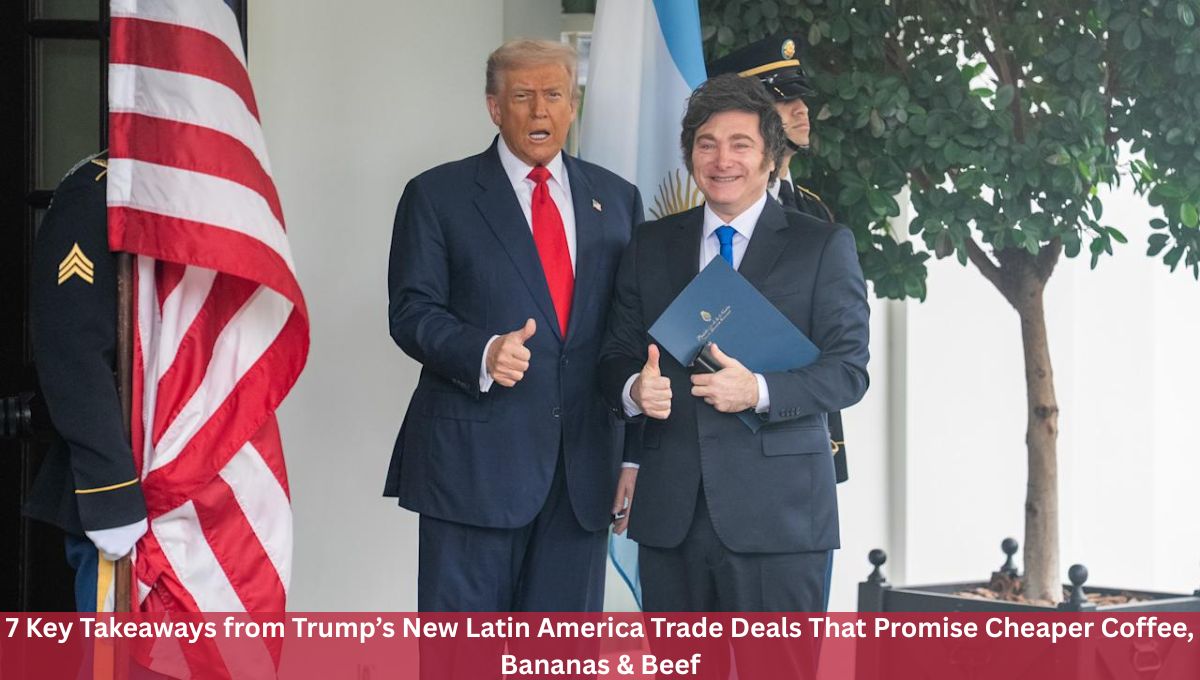
7 Key Takeaways from Trump’s New Latin America Trade Deals That Promise Cheaper Coffee, Bananas & Beef amid deepening U.S. affordability concerns. The Trump administration has rolled out a sweeping set of new trade frameworks with Argentina, Guatemala, El Salvador and Ecuador, in a move officials say will help lower prices on everyday essentials such as coffee, bananas, cocoa and beef.
The agreements come at a politically sensitive moment: U.S. voters are increasingly frustrated about the rising cost of groceries, and President Donald Trump has shifted into damage-control mode after a weaker-than-expected performance for Republicans in last week’s off-year elections.
Senior administration officials say the new Latin America trade deals will bring the U.S. closer to “balanced and reciprocal trade,” while delivering targeted tariff relief on products Americans consume but cannot produce in sufficient quantities. Below is a detailed breakdown of the agreements, their political implications, and how they may affect U.S. consumers.
7 Key Takeaways from Trump’s New Latin America Trade Deals That Promise Cheaper Coffee, Bananas & Beef
1. Tariffs to Ease on Coffee, Bananas, Cocoa and Other Imported Goods
The headline announcement from the Trump administration is clear: tariffs will be lowered on key consumer imports—most notably coffee, bananas and cocoa.
Officials confirmed that these goods fall under a category of products the U.S. doesn’t grow, mine, or produce in adequate volumes. Coffee and bananas are among the most widely consumed items in the United States, and both have seen sharp price increases this year.
The easing of coffee tariffs comes shortly after both President Trump and Treasury Secretary Scott Bessent vowed to address the spike in coffee prices, which have surged nearly 20% in 2024 due to a combination of global supply issues and extreme weather affecting crops.
Bananas, largely imported from Guatemala and Ecuador, are also set for tariff relief. The administration hopes that lowering import taxes will translate into reduced grocery-store prices, though officials acknowledge that wholesalers and retailers must pass on the savings to consumers for the impact to be felt.
2. Four Latin American Nations Strike Deals: Argentina, Guatemala, El Salvador & Ecuador
The U.S. has secured trade frameworks—preliminary but politically significant commitments—with:
- Argentina
- Guatemala
- El Salvador
- Ecuador
These frameworks are expected to be signed within two weeks, according to senior administration figures who briefed reporters.
They include commitments on:
- Eliminating import licenses and other nontariff barriers
- Preventing digital services taxes on U.S. companies
- Reducing tariffs toward 0% on some American-made goods
- Offering reciprocal market access in agriculture and industry
- Streamlining regulatory obstacles in food, health, and safety
Officials say the agreements will expand U.S. export opportunities while offering Latin American partners tariff exemptions for select products.
3. Tariffs Remain in Place for Most Goods — with Select Relief
Despite the relief on coffee and bananas, the core tariffs introduced by President Trump earlier this year remain largely unchanged:
- 10% tariffs on goods from Argentina, El Salvador and Guatemala
- 15% tariffs on goods from Ecuador, due to the U.S. trade deficit with the country
The framework exempts goods the U.S. does not produce sufficiently, allowing targeted tariff cuts on:
- Coffee
- Cocoa
- Bananas
- Possibly other agricultural commodities
This approach allows the White House to claim continued “toughness” on trade while offering price relief on politically sensitive grocery items.
4. Argentina Deal Also Focuses on Beef Exports
Argentina’s agreement with Washington goes beyond coffee and bananas. As part of the bilateral framework, Argentina will receive improved access to foreign beef markets—a major win for Buenos Aires.
The U.S. is expected to exempt Argentinian beef from the current 10% tariff, though the overall beef import quota will remain unchanged. This announcement comes at a moment when beef prices in the U.S. have soared, becoming a political pressure point for Trump.
Last week, the president ordered the Justice Department to investigate meatpacking companies over alleged price manipulation, suggesting foreign ownership and market consolidation may be distorting prices for ranchers and consumers.
Argentina’s libertarian president Javier Milei, who visited the White House recently, celebrated the agreement as “tremendous news” and declared that his administration is committed to “making Argentina great again.”
5. Guatemala and Ecuador Call the Deals a Major Economic Boost
Guatemala’s President Bernardo Arévalo hailed the trade framework as a breakthrough for investment and export expansion. Guatemala exports large quantities of bananas, coffee and cocoa to the U.S., and 70% of its exports will face zero tariffs under the new arrangement.
Arévalo emphasized that the deal reflects Guatemala’s strong diplomatic relationship with Washington and will boost investor confidence.
Ecuador, another major banana exporter, is expected to benefit from the U.S. relaxing the 15% tariff imposed earlier this year. Officials say Ecuadorian bananas and coffee are among the products being considered for tariff relief.
El Salvador’s President Nayib Bukele, who often touts his rapport with Trump, celebrated the agreement on social media with the caption: “Friends.”
6. Political Urgency: Trump Faces Pressure Over Affordability Crisis
The new trade deals arrive at a time when the White House is scrambling to address voter dissatisfaction over the rising cost of living.
Food inflation—especially for staples such as:
- coffee
- bananas
- beef
- cocoa
—has hit American families hard, eroding consumer confidence.
Just days ago, Trump dismissed affordability concerns as a “con job” by Democrats. But after the Republican Party underperformed in several statewide elections, the administration has shifted rapidly toward price-focused policy announcements.
Treasury Secretary Bessent confirmed that affordability is now “a key concern” for voters—and therefore a central focus of the administration’s economic strategy.
By targeting coffee and bananas—products nearly all American households buy weekly—the White House is taking visible, consumer-facing steps to ease grocery costs ahead of the 2026 midterms.
7. Part of a Broader Global Trade Push by the Trump Administration
These Latin American frameworks are just the latest in a fast-expanding set of international deals aimed at reshaping global trade under Trump’s second presidency.
In recent weeks, the administration has also announced new agreements with:
- The European Union
- South Korea
- Japan
- Malaysia
- Cambodia
- Thailand
Additionally, the White House recently unveiled $150 billion in agreements with Uzbekistan and several Central Asian nations.
Trump has been eager to showcase these developments as evidence that his aggressive tariff strategy—launched in April with sweeping penalties on dozens of countries—is “working.”
Most of the initial tariffs were temporarily paused after global financial markets panicked, but new tariff rates began rolling out again in August, with Washington seeking concessions from trade partners worldwide.
What It Means for U.S. Consumers
If retailers pass along the tariff savings, Americans could see:
- Lower coffee prices
- Cheaper bananas and cocoa-based products
- Potential relief in beef prices
- Broader stability in key grocery categories
But the ultimate impact depends on supply chains, global weather patterns, and corporate pricing decisions.
Still, administration officials say they expect a “positive effect” on consumer prices, particularly in categories where imports dominate U.S. consumption.
Conclusion
The new Latin America trade deals mark a significant moment for President Trump’s trade agenda and could offer tangible financial relief for millions of Americans grappling with rising food costs.
With tariff reductions targeting coffee, bananas, cocoa and beef—items central to U.S. diets—the administration aims to address affordability concerns while deepening economic ties across the Western Hemisphere.
Whether these agreements lead to noticeable price drops will depend on the speed and willingness of wholesalers, distributors and retailers to pass along tariff savings. But politically, the message is clear: the White House wants voters to know it is acting on the cost-of-living crisis.
Also Read: 5 Key Takeaways from Trump–Carney Meet: Trade, Peace, and Global Diplomacy
Also Read: Swiss hope to slash crippling Trump tariffs after golden charm offensive
Related Posts:
- 7 Key Takeaways: Trump’s Surprise Meeting with NYC…

- 11 Explosive Revelations From Ted Cruz’s Leaked…

- 7 Stunning Moments from Trump–Mamdani’s Unexpected…

- Trump’s 2025 Gaza Peace Plan Signing and Historic…

- 5 Powerful Highlights as Trump Lands Second Nobel…

- 9 Facts About Trump’s Drug Boat Strikes That Shook the World
