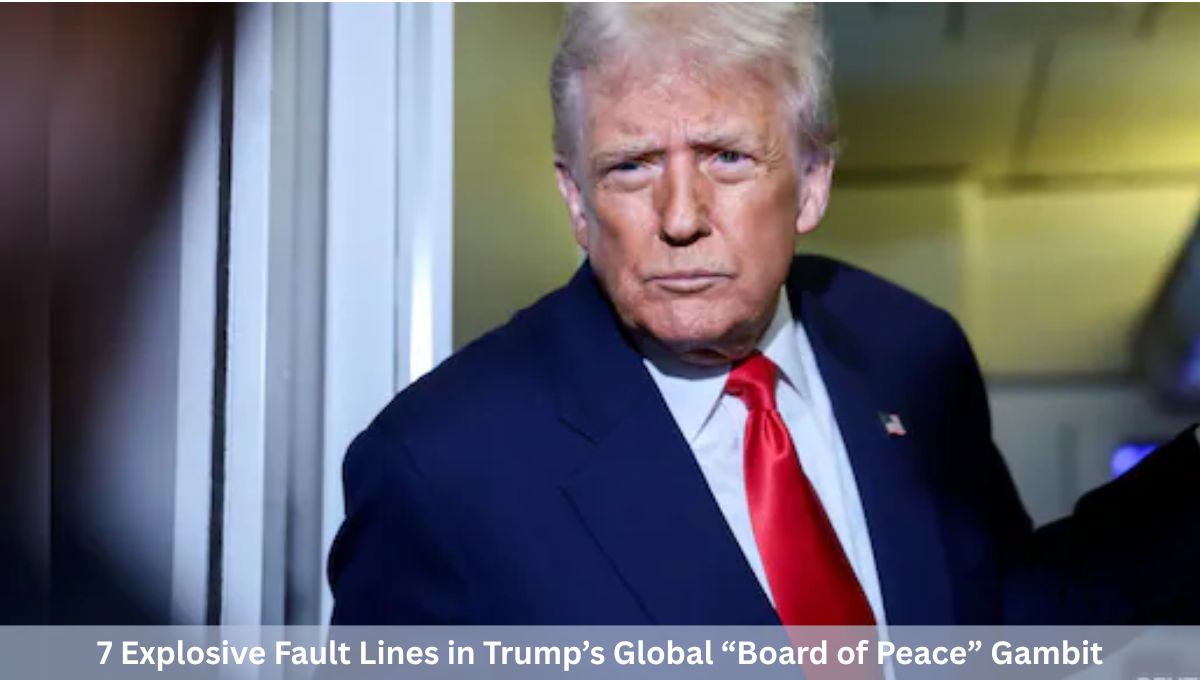
7 Explosive Fault Lines in Trump’s Global “Board of Peace” Gambit, deepening unease worldwide. The United States has formally withdrawn Canada’s invitation to join President Donald Trump’s controversial “Board of Peace,” marking a sharp escalation in diplomatic tensions between two of the world’s closest allies.
The move followed a public and unusually blunt exchange between Trump and Canadian Prime Minister Mark Carney, underscoring widening fractures in the U.S.-led global order and raising fresh questions about the legitimacy, intent, and future of Trump’s ambitious peace initiative.
The episode, unfolding against the backdrop of the World Economic Forum (WEF) in Davos, has reverberated far beyond Ottawa and Washington.
It has intensified scrutiny of the Board of Peace itself, an entity initially conceived to oversee the Gaza ceasefire but now pitched as a sweeping global conflict-resolution body—one that critics say risks undermining established multilateral institutions, particularly the United Nations.
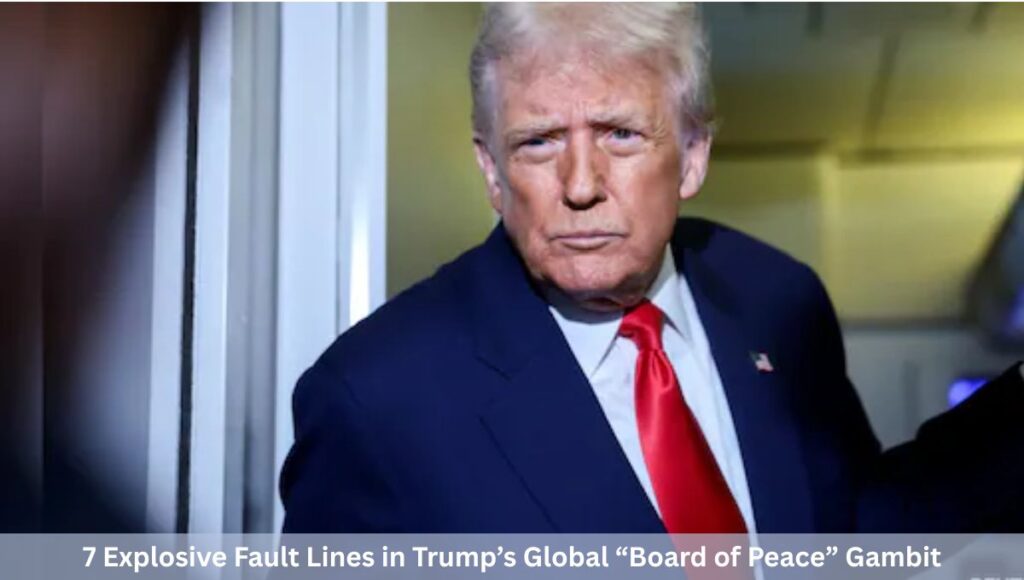
7 Explosive Fault Lines in Trump’s Global “Board of Peace” Gambit
A Public Diplomatic Rupture
The immediate trigger was Trump’s assertion at Davos that “Canada lives because of the United States,” a remark that drew swift rebuke from Prime Minister Carney.
Speaking in Quebec City ahead of the opening of a new legislative session, Carney struck a defiant tone.
“Canada doesn’t live because of the United States. Canada thrives because we are Canadian,” he said, while still acknowledging the “remarkable partnership” between the two nations.
The response resonated domestically and internationally, particularly as Carney framed his remarks within a broader critique of what he described as a “rupture” in the U.S.-led, rules-based global order.
Trump’s retaliation came swiftly and publicly. On his Truth Social platform, the U.S. president announced that Canada’s invitation to join the Board of Peace was being withdrawn.
“Please let this Letter serve to represent that the Board of Peace is withdrawing its invitation to you regarding Canada’s joining,” Trump wrote, directly addressing Carney.
A Canadian government source later confirmed that Ottawa would not pay the reported $1 billion required for permanent membership, even though Carney had earlier indicated openness to joining under different circumstances.
What Is Trump’s ‘Board of Peace’?
The Board of Peace was formally unveiled by Trump at Davos as part of the second phase of his 20-point plan to end the Gaza conflict.
Initially framed as a mechanism to oversee Gaza’s reconstruction following the Israel–Hamas war, the board’s mandate has since expanded dramatically.
According to its charter, the Board of Peace aims to:
- Promote global stability
- Resolve international conflicts
- Oversee post-conflict reconstruction
- Mobilize large-scale funding
- Support governance capacity-building
Trump has described it as a “bold new approach to resolving global conflict” and, at times, as potentially “the most impressive and consequential board ever assembled.”
Permanent membership reportedly comes with a price tag of $1 billion per country, a condition that has fueled criticism and skepticism.
Canada’s Pushback and Domestic Messaging
Carney’s criticism of Trump was not limited to a single remark. In his Quebec City address, the prime minister warned that traditional alliances were under strain.
“The world is more divided. Former alliances are being redefined and, in some cases, broken,” he said.
He positioned Canada as a potential model in an era of democratic decline, emphasizing sovereignty, border security, and increased defense spending.
“Canada can’t solve all the world’s problems, but we can show that another way is possible,” Carney said.
While rhetorically assertive, Carney faces significant constraints. Canada remains heavily dependent on the U.S. market, with more than three-quarters of its exports destined for the United States.
Key sectors—automobiles, aluminum, and steel—have already been hit by Trump’s sectoral tariffs, though existing North American trade agreements have so far softened the blow.
Negotiations to revise that trade deal are expected to begin this year, adding further complexity to an already strained bilateral relationship.
Trump’s Broader Pressure on Canada
The Board of Peace dispute is only one element of a broader pattern of pressure from Washington.
Trump has repeatedly claimed that the U.S. does not need Canadian products, a stance that, if acted upon, would have sweeping economic consequences for Canada.
He has also made provocative remarks about annexing Canada and recently shared an image depicting Canada, Greenland, and Venezuela covered by the American flag.
These statements, though often dismissed as rhetorical or performative, have heightened anxiety in Ottawa and reinforced Carney’s warnings about a shifting global landscape.
India’s Calculated Absence
Canada is not alone in stepping back from Trump’s initiative. India, despite receiving an invitation, has so far chosen not to join the Board of Peace.
New Delhi’s absence from the Davos signing ceremony was particularly notable given the presence of Pakistan—India’s rival and a frequent source of bilateral tension.
Why India Is Hesitating
According to officials familiar with the matter, India is:
- Monitoring the positions of key partners such as France and Russia
- Concerned about Trump remaining chairman indefinitely
- Wary of the board undermining the United Nations
- Uncomfortable with Pakistan’s prominent participation
India has also rejected Trump’s repeated claims that he personally helped avert a war between India and Pakistan in May 2025, following India’s Operation Sindoor strikes against terrorist infrastructure.
New Delhi maintains that the escalation ended after direct military-to-military communication, not U.S. intervention.
Optics at Davos: Pakistan Joins, India Stays Away
The Davos launch was carefully choreographed. Leaders signed the charter in pairs, seated alongside Trump. Pakistan Prime Minister Shehbaz Sharif’s presence—seated to Trump’s right—stood in stark contrast to India’s absence.
The optics were widely seen as unfavorable in New Delhi, particularly given India’s long-standing concerns over Pakistan’s role in cross-border terrorism.
Political risk analyst Ian Bremmer later described India as being in a strong position to engage a second Trump presidency selectively.
“India is a partner and friend, not an ally,” Bremmer said, suggesting this gives New Delhi greater flexibility to push back without jeopardizing core interests.
Who Has Joined the Board of Peace?
As of the Davos signing, fewer than 20 countries had formally participated, despite invitations being sent to around 60 nations.
Countries Represented at the Signing
Among those who signed or were represented:
- Argentina
- Armenia
- Azerbaijan
- Bulgaria
- Hungary
- Indonesia
- Kazakhstan
- Kosovo
- Pakistan
- Paraguay
- Uzbekistan
Senior officials from Bahrain, Jordan, Morocco, Qatar, Saudi Arabia, Turkey, the UAE, and Mongolia also attended.
Who Stayed Away—and Why It Matters
Notably absent were:
- Canada
- India
- France
- Germany
- United Kingdom
- Italy (non-committal)
- Spain
- Belgium
- Sweden
- Norway
- Slovenia
France and Germany reportedly declined outright, while the UK said it would not sign “at present,” citing concerns over Russian President Vladimir Putin’s invitation to join.
The lack of participation from G7 nations—apart from the United States—has raised serious questions about the board’s credibility.
Russia, Frozen Assets, and a $1 Billion Offer
Russia’s role has added another layer of controversy. President Vladimir Putin has offered to contribute $1 billion from Russian sovereign assets frozen in the United States to the Board of Peace, particularly for Gaza and potentially Ukraine.
However, the proposal faces major legal hurdles, as Moscow still considers the asset freeze illegal and any transfer would require U.S. approval.
Putin has said he is “studying” Trump’s invitation, while Kremlin officials stress that details remain unclear.
The Executive Board: Power Concentrated
To operationalize the initiative, the White House has announced a founding Executive Board that includes:
- Marco Rubio, U.S. Secretary of State
- Steve Witkoff, U.S. Special Envoy
- Jared Kushner, Trump’s son-in-law
- Tony Blair, former UK prime minister
- Ajay Banga, World Bank president
- Marc Rowan, CEO of Apollo Global Management
Critics argue this structure centralizes power excessively around Washington and Trump personally.
Concerns Over the United Nations
Perhaps the most persistent criticism of the Board of Peace is that it risks diluting the role of the United Nations.
Although Trump has said the board would work “in conjunction” with the UN, he has also dismissed the world body as ineffective and taken credit for resolving conflicts without its involvement.
Diplomats in Europe and Asia worry that the board could function as a parallel system of global governance—one driven by U.S. leverage, funding, and political loyalty rather than multilateral consensus.
A Board with Global Ambitions—and Limited Buy-In
Despite Trump’s confident rhetoric, the Davos event revealed significant limits to the board’s appeal. Attendance was modest, applause muted, and skepticism widespread.
As one European official put it privately, there is concern the board could become “a gallery of rogues,” particularly if leaders accused of authoritarianism or aggression are welcomed while democratic allies stay away.
What Comes Next
In the coming weeks:
- The first Board of Peace conference is expected in Washington
- Several countries, including India and Italy, will continue evaluating participation
- Trade and security negotiations between the U.S. and Canada will proceed under heightened strain
- The UN will assess how, or whether, to engage with the board
For now, the withdrawal of Canada’s invitation stands as the clearest signal yet that Trump’s Board of Peace—while ambitious in scope—faces deep skepticism among allies whose participation it needs most.
Conclusion: A Peace Initiative at a Crossroads
Trump’s Board of Peace has emerged as both a symbol and a stress test of a changing global order.
The public clash with Canada, India’s cautious distance, Europe’s reluctance, and the inclusion of divisive actors all underscore the central dilemma facing the initiative:
whether it can achieve legitimacy without broad-based trust.
As Prime Minister Mark Carney warned, alliances are being redefined—and in some cases, broken. Whether the Board of Peace becomes a cornerstone of a new diplomatic architecture or a footnote in an era of disruption will depend less on presidential declarations and more on whether the world is willing to follow.
For now, many are watching—but few are signing.
Also Read: 7 Explosive Facts About Trump’s $1 Billion Gaza Peace Board
Also Read: NATO’s Arctic bluff: How Greenland exposed Western hypocrisy
Related Posts:
- 5 Key Takeaways from Trump–Carney Meet: Trade,…
- 9 Explosive Stakes Behind Trump’s 100% Tariff Threat…
- 7 Shocking Reasons FIFA’s Peace Prize for Trump…

- Trump’s 2025 Gaza Peace Plan Signing and Historic…

- 5 Powerful Highlights as Trump Lands Second Nobel…

- 7 Explosive Moments in the Trump–Macron Davos Showdown