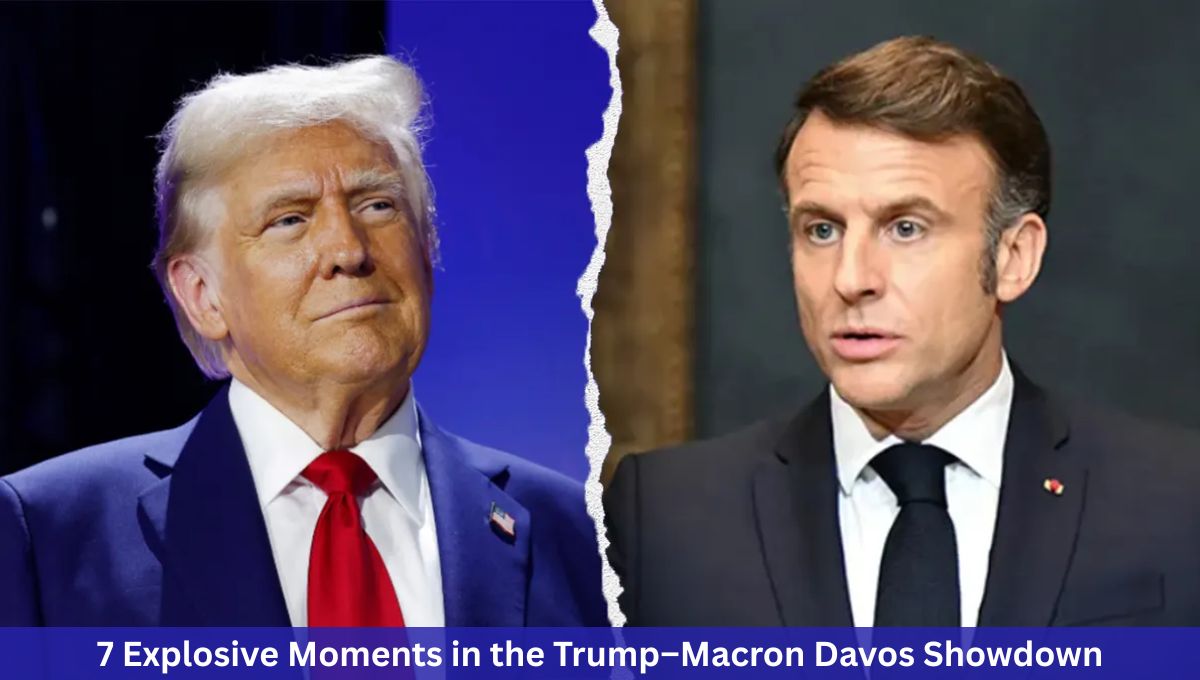
7 Explosive Moments in the Trump–Macron Davos Showdown that exposed deep fractures in transatlantic relations. US President Donald Trump has firmly rejected a proposal by French President Emmanuel Macron to convene an emergency G7-format meeting in Paris, dealing a fresh blow to already strained US–European relations.
The proposal, floated privately by Macron and later made public after Trump shared screenshots of their text exchange on Truth Social, was intended to gather leaders to discuss the Ukraine war, Greenland, and broader geopolitical instability.
Asked directly at a White House briefing whether he would consider attending such a meeting, Trump responded bluntly:
“No, I wouldn’t do that.”
The remark underscored his growing impatience with European leaders and his unwillingness to engage in what he views as symbolic multilateral diplomacy. Macron later clarified that no such meeting would take place this week, but the damage was already done.
Trump’s refusal — and his decision to publish private diplomatic messages — intensified a diplomatic row that has been simmering for months.
7 Explosive Moments in the Trump–Macron Davos Showdown
The Private Texts That Went Public
The latest escalation began when Trump posted what he described as a private message from Macron on his Truth Social platform.
The text, later confirmed as authentic by a source close to the French president, revealed a markedly different tone from Macron’s public rhetoric.
Beginning with “My friend,” Macron told Trump that the two leaders were “totally in line on Syria” and could “do great things on Iran.”
He then pivoted to the issue at the heart of the dispute: “I do not understand what you are doing on Greenland.”
Macron proposed two ideas: a G7-format meeting in Paris after Davos and a private dinner with Trump before the US president returned home.
The message also suggested inviting Ukraine, Denmark, Syria, and even Russia to participate on the margins.
By making the exchange public, Trump shattered long-standing diplomatic norms. Private leader-to-leader communications are typically guarded to allow frank discussion without political fallout.
Trump’s decision to publish them sent shockwaves through European capitals and raised questions about trust in US diplomacy.
Greenland: The Arctic Flashpoint
At the center of the Trump–Macron clash lies Greenland, the semi-autonomous Danish territory that Trump has repeatedly said the United States must “acquire” for national security reasons.
The president has argued that Denmark cannot adequately protect Greenland from future threats posed by Russia and China.
European leaders, led by France and Denmark, have categorically rejected the idea. Macron has framed Trump’s ambitions as a direct challenge to territorial sovereignty and international law — principles he insists Europe cannot compromise.
France has gone beyond rhetoric. Paris recently sent troops to Greenland as part of Operation Arctic Endurance, joining forces from Germany and Norway in a show of solidarity with Denmark.
Macron has stressed that the deployment is defensive and symbolic, but Washington has viewed it as a provocation.
Trump, for his part, has dismissed European objections as weakness. In a fiery response to Norway’s prime minister, which he also made public, Trump argued that historical claims to Greenland were flimsy and that US control was essential for global security.
Davos and a ‘World Without Rules’
As tensions escalated, Macron took to the stage at the World Economic Forum in Davos with a stark warning: the world, he said, is drifting toward a system without rules.
“We are witnessing a shift toward a world without international law,” Macron told global leaders. “A world where the only law that seems to matter is that of the strongest.”
Without naming Trump directly, Macron criticized what he described as the return of “imperial ambitions” and the erosion of collective governance.
His remarks were widely interpreted as a rebuke of US policies — from Greenland to tariffs — that he believes undermine the post-war international order.
Wearing aviator sunglasses to protect a bloodshot eye, Macron struck an unusually combative tone. “We do prefer respect to bullies,” he said. “And we do prefer rule of law to brutality.”
Tariffs, Trade, and the ‘Bullying’ Accusation
Trade has become another major flashpoint in the Trump–Macron relationship. Trump has threatened to impose 200% tariffs on French wine and champagne, as well as escalating duties on several European countries, unless they acquiesce to US demands on Greenland.
Macron has condemned the threats as economic blackmail. Speaking in Davos, he described Washington’s actions as an “endless accumulation of new tariffs” that are “fundamentally unacceptable — especially when used as leverage against territorial sovereignty.”
The French president has urged the dismantling of tariffs altogether, arguing that economic fragmentation only weakens the West in an increasingly competitive global environment.
He has also floated the possibility of deploying the European Union’s Anti-Coercion Instrument — dubbed the “trade bazooka” — which could restrict US companies’ access to EU markets.
Calling the situation “crazy,” Macron warned that Europe was being pushed toward a trade war it does not want but may not be able to avoid.
Ukraine, Russia, and a Risky Proposal
Macron’s private proposal to include Russia in a Paris meeting raised eyebrows across Europe. Publicly, France has remained one of Ukraine’s strongest backers, supplying military aid and diplomatic support since Russia’s invasion.
Privately, however, Macron appeared willing to explore unconventional formats to break the stalemate. In his message to Trump, he suggested hosting Russian representatives “in the margins” — a formulation that hinted at the sensitivity of engaging Moscow while standing with Kyiv.
Trump has seized on Europe’s internal contradictions, portraying himself as the only leader capable of forcing an end to the war.
He has repeatedly claimed credit for de-escalating conflicts and has expressed frustration with what he sees as Europe’s reliance on US leadership without sufficient burden-sharing.
The proposed Paris meeting, had it gone ahead, would have tested whether any common ground remained between Washington and its European allies on Ukraine.
NATO Strains and Mixed Messages
The diplomatic drama deepened when Trump also published flattering messages from NATO Secretary General Mark Rutte, who praised the president’s actions in Syria, Gaza, and Ukraine and expressed commitment to “finding a way forward on Greenland.”
The contrast between Rutte’s private praise and NATO’s public silence on Greenland highlighted the alliance’s discomfort.
While Denmark has warned that any US attempt to seize Greenland could threaten NATO unity, alliance leaders have been reluctant to confront Trump directly.
Macron has been more outspoken, arguing that NATO cannot survive if its members disregard each other’s sovereignty.
His stance has won him both praise and criticism within Europe, where some leaders fear provoking Washington further.
The Board of Peace and a Wider Rift
Another source of friction is Trump’s proposed “Board of Peace,” an international body he would chair to oversee ceasefires, beginning with Gaza.
France declined to join, citing concerns that the initiative undermines the United Nations and concentrates too much power in the hands of the US president.
Trump reacted angrily, dismissing Macron as politically irrelevant and threatening tariffs in retaliation.
French officials responded by mocking the logic of US justifications for Greenland, using biting analogies that went viral on social media.
The episode underscored a deeper philosophical divide:
Trump’s preference for ad hoc, US-led mechanisms versus Macron’s defense of multilateral institutions.
No Trump–Macron Meeting in Davos
Despite speculation, Macron confirmed he would not extend his stay in Davos to meet Trump, who is scheduled to address the forum a day later. “I don’t have to change my schedule,” Macron said, signaling that he saw little value in a last-minute encounter.
Trump, meanwhile, has indicated that his Davos speech will focus on what he calls the “tremendous success” of his administration, particularly on energy and immigration. European leaders are bracing for further sharp remarks.
A Relationship at Breaking Point
The Trump–Macron relationship has oscillated between cordiality and confrontation since Trump’s first term. Macron has often tried personal diplomacy — phone calls, informal texts, even public gestures — to manage Trump’s unpredictability.
This time, however, the strategy appears to have backfired. By exposing private messages, Trump has made clear that no communication is off-limits, forcing European leaders to reconsider how they engage with Washington.
People close to Macron say France has become a target precisely because it is leading resistance to Trump’s most controversial policies. “By leading the resistance, France becomes a target,” one lawmaker said.
What Comes Next for Transatlantic Relations?
With EU leaders planning emergency talks in Brussels and US tariffs looming, the transatlantic relationship is entering one of its most volatile phases in decades.
The disputes over Greenland, Ukraine, trade, and global governance are no longer isolated issues — they are interconnected tests of whether the West can maintain unity in a rapidly changing world.
Trump’s rejection of Macron’s Paris proposal may have closed one diplomatic door, but it has opened a broader debate about leadership, sovereignty, and the future of international cooperation.
As Macron warned in Davos, the world may indeed be shifting toward a “world without rules.” Whether that shift becomes permanent will depend on how — and whether — Washington and its allies find a way back to common ground.
Also Read: 7 Explosive Claims: Trump Links Greenland Push to Nobel Snub
Also Read: European leader brands Trump ‘a very hungry caterpillar’ ahead of Davos showdown
Related Posts:
- 7 Explosive Reasons Denmark Warned Trump to Stop…

- 7 Explosive Moments as Trump’s Davos Flight Turns…

- 9 Shocking Signals Behind Trump’s Explosive Greenland Gambit

- 9 Explosive Developments as Trump Taps Greenland Envoy

- 11 Explosive Signals Behind Trump’s High-Stakes…

- 9 Stark Signals as US Deploys Aircraft to Greenland Base