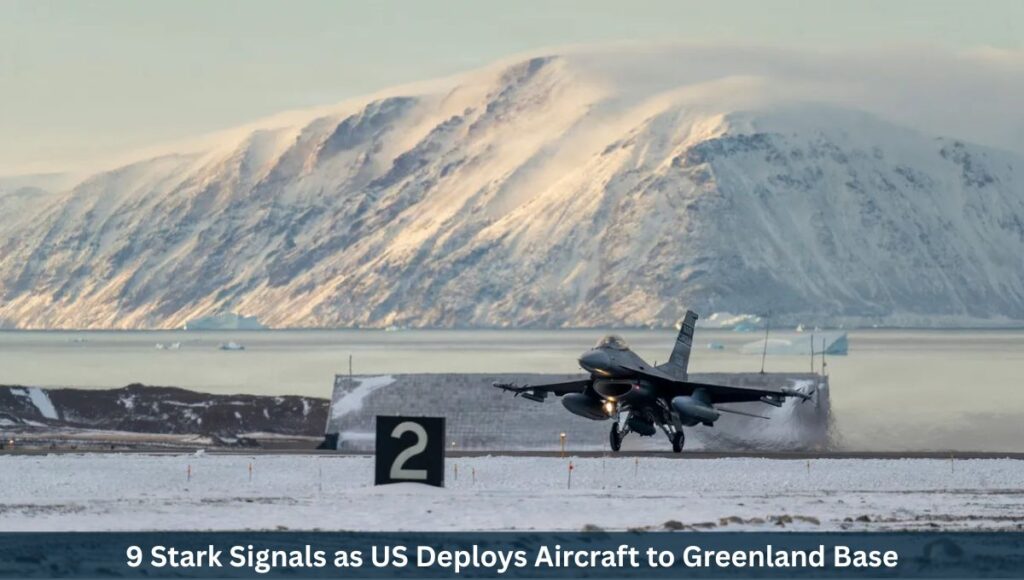
9 Stark Signals as US Deploys Aircraft to Greenland Base, escalating NATO and Arctic tensions.The United States is preparing to deploy military aircraft to Greenland’s strategically vital Pituffik Space Base, a move announced by the North American Aerospace Defense Command (NORAD) and framed as part of long‑planned regional defence operations.
Thank you for reading this post, don't forget to subscribe!While US officials stress that the deployment is routine and coordinated with allies, the timing has drawn intense scrutiny as President Donald Trump escalates his push to acquire the Arctic island from Denmark.
NORAD said aircraft would “soon arrive” at the base, formerly known as Thule Air Force Base, to support sustained and dispersed aerospace defence missions across North America. The command emphasised that Denmark and Greenland’s autonomous government were informed in advance and that all forces are operating with full diplomatic clearances.
Yet the deployment comes against the backdrop of Trump’s extraordinary threat to impose sweeping tariffs on European allies unless Washington is allowed to purchase Greenland — a demand that has sparked outrage across Europe and raised fears of a deeper rift within NATO.
9 Stark Signals as US Deploys Aircraft to Greenland Base
Why Greenland Matters to US National Security
Greenland occupies a unique and increasingly critical position in global security. Located between North America and Europe and extending deep into the Arctic, the vast, sparsely populated island sits astride key air and maritime routes.
As climate change accelerates the melting of Arctic ice, previously inaccessible sea lanes are opening, intensifying competition among major powers.
The United States, Russia, and China have all increased their strategic focus on the region, viewing the Arctic as central to future military, economic, and technological influence.
For Washington, Greenland represents:
- A forward line of missile and aerospace defence
- A critical hub for early warning systems
- A platform for monitoring Russian and Chinese activity in the Arctic and North Atlantic
These strategic considerations underpin the long‑standing US military presence on the island and explain why Greenland has returned to the centre of American geopolitical thinking under Trump.
Pituffik Space Base: America’s Arctic Sentinel
Pituffik Space Base, located in northwestern Greenland around 750 miles north of the Arctic Circle, is one of the most important US military installations in the world.
Renamed from Thule Air Force Base, Pituffik hosts roughly 150 US Air Force and Space Force personnel. Its core mission includes missile warning, space surveillance, and domain awareness across the Arctic and North Atlantic.
Key capabilities at Pituffik include:
Missile Warning and Tracking
The base operates advanced phased‑array radar systems run by the 12th Space Warning Squadron. These radars can detect ballistic missile launches within seconds, providing early warning to US and allied defence networks.
Space Surveillance
Units such as the 22nd Space Operations Squadron Detachment 7 track satellites and space debris, supporting US Space Force efforts to protect orbital assets and maintain situational awareness.
Strategic Geography
Pituffik’s location makes it the northernmost deep‑water port capable of supporting large military vessels, giving the US unmatched reach into the High Arctic.
NORAD said the incoming aircraft will integrate with operations from bases in the continental United States and Canada, reinforcing a tri‑national defence architecture linking Washington, Ottawa, and Copenhagen.
NORAD’s Message: Routine Operation or Strategic Signal?
In its statement, NORAD insisted the aircraft deployment reflects “long‑planned” activities and builds on “enduring defence cooperation” among the US, Canada, and Denmark.
“NORAD routinely conducts sustained, dispersed operations in the defence of North America,” the command said, noting that missions can involve one or more of its three regions — Alaska, Canada, and the continental United States.
Despite this reassurance, analysts note that military signalling is often as much about timing as intent. With Trump intensifying rhetoric around Greenland, the arrival of US aircraft — however routine — inevitably takes on political significance.
Trump’s Push to Acquire Greenland
President Trump has repeatedly argued that Greenland is essential to US national security, citing growing interest in the Arctic from Russia and China.
In recent weeks, Trump has gone further than any previous US leader, openly pressing Denmark to sell the semi‑autonomous territory. When Danish and Greenlandic leaders rejected the idea, Trump escalated the pressure dramatically.
Tariff Threats Against Europe
Trump has warned that the United States will impose tariffs starting at 10 percent from February 1, 2026, rising to 25 percent by June, on countries including:
- Denmark
- Norway
- Sweden
- France
- Germany
- The United Kingdom
- The Netherlands
- Finland
The tariffs, Trump said, would remain in place “until a deal is reached” allowing the US to acquire Greenland.
In one post, Trump claimed it was “time for Denmark to give back” after decades of US security support, language that stunned European capitals.
Europe Pushes Back: ‘Greenland Is Not for Sale’
European leaders have responded with rare unity and unusually blunt language.
Roberta Metsola, President of the European Parliament, said Greenland “is not for sale,” stressing that Europe stands firmly behind Denmark and the people of Greenland.
“Greenland’s sovereignty and territorial integrity need to be respected. That fact will not change,” Metsola said, while signalling the EU’s willingness to keep diplomatic channels open.
France and Germany have called for a coordinated European response to Trump’s tariff threats, warning that retaliatory measures could follow if Washington proceeds.
Denmark Strengthens Its Military Presence
As diplomatic tensions rise, Denmark has quietly but decisively increased its military footprint in Greenland.
According to Danish authorities and media reports, Copenhagen has:
- Deployed additional troops and military equipment
- Sent senior army leadership to Nuuk and Kangerlussuaq
- Conducted a multinational military exercise on the island
Germany, Sweden, France, Norway, the Netherlands, and Finland have all contributed small contingents to recent exercises, underlining European concern over Arctic security.
Denmark has also emphasised that while it welcomes strong defence cooperation with the US, Greenland’s sovereignty is not negotiable.
Denmark Proposes NATO Surveillance Operations
In a bid to anchor Greenland firmly within existing multilateral frameworks, Denmark has proposed that NATO launch dedicated surveillance operations in the territory.
Defence Minister Troels Lund Poulsen said discussions with NATO Secretary‑General Mark Rutte focused on strengthening alliance attention on the Arctic and far north.
“We underlined the importance of NATO also having a greater focus on security in the far north and the Arctic in general,” Poulsen said.
While details are still being worked out, Danish officials say talks have advanced far enough for a practical framework to begin taking shape, with Greenland’s authorities involved.
NATO’s Delicate Balancing Act
NATO now finds itself navigating one of its most sensitive internal challenges in decades.
On one hand, the alliance recognises Greenland’s immense strategic value and supports enhanced Arctic vigilance.
On the other, Trump’s rhetoric and tariff threats risk destabilising alliance cohesion at a time when NATO is already strained by Russia’s war in Ukraine.
NATO officials have emphasised:
- The importance of alliance unity
- Respect for member sovereignty
- Continued dialogue to prevent escalation
Finnish President Alexander Stubb has publicly dismissed fears that the US would use force to seize Greenland, but concerns linger privately among European diplomats.
Could the US Use Force?
Trump has declined to rule out the use of force to acquire Greenland, responding “no comment” when pressed in interviews.
Earlier remarks in which he suggested the US could no longer think “purely of peace” after being snubbed for a Nobel Prize have further unsettled allies.
While most analysts consider a military takeover highly unlikely, the combination of economic pressure, military deployments, and rhetorical escalation has created an atmosphere of unease not seen in transatlantic relations for years.
The Russia and China Factor
Trump has repeatedly justified his Greenland stance by pointing to Russia and China’s expanding Arctic ambitions.
Russia has reopened Cold War‑era bases and increased Arctic patrols, while China has declared itself a “near‑Arctic state” and invested heavily in polar research and infrastructure.
US defence planners argue that maintaining uncontested access to Greenland is essential to countering these moves, particularly as new shipping routes and undersea resources become viable.
Greenland’s Own Voice
Amid the geopolitical tug‑of‑war, Greenland’s leaders have consistently stated that the island’s future must be decided by its people.
The self‑governing territory, home to around 56,000 people, has steadily expanded its autonomy from Denmark and has no appetite for becoming a bargaining chip between great powers.
Greenlandic officials have welcomed security cooperation but rejected any discussion of sovereignty transfer.
What Comes Next for Arctic Security
The arrival of US military aircraft at Pituffik Space Base underscores how rapidly the Arctic is emerging as a central theatre of global competition.
In the short term, officials insist the deployment will proceed as planned, focused on routine defence missions. In the longer term, however, Trump’s Greenland push has injected unprecedented political volatility into Arctic security.
For NATO, Europe, and the United States, the challenge will be balancing legitimate security concerns with respect for sovereignty and alliance cohesion.
As ice melts, tensions rise, and strategic interests converge, Greenland is no longer a remote outpost on the world map — it is fast becoming a defining test of 21st‑century geopolitics.
Also Read: 13 Stunning Signs Europe Is Defying Trump Over Greenland