

7 Explosive Signals Behind Denmark’s “Shoot First” Greenland Order amid Trump’s renewed threats.
Denmark has quietly reaffirmed one of the most extraordinary military directives in modern Europe:
a “shoot first, ask questions later” order instructing troops in Greenland to open fire immediately on any invading foreign force—without waiting for political authorization or confirmation of war.
The revelation, reported by Danish newspaper Berlingske, comes amid renewed and increasingly explicit threats by U.S. President Donald Trump to take control of Greenland, an autonomous territory under Danish sovereignty.
While the order itself dates back to 1952, its reassertion today underscores the gravity of the crisis now confronting NATO, Europe, and the transatlantic alliance.
For the first time in its history, NATO faces the real prospect of conflict triggered not by an external adversary, but by one of its own most powerful members.
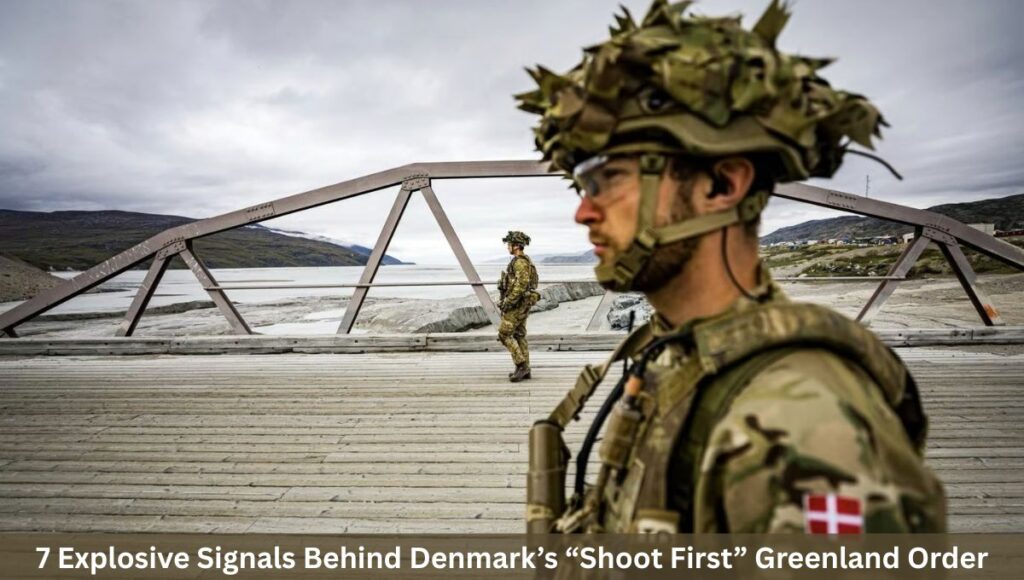
7 Explosive Signals Behind Denmark’s “Shoot First” Greenland Order
A Cold War Rule Reawakened
What Is the ‘Shoot First’ Order?
The directive originates from a 1952 Danish military rule of engagement, formulated during the early Cold War.
It mandates that Danish soldiers must:
- Immediately engage any foreign military force attempting to seize Danish territory
- Act without waiting for orders, even if political leaders or commanders are unaware that a state of war exists
- Assume hostile intent until proven otherwise
The language is unequivocal. Soldiers are instructed to “immediately take up the fight” against invaders, even in the absence of formal declarations of war.
According to Denmark’s defence ministry, the rule “remains in force” and applies fully to Greenland.
Why This Rule Exists
The order is rooted in Denmark’s traumatic experience during Nazi Germany’s invasion in April 1940. At the time, Danish forces were unprepared and restrained by political hesitation.
German troops captured Copenhagen and other major cities within hours.
The post-war lesson was stark:
hesitation equals defeat.
The 1952 rule was designed to ensure that Danish forces would never again wait for politicians while territory was lost.
Why Greenland Is at the Center of a Global Storm
Greenland’s Strategic Importance
Greenland is not just the world’s largest island—it is one of the most strategically valuable pieces of territory on Earth.
Key factors include:
- Geographic position between North America and Europe
- Proximity to Russian Arctic bases and Chinese shipping routes
- Hosting the U.S. Pituffik Space Base, vital for missile warning and space surveillance
- Vast untapped mineral resources, including rare earths critical for advanced weapons systems
Control of Greenland offers dominance over the Arctic’s future military and economic landscape.
Trump’s Renewed Push for Greenland
Donald Trump’s obsession with Greenland is not new. During his first term, he openly floated the idea of purchasing the island. Denmark’s firm rejection temporarily shelved the issue.
Now, Trump is back—and more aggressive.
Trump’s Core Argument
Trump has repeatedly stated that:
- Greenland is essential to U.S. national security
- Denmark is incapable of adequately securing the island
- Russian and Chinese activity in the Arctic demands American control
“We need Greenland from a national security standpoint,” Trump said recently. “It’s very strategic right now.”
When asked whether preserving NATO mattered more than acquiring Greenland, Trump told The New York Times: “It may be a choice.”
Military Force ‘Not Off the Table’
White House Press Secretary Karoline Leavitt confirmed that:
- The administration is discussing “a range of options”
- Military force remains an option available to the president
Vice President JD Vance went further, stating that Denmark had “obviously” failed to secure Greenland and that Trump was willing to “go as far as he has to.”
While Secretary of State Marco Rubio has attempted to soften the rhetoric—emphasizing diplomacy and purchase—the message from the White House is unmistakable: the threat is real.
Denmark’s Response: Deterrence Through Resolve
Why Denmark Reaffirmed the Order Now
By publicly confirming the 1952 directive, Denmark is sending a calculated message:
- Greenland is not undefended
- Any forcible takeover would be met with immediate resistance
- Even U.S. troops would not receive special treatment
The reaffirmation also strengthens Denmark’s legal position. Under international law, armed resistance to invasion—even by an ally—is lawful self-defense.
Military Reinforcement of Greenland
Denmark has announced 88 billion Danish kroner ($13.8 billion) in new defense spending focused on Greenland, including:
- New Arctic naval vessels
- Long-range surveillance drones
- Expanded satellite monitoring
- Enhanced sovereignty patrols
Elite units such as the Sirius Dog Sled Patrol remain active across Greenland’s vast and inhospitable terrain.
Greenland’s Position: ‘Not for Sale’
Greenland’s leaders have responded with rare unity and clarity.
Prime Minister Jens-Frederik Nielsen condemned Trump’s rhetoric as:
- Disrespectful
- Colonial in tone
- Dismissive of Greenlandic self-determination
Greenland’s government has reiterated its core principle:
“Nothing about Greenland, without Greenland.”
Polls show that while many Greenlanders favor eventual independence from Denmark, they overwhelmingly oppose becoming part of the United States.
NATO’s Existential Crisis
Can NATO Survive This?
NATO’s founding principle—Article 5, collective defense—assumes that threats come from outside the alliance. Trump’s threats shatter that assumption.
Danish Prime Minister Mette Frederiksen warned bluntly:
“If the U.S. attacks another NATO country militarily, everything stops—including NATO.”
Analysts widely agree:
a U.S. invasion of Greenland would effectively end NATO.
Would NATO Fight the United States?
The uncomfortable answer is likely no.
Military analysts note:
- The U.S. vastly outmatches any European force
- European commanders would be reluctant to fire on U.S. troops
- An inter-NATO war would benefit Russia and China immediately
As one expert put it: “No European general wants to start World War III over Greenland.”
Europe’s Strategic Dilemma
Europe faces an impossible balancing act:
- It needs U.S. support to deter Russia
- It must defend international law and sovereignty
- It lacks immediate military leverage over Washington
This explains the cautious responses from leaders in Paris, Berlin, and London—many of whom fear antagonizing Trump could jeopardize Ukraine’s defense.
Economic and Political Leverage: Europe’s Only Tools
While military resistance is unlikely, Europe does have non-military options:
- Trade tariffs and sanctions
- Limiting U.S. access to European bases
- Restricting defense technology sharing
- Diplomatic isolation
However, each option carries significant risks.
The Venezuela Precedent: A Chilling Warning
Trump’s recent authorization of a direct U.S. operation to capture Venezuelan leader Nicolás Maduro has heightened fears in Europe.
The operation demonstrated:
- Willingness to bypass international norms
- Confidence in rapid, decisive military action
- Disregard for diplomatic fallout
European officials fear Greenland could be next.
Buying Greenland? Payments and Pressure
Reuters has reported that Trump administration officials have discussed:
- Direct cash payments to Greenlanders
- Figures ranging from $10,000 to $100,000 per person
- Potential inducements for independence or free association with the U.S.
While legally dubious, the proposal highlights the administration’s transactional approach to sovereignty.
International Law and the Arctic Order
A forcible takeover of Greenland would violate:
- The UN Charter
- Principles of self-determination
- NATO’s founding treaties
It would also accelerate the collapse of the rules-based international order—something Russia and China would eagerly exploit.
Why Russia and China Are Watching Closely
Both Moscow and Beijing stand to gain from NATO’s fracture:
- Russia would face a weakened European security architecture
- China could normalize territorial expansion arguments
- Arctic governance would descend into power politics
As one former Danish prime minister warned:
“This would be a fantastic day for Putin and Xi.”
Is War Likely? Or Is This Coercive Diplomacy?
Many European leaders hope Trump’s rhetoric is a negotiating tactic—designed to extract concessions such as:
- Expanded U.S. military presence
- Greater Danish defense spending
- Preferential access to minerals
If so, diplomacy could still prevail. But the reaffirmation of Denmark’s “shoot first” order suggests Copenhagen is preparing for the worst, not the best.
Conclusion: A Red Line in the Arctic
Denmark’s decision to publicly stand by its Cold War-era rule is not about aggression—it is about deterrence.
The message is unmistakable:
- Greenland is sovereign
- Danish troops will defend it
- No ally is exempt from international law
As the Arctic emerges as the next great theater of global competition, Greenland has become more than an island. It is now a test case for whether power or principles will shape the 21st-century world order.
Whether NATO survives this test may depend less on weapons—and more on whether restraint, respect, and diplomacy can still prevail.
Also Read: 7 Explosive Reasons Denmark Warned Trump to Stop Threatening Greenland
Also Read: Denmark Warns of Immediate Military Response as Tensions Rise Over US Interest in Greenland
Related Posts:
- 7 Explosive Reasons Denmark Warned Trump to Stop…

- 9 Defiant Signals as Greenland Crisis Enters a…

- 9 Explosive Developments as Trump Taps Greenland Envoy

- 9 Shocking Signals Behind Trump’s Explosive Greenland Gambit

- 9 Stark Signals as US Deploys Aircraft to Greenland Base
- 7 Explosive Revelations Behind Trump’s Move to…
