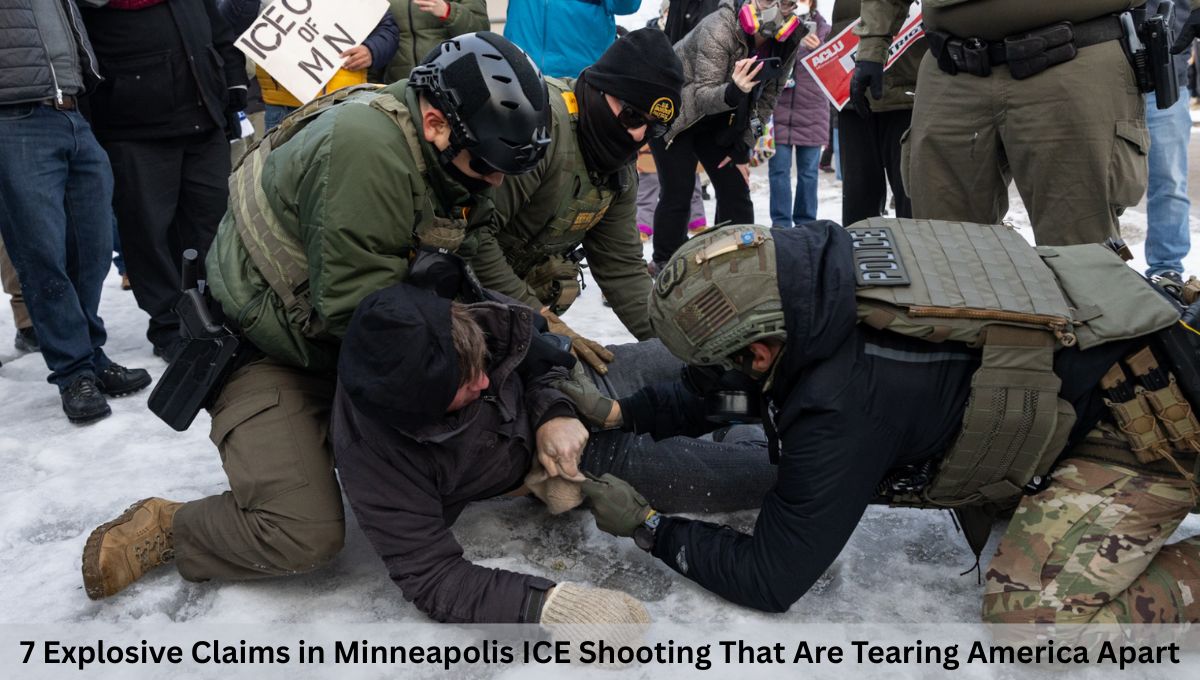
7 Explosive Claims in Minneapolis ICE Shooting That Are Tearing America Apart nationwide. The fatal shooting of Renee Nicole Good, a 37-year-old poet, mother of three, and U.S. citizen, by an Immigration and Customs Enforcement (ICE) officer in Minneapolis has become one of the most polarizing law enforcement incidents in the United States in recent years.
What began as a brief, chaotic encounter on a residential street south of downtown Minneapolis has exploded into a national firestorm—fueling mass protests, deepening distrust between state and federal authorities, and placing President Donald Trump’s immigration enforcement strategy under intense scrutiny.
At the center of the controversy is a fundamental question that remains unresolved:
Was the shooting an act of lawful self-defense—or a reckless use of deadly force?
7 Explosive Claims in Minneapolis ICE Shooting That Are Tearing America Apart
Trump’s Explosive Defense: “She Was Horrible”
Within hours of the shooting, President Donald Trump publicly defended the ICE officer involved, framing the killing as both justified and unavoidable.
Speaking to New York Times reporters in the Oval Office, Trump accused Good of deliberate violence.
“She behaved horribly,” Trump said. “And then she ran him over. She didn’t try to run him over. She ran him over.”
Trump attempted to bolster his claim by personally showing reporters video footage on a laptop brought to the Resolute Desk by aide Natalie Harp. According to Trump, the video proved the officer acted in self-defense.
While acknowledging the tragedy of a life lost, Trump emphasized the danger faced by immigration agents.
“It’s a terrible scene. I hate to see it,” he said. “But these officers are under constant threat.”
On Truth Social, Trump escalated his rhetoric, blaming what he called the “Radical Left” for creating a climate of hostility toward law enforcement and ICE agents in particular.
Who Was Renee Nicole Good?
A Poet, Mother, and Newcomer to Minneapolis
Renee Nicole Good was far from the caricature painted by federal officials in the immediate aftermath of her death.
Born in Colorado, Good was a U.S. citizen, a mother of three, an award-winning poet, and a devout Christian. She had recently moved to Minneapolis from Kansas City with her wife and youngest son.
Good described herself on social media as a “poet and writer and wife and mom,” and friends and family remembered her as compassionate, gentle, and deeply devoted to her children.
She had studied creative writing at Old Dominion University, where she won an undergraduate prize from the Academy of American Poets in 2020.
She also hosted a podcast with her second husband, who died in 2023. Her mother, Donna Ganger, described her daughter as “one of the kindest people I’ve ever known.”
The Fatal Encounter: What the Videos Show
A 20-Second Confrontation
Multiple bystander videos posted to social media—and later verified by Reuters—capture the final moments of Good’s life.
The footage shows ICE agents approaching Good’s maroon Honda Pilot, which was stopped in the middle of a residential street. Officers demand that she open the door, with one agent grabbing the door handle.
Good’s vehicle begins to move forward.
Another ICE officer—later identified through court records as Jonathan Ross—steps in front of the vehicle, draws his weapon, and fires at least three shots at close range.
The entire encounter lasts less than 20 seconds.
Critically, none of the publicly available videos conclusively show the vehicle making contact with the officer.
Conflicting Narratives: Self-Defense or Reckless Force?
Federal Officials’ Account
Homeland Security Secretary Kristi Noem has repeatedly asserted that Good “weaponized her vehicle” and attempted to kill ICE agents—an act she labeled “domestic terrorism.”
According to Noem and other administration officials, the officer feared for his life and followed his training.
Local Officials Push Back
Minneapolis Mayor Jacob Frey forcefully rejected the administration’s claims.
“That is bullshit,” Frey said after reviewing the video. “This was reckless use of force.”
Minnesota Governor Tim Walz echoed those concerns, demanding that the state be allowed to participate fully in the investigation.
FBI Takes Over the Investigation
Tensions escalated further when federal authorities removed Minnesota’s Bureau of Criminal Apprehension (BCA) from the investigation.
The FBI is now solely leading the probe into the shooting, a decision that state officials say undermines transparency and public trust.
Minnesota Attorney General Keith Ellison warned that the exclusion of state investigators could jeopardize accountability.
Who Is the ICE Officer? Jonathan Ross
Though federal officials initially refused to identify the shooter, court documents and confirmations later revealed the officer as Jonathan Ross, a veteran ICE deportation officer.
A Long Law Enforcement Career
Ross has served nearly two decades in law enforcement, including:
- Iraq War deployment (2004–2005)
- U.S. Border Patrol service beginning in 2007
- ICE deportation officer since 2015
- Firearms instructor and SWAT team member
- FBI Joint Terrorism Task Force leader
A Troubling Prior Incident
In June last year, Ross was dragged by a fleeing suspect’s vehicle during an arrest in Minnesota, suffering serious injuries that required dozens of stitches.
That incident has become central to the administration’s defense of his actions—suggesting prior trauma may have influenced his perception of threat.
Experts Question Officer Tactics
Law enforcement experts interviewed by Reuters and CNN raised serious concerns about the shooting.
Officer-Created Jeopardy
Criminologist Geoffrey Alpert questioned why the officer placed himself in front of a moving vehicle.
“That could be officer-created jeopardy,” he said.
Former police chiefs and FBI agents emphasized that many departments prohibit firing at moving vehicles unless there is no alternative.
“Don’t stand in front of a car,” said former Philadelphia Police Commissioner Charles Ramsey. “That’s option number one.”
Nationwide Protests Erupt
Minneapolis on Edge
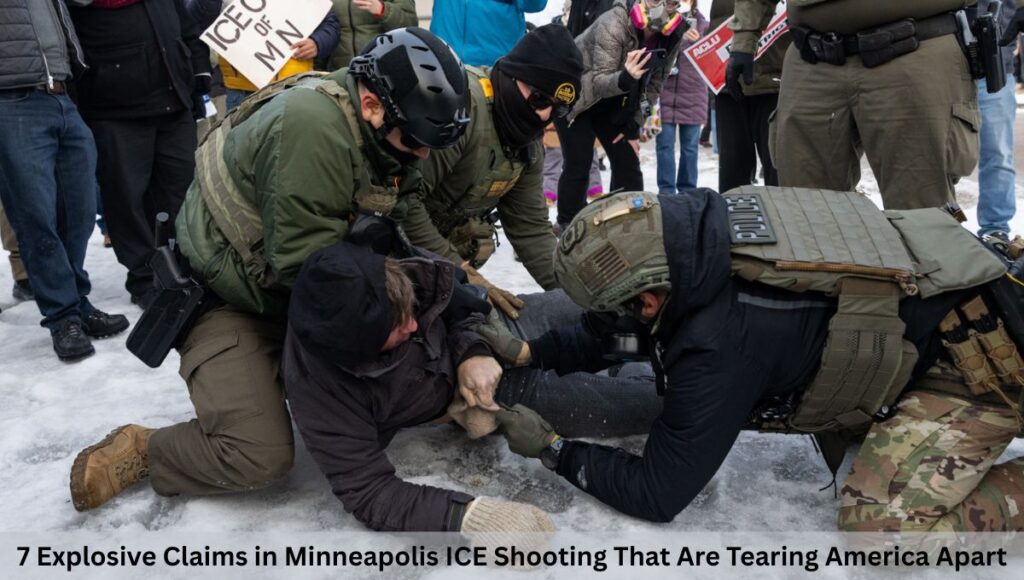
Within hours of the shooting, protests erupted across Minneapolis.
Dozens gathered outside federal buildings chanting “No More ICE” and “Justice for Renee.” Federal officers responded with pepper spray, tear gas, and arrests.
Schools canceled classes, and state officials called for calm amid growing unrest.
Protests Spread Nationwide
Demonstrations were quickly planned in:
- New York City
- Los Angeles
- Seattle
- Chicago
- Washington, D.C.
- Detroit
Signs reading “ICE = Murder” and “Justice for Renee” became common fixtures.
A Broader Immigration Crackdown
Good’s death occurred amid the Trump administration’s largest immigration enforcement operation ever, with more than 2,000 DHS officers deployed to the Minneapolis area alone.
Secretary Noem said more than 1,500 people had already been arrested. Critics argue the aggressive tactics have escalated tensions and placed civilians at risk.
Political Fallout and Media Wars
Vice President JD Vance emerged as one of the administration’s most aggressive defenders of the ICE officer, launching scathing attacks on the media.
“This was an attack on law and order,” Vance said.
He accused journalists of spreading propaganda and endangering law enforcement—claims that further inflamed public debate.
Why This Case Resonates So Deeply
Several factors have made the Minneapolis ICE shooting uniquely explosive:
1. The Victim
Good was a U.S. citizen, mother, poet, and community member—not an undocumented immigrant.
2. The Videos
Clear visual evidence contradicts key official claims, fueling distrust.
3. Federal Overreach
Excluding state investigators has raised constitutional and ethical concerns.
4. Historical Context
The shooting occurred just a mile from where George Floyd was killed in 2020.
A Family Left Behind
Good leaves behind three children—ages 15, 12, and 6.
A fundraiser for her family raised over $500,000 in less than 15 hours, underscoring the public’s emotional response.
At vigils near her home, mourners placed flowers, candles, and handwritten notes.
One neighbor said simply:
“I can’t imagine my kids coming home and their mom not being there.”
Conclusion: A Defining Test for Justice
The killing of Renee Nicole Good is no longer just a police shooting—it is a defining test of accountability, transparency, and the limits of federal power in modern America.
As investigations continue and protests grow, the nation remains divided between two irreconcilable narratives:
one of an officer defending his life, and another of a woman killed while trying to leave.
What happens next may shape public trust in law enforcement—and immigration policy—for years to come.
Also Read: 7 Explosive Shifts in Trump’s New Immigration Crackdown After DC Shooting
Also Read: What to know about the fatal shooting of a woman by an ICE officer in Minneapolis
Related Posts:
- 7 Shocking Signals as India Flags Safety Fears After…

- 5 Major Takeaways from the US Supreme Court's…

- 7 Heartbreaking Facts About Venezuela's Earthquake Disaster
- 9 Explosive Claims as Trump Says US Winning Iran War
- 7 Dead in Explosive Iran Protests as Economic Anger…

- 11 Explosive Revelations From Ted Cruz’s Leaked…