

9 Defiant Signals as Greenland Crisis Enters a Decisive Moment amid Trump’s renewed threats. Greenland has emerged as one of the most volatile geopolitical flashpoints of Donald Trump’s second presidency, with Denmark warning that the confrontation over the Arctic island has reached a “decisive moment.”
Danish Prime Minister Mette Frederiksen said the stakes now extend far beyond Greenland itself, touching the foundations of international law, NATO unity, and the principle of self-determination, after Trump once again threatened to seize the mineral-rich territory — by force if necessary.
“This is a decisive moment,” Frederiksen said, acknowledging openly that “there is a conflict over Greenland.”
Her comments came as European allies rallied behind Denmark, NATO discussions intensified, and Trump doubled down on claims that the United States would “one way or another” acquire Greenland to prevent Russia or China from gaining a foothold in the Arctic.
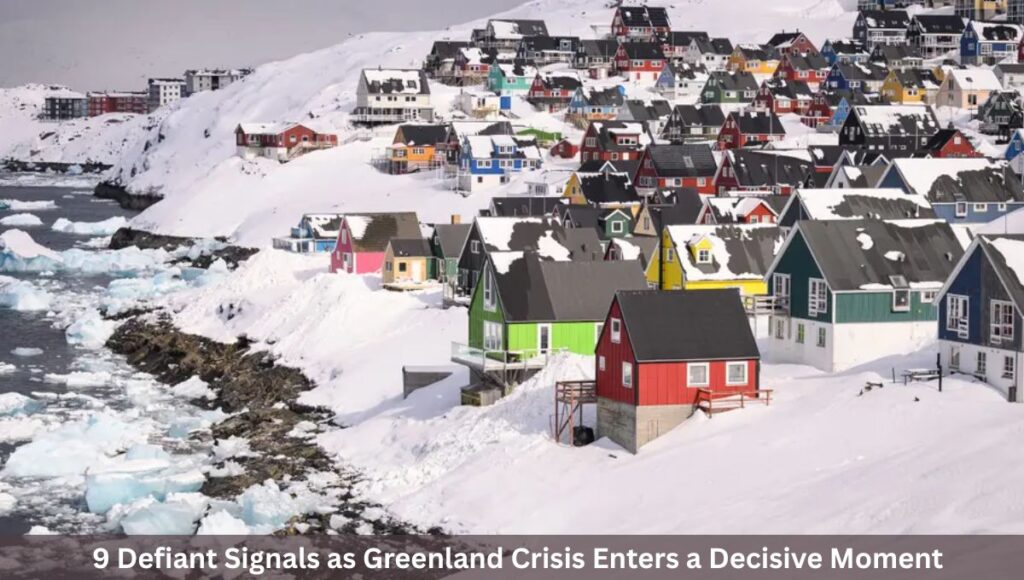
9 Defiant Signals as Greenland Crisis Enters a Decisive Moment
Frederiksen: ‘We Are Ready to Defend Our Values’
Speaking ahead of high-level meetings in Washington focused on access to critical raw materials, Frederiksen struck a defiant tone.
In a debate with other Danish political leaders, she warned that the Greenland dispute is about more than territory.
“This is not only about Greenland’s future,” she said, “but about the international order we believe in.”
In a subsequent Facebook post, Frederiksen underlined Denmark’s position:
“We are ready to defend our values – wherever it is necessary – also in the Arctic. We believe in international law and in peoples’ right to self-determination.”
Her remarks reflect growing alarm in Copenhagen that Trump’s rhetoric could undermine NATO itself if the US were to threaten or use force against a fellow alliance member.
Europe Closes Ranks Behind Denmark
Sweden and Germany Push Back
Trump’s renewed statements triggered swift responses across Europe.
Swedish Prime Minister Ulf Kristersson condemned what he called Washington’s “threatening rhetoric” after Trump repeated that the US would “do something on Greenland, whether they like it or not.”
Speaking at a defence conference in Salen attended by NATO’s top US general, Kristersson said:
“Sweden, the Nordic countries, the Baltic states, and several major European countries stand together with our Danish friends.”
He warned that a US takeover of Greenland would violate international law and set a dangerous precedent.
Germany also reiterated its support for Denmark and Greenland, with Foreign Minister Johann Wadephul stressing that Arctic security must be handled collectively through NATO, not unilaterally.
‘International Law Applies to Everyone, Including the US’
Germany’s Finance Minister and Vice Chancellor Lars Klingbeil was even more explicit.
Ahead of a G7 finance ministers’ meeting in Washington, Klingbeil said:
“The principles of international law apply to everyone, including the United States.”
He added that Greenland’s future can only be decided by Denmark and Greenland itself, warning that a US military seizure would send shockwaves through NATO and deepen divisions between Washington and Europe.
“We increase security in the Arctic together as NATO allies, not in opposition to one another,” Klingbeil said.
NATO and the Arctic: From Debate to Planning
Reports of a Potential NATO Mission
As rhetoric escalates, planning has quietly intensified.
Britain’s Telegraph reported that military chiefs from the UK and other European nations are discussing a potential NATO mission in Greenland, amid fears of growing Russian and Chinese activity in the Arctic — and concern over Trump’s threats.
According to the report:
- UK officials have begun early talks with Germany, France, and others.
- Options include deploying troops, warships, and aircraft.
- The goal would be deterrence and protection of Greenland’s territory.
UK Transport Secretary Heidi Alexander described Arctic discussions as “business as usual,” citing increasing geopolitical competition in the region.
Calls for an ‘Arctic Sentry’ Operation
Belgian Defence Minister Theo Francken suggested NATO should proactively launch an Arctic operation to address security concerns — including those raised by the US.
“We have to collaborate, work together and show strength and unity,” Francken said, proposing an “Arctic Sentry” modeled on NATO’s Baltic and Eastern Sentry missions, using drones, sensors, and joint patrols.
The irony is not lost on European officials: NATO is considering action to reassure the US, even as Washington threatens unilateral moves against an ally.
Trump’s Renewed Push: ‘We’re Talking About Acquiring’
‘Two Dog Sleds’ Remark Sparks Outrage
Trump has shown no sign of backing down.
Aboard Air Force One, he mocked Greenland’s defenses as “two dog sleds,” dismissing Denmark’s ability to protect the island.
“You know what their defense is? Two dog sleds,” Trump said, claiming Russian and Chinese submarines and destroyers were “all over the place” in Arctic waters.
He made clear the US is not interested in a lease:
“We’re not talking about leasing. We’re talking about acquiring.”
Trump repeated his warning:
“If we don’t take Greenland, Russia or China will take Greenland. And I am not going to let that happen.”
Greenland’s Leaders: ‘We Want to Be Greenlanders’
Greenland’s political leadership has responded with rare unity.
Prime Minister Jens-Frederik Nielsen and leaders of four major parties issued a joint statement rejecting both American and Danish domination.
“We don’t want to be Americans. We don’t want to be Danes. We want to be Greenlanders.”
Polls consistently show strong opposition among Greenland’s population to a US takeover, even as support grows for eventual independence from Denmark.
Denmark’s Stark Warning: NATO at Risk
Frederiksen has gone further than most European leaders in spelling out the consequences.
“If the US chooses to attack another NATO country militarily, then everything stops,” she told Danish broadcaster TV2.
She warned such a move would dismantle NATO’s post-World War II security framework — an unprecedented collapse of Western military cooperation.
Denmark’s Defence Ministry has also reiterated a Cold War-era directive:
Danish soldiers must immediately open fire if any foreign force attempts to invade Danish territory, including Greenland.
Greenland’s Complex Status: Colony to Self-Rule
A History of Danish Control
Greenland has been ruled by Denmark for nearly 300 years, despite being almost 3,000 km from the Danish mainland.
- It remained Danish after the Denmark-Norway split in 1814.
- In 1916, the US formally recognised Denmark’s sovereignty.
- A 1933 ruling by the Permanent Court of International Justice rejected Norwegian claims.
Greenland was formally incorporated into Denmark in 1953 and gained Home Rule in 1979, followed by expanded self-rule in 2009.
That legislation explicitly allows Greenlanders to choose independence.
Why Independence Is Complicated
Despite growing support for sovereignty, Greenland remains economically dependent on Denmark:
- Around $600 million annually in block grants.
- Danish support for defense, coast guard, and policing.
Concerns persist that sudden independence could undermine Greenland’s welfare state, making continued partnerships unavoidable — at least in the short term.
Why the US Wants Greenland
Strategic Geography
Greenland sits between North America and the Arctic, making it crucial for:
- Missile early-warning systems.
- Monitoring shipping routes.
- Arctic military surveillance.
The US has operated Pituffik Space Base (formerly Thule Air Base) since World War II, which tracks missile activity.
Critical Minerals and Climate Change
Greenland holds vast untapped resources:
- Rare earth minerals.
- Uranium.
- Iron ore.
- Potential oil and gas reserves.
As climate change melts Arctic ice, these resources are becoming more accessible — intensifying global competition.
While Trump insists “we need Greenland for national security, not minerals,” critics argue the two are inseparable.
Billionaires, Business, and Strategic Influence
Lauder, Bezos, Gates, and KoBold Metals
Some of the world’s wealthiest individuals have quietly invested in Greenland.
- Ronald Lauder, a Trump associate, has backed Greenlandic ventures.
- Jeff Bezos, Bill Gates, and Michael Bloomberg have invested in KoBold Metals, an AI-driven mineral exploration company active in Greenland.
- KoBold’s valuation neared $3 billion in late 2024.
Arctic security experts warn these investments blur the line between commerce and strategy.
Growing American Presence
Direct flights between New York and Nuuk have increased American traffic to Greenland, fueling speculation about deeper strategic interests.
Elon Musk has publicly supported US annexation, writing on X:
“If the people of Greenland want to be part of America, which I hope they do, they would be most welcome.”
Greenland MP: ‘Annexation Would Destroy NATO’
Greenland MP Kuno Fencker told NDTV that Greenland is “not for sale” and warned that military action would be catastrophic.
“If Denmark reacts militarily during a US takeover, it would destroy NATO,” he said, adding that while Greenland cannot be fully independent yet, it will never accept annexation.
Fencker urged diplomacy, not force, warning that rhetoric from Washington is fueling unnecessary escalation.
A Colonial Reckoning in Denmark
Trump’s threats have also forced Denmark to confront its own colonial past.
Frederiksen has issued formal apologies for historical abuses, including coercive birth-control programs imposed on Indigenous Greenlandic women.
Younger Danes, influenced by global movements like Black Lives Matter, are questioning long-held narratives of “benevolent” colonialism.
Ironically, Trump’s pressure has reawakened Danish engagement with Greenland, strengthening public solidarity.
A Flashpoint for 2026
Greenland now sits at the intersection of:
- Trump’s hard-line foreign policy.
- NATO’s credibility.
- The global race for critical minerals.
- Indigenous self-determination.
As Denmark, Europe, and Greenland push back, and Trump doubles down, the Arctic island has become far more than a remote territory — it is a test case for the future of alliances, international law, and global power politics.
Whether this decisive moment ends in diplomacy or deepens into confrontation may shape the geopolitical landscape of the Arctic — and NATO — for decades to come.
Also Read: 7 Explosive Reasons Greenland Keeps Resisting US Takeover
Also Read: Prime Minister of Denmark warns that Greenland crisis threatens NATO security
Related Posts:
- 7 Explosive Reasons Denmark Warned Trump to Stop…

- 9 Explosive Developments as Trump Taps Greenland Envoy

- 7 Explosive Signals Behind Denmark’s “Shoot First”…

- 9 Stark Signals as US Deploys Aircraft to Greenland Base
- 7 Powerful Signals Behind Europe’s United Stand on…
- 9 Explosive Facts Behind Trump’s Greenland Military Threat
