
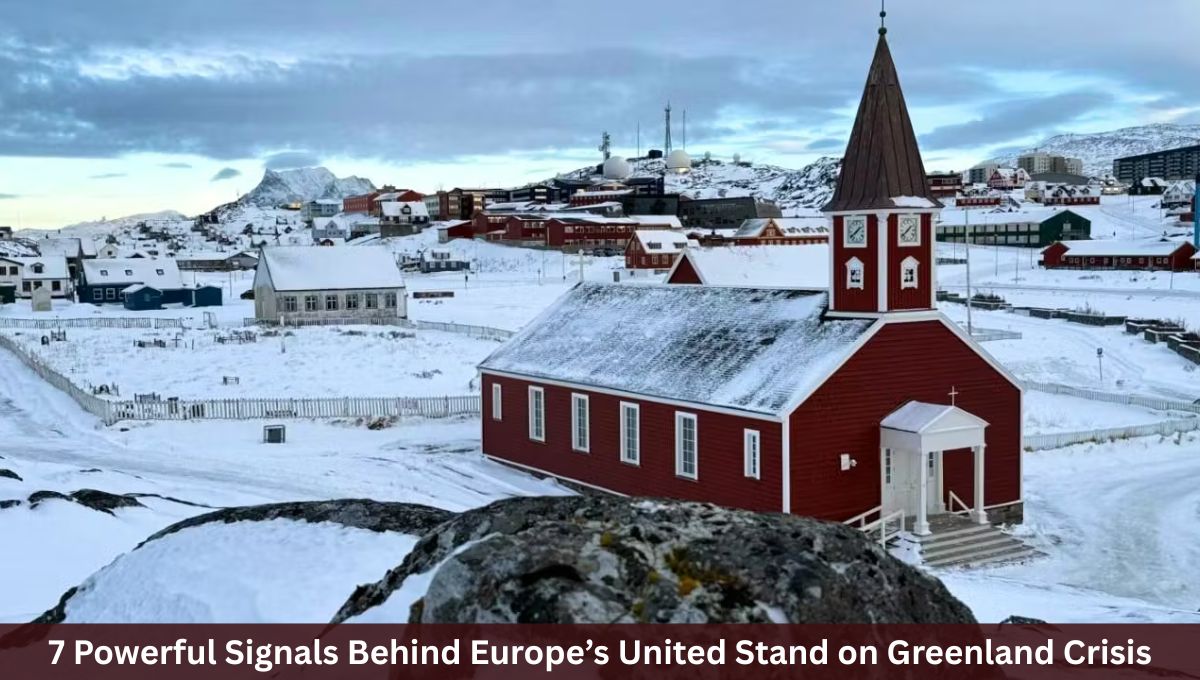
7 Powerful Signals Behind Europe’s United Stand on Greenland Crisis amid renewed US pressure. Europe is moving decisively to protect its strategic interests in the Arctic as Denmark and Greenland intensify diplomatic outreach following unprecedented pressure from the United States over Greenland.
High-level meetings in Berlin and Paris this week underscore how the dispute has become a defining test for European unity, NATO cohesion, and the future of the transatlantic relationship. At the heart of the issue lies Greenland, a vast, mineral-rich Arctic island that is an autonomous territory within the Kingdom of Denmark.
US President Donald Trump’s renewed insistence on securing control or exclusive access to Greenland—citing national security concerns—has rattled European capitals, accelerated calls for strategic autonomy, and prompted Denmark to seek firm continental backing.
7 Powerful Signals Behind Europe’s United Stand on Greenland Crisis
Denmark and Greenland Take Their Case to Europe
Danish Prime Minister Mette Frederiksen and Greenland’s leader Jens-Frederik Nielsen met German Chancellor Friedrich Merz in Berlin on Tuesday, marking a critical step in a coordinated European diplomatic push.
The leaders are scheduled to travel to Paris next, where they will meet French President Emmanuel Macron in a show of continental solidarity.
The message from Copenhagen and Nuuk has been consistent: dialogue with Washington remains possible, but sovereignty and territorial integrity are non-negotiable red lines.
“I have a deep gratitude towards the Americans,” Frederiksen told German public broadcaster ARD. “But there is now so much disruption that the most important thing is that we Europeans do the right thing to protect our people, freedom, and security.”
Her remarks reflect a broader recalibration in Europe, where trust in the permanence of US guarantees is increasingly questioned.
Germany Signals NATO Commitment in the High North
Following talks in Berlin, a German government spokesperson confirmed that Chancellor Merz reaffirmed Berlin’s solidarity with Denmark and Greenland, while also signalling Germany’s readiness to increase its security role in the Arctic.
Germany framed the issue not as a bilateral dispute, but as a collective NATO concern.
“Germany, as a European NATO ally, will do more for security in the High North within the framework of NATO. This is a common transatlantic interest,” the spokesperson said.
This stance is notable, given that Arctic security has historically been dominated by US leadership. Europe’s growing involvement reflects concerns about Russian and Chinese activity in the region—and about Washington’s increasingly unilateral posture.
Paris Steps Forward as a Pillar of European Solidarity
France has positioned itself at the forefront of European support for Denmark and Greenland. President Macron is set to host Frederiksen and Nielsen for a working lunch in Paris, where discussions will focus on Arctic security and Greenland’s economic and social development.
Macron’s office confirmed that France will reaffirm:
- Support for Denmark and Greenland’s sovereignty
- Commitment to European solidarity
- Willingness to back development projects in Greenland
France has also announced plans to open a consulate in Nuuk, Greenland’s capital, next month—a move widely seen as both symbolic and strategic.
This deepening engagement reflects Paris’s broader ambition to assert Europe as a geopolitical actor capable of defending its own interests, even when those interests diverge from Washington’s.
Trump’s Greenland Push and the Diplomatic Reset
President Trump’s rhetoric earlier this month sent shockwaves through Europe. He openly suggested the US could take over Greenland and threatened tariffs against European allies who opposed the move.
While Trump later ruled out using force and withdrew tariff threats after talks with NATO Secretary General Mark Rutte, he maintained that the US had secured “total and permanent access” to Greenland under a NATO framework—details of which remain undisclosed.
European leaders remain sceptical.
Denmark and Greenland have acknowledged the US security role in the Arctic, but insist that any agreement must respect sovereignty.
Existing arrangements already allow the US to operate military bases in Greenland, making Trump’s aggressive posture appear, to many Europeans, unnecessary and destabilising.
A NATO Alliance Under Strain
The Greenland dispute has exposed deeper fault lines within NATO. Denmark and the United States are founding members of the alliance, yet recent tensions raised questions about whether NATO could withstand a direct challenge to a member state’s territorial integrity.
While the conflict has now shifted to a diplomatic track, trust has been shaken.
NATO leaders have stressed the need for stronger Arctic security to counter Russian and Chinese influence, but European governments increasingly argue that NATO must not become a vehicle for unilateral US ambitions.
“The Old World Order No Longer Exists”
Speaking at the Danish embassy in Berlin, Frederiksen delivered one of her starkest assessments yet of the global landscape.
“The old world order no longer exists,” she said. “I don’t know if it will return—but it probably won’t.”
Her remarks echoed similar comments made by Canada’s Prime Minister Mark Carney, who recently said the rules-based international order was effectively over.
For Denmark, this realization has translated into a dual strategy:
engage Washington diplomatically, while simultaneously strengthening European defence cooperation and accelerating rearmament.
“If Europeans stand together, Europe is strong,” Frederiksen said. “If we give up on the most basic values of international cooperation, then it’s game over.”
Europe’s Strategic Awakening
The Greenland crisis has become a catalyst for broader European thinking on security and sovereignty.
Frederiksen has repeatedly called for:
- A permanent NATO presence in Greenland
- Stronger European defence capabilities
- Reduced dependence on the United States
She has suggested that NATO’s Baltic Sentry surveillance mission could be replicated in Greenland, sending a clear signal to Moscow and Beijing that Europe takes Arctic security seriously.
German Chancellor Merz has expressed scepticism about renegotiating existing US-Denmark defence agreements, noting that Washington itself dramatically reduced troop levels on the island over recent decades.
Greenlanders React with Pragmatism
While diplomats sparred across capitals, life in Greenland continued—albeit under intense global scrutiny.
Residents of Nuuk described a mix of anxiety, fatigue, and opportunity as media descended on the island. Local businesses reported increased tourism, driven by global curiosity sparked by Trump’s remarks.
Despite warnings from Greenland’s leadership about potential US aggression, many Greenlanders adopted a philosophical approach.
Political expressions such as “Greenland is not for sale” were widely seen as pro-Greenland rather than anti-American. While some irritation toward Denmark surfaced, it reflected long-standing debates rather than a sudden rupture.
As one Greenlandic politician put it bluntly:
“Nothing can be the same after this.”
Economic Stakes Beneath the Diplomacy
Beyond geopolitics, Greenland’s vast reserves of rare earths and critical minerals are a central factor in global interest. These resources are crucial for renewable energy technologies, defence systems, and advanced electronics.
Europe sees Greenland not only as a security concern but as a strategic partner in reducing dependence on China for critical minerals.
France and the EU have signalled readiness to support sustainable development projects in Greenland, balancing economic opportunity with environmental protection and Indigenous rights.
Can Denmark and the US Reach a Deal?
Frederiksen has stressed that Denmark will “do all it can” to reach an agreement with the United States—short of surrendering territory.
“No, one can’t imagine that,” she said when asked about handing over Greenlandic land.
Negotiations remain opaque, with no clear timeline or framework publicly disclosed. What is clear is that Denmark sees European unity as its strongest leverage in talks with Washington.
A Defining Moment for Europe
The Greenland crisis has evolved into far more than a territorial dispute.
It has become a stress test for:
- European unity
- NATO’s internal balance
- The future of the transatlantic alliance
As Denmark and Greenland continue their diplomatic tour, Europe appears increasingly determined to stand together—less deferential to Washington, more assertive in defending its own red lines.
Whether this marks a temporary recalibration or a lasting shift in global power dynamics remains to be seen.
But one conclusion is already clear:
the Arctic is no longer a peripheral theatre—it is now central to Europe’s geopolitical future.
Also Read: 13 Stunning Signs Europe Is Defying Trump Over Greenland
Also Read: NATO faces a major crisis over Greenland. Europe seems powerless to stop it
Related Posts:
- 9 Stark Signals as US Deploys Aircraft to Greenland Base

- 7 Explosive Reasons Denmark Warned Trump to Stop…

- Berlin Pride Horror: 1 Dead, 16 Injured After Van…

- 5 Major Takeaways from the US Supreme Court's…

- 9 Explosive Claims as Trump Says US Winning Iran War

- 9 Defiant Signals as Greenland Crisis Enters a…
