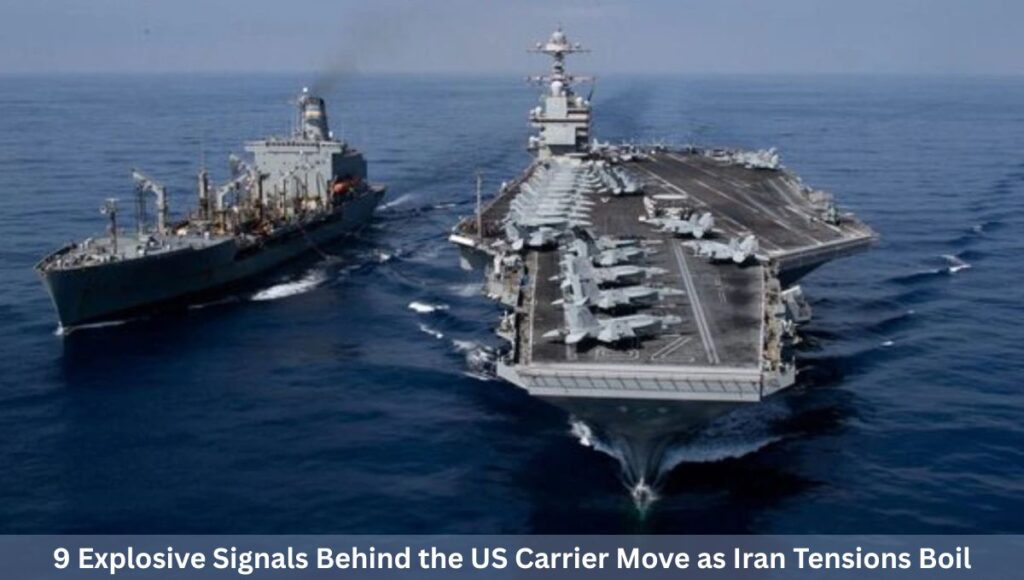
9 Explosive Signals Behind the US Carrier Move as Iran Tensions Boil amid protests and economic collapse. The arrival of the USS Abraham Lincoln carrier strike group in the Middle East has dramatically intensified global speculation over whether the United States is preparing for a direct military confrontation with Iran.
Redirected from the Indo-Pacific amid escalating tensions, the deployment significantly expands Washington’s military footprint near Iranian waters at a moment when Iran is facing internal unrest, economic collapse, and mounting international pressure.
President Donald Trump has framed the buildup as a precautionary show of force—“just in case”—while repeatedly warning Tehran against killing protesters, carrying out mass executions, or restarting its nuclear program.
At the same time, his administration insists that diplomacy remains possible, sending mixed signals that have left allies, adversaries, and regional powers on edge.
The question dominating capitals from Washington to Tehran is no longer whether tensions are high—but whether the presence of one of America’s most powerful naval formations signals imminent strikes, or calculated coercion short of war.
9 Explosive Signals Behind the US Carrier Move as Iran Tensions Boil
USS Abraham Lincoln Enters CENTCOM Waters
A Major Strategic Redeployment
The USS Abraham Lincoln (CVN-72), a Nimitz-class nuclear-powered aircraft carrier and the flagship of Carrier Strike Group 3, officially entered the United States Central Command (CENTCOM) area of responsibility on Monday.
The move followed the carrier’s passage through the Strait of Malacca on January 19, accompanied by three Arleigh Burke-class guided-missile destroyers:
- USS Frank E. Petersen Jr. (DDG-121)
- USS Spruance (DDG-111)
- USS Michael Murphy (DDG-112)
According to US Central Command, the strike group is deployed “to promote regional security and stability.”
In practical terms, the arrival places thousands of additional US service members, combat aircraft, and missile systems within operational range of Iran.
It is the first time a US aircraft carrier has operated in Middle Eastern waters since October, when the USS Gerald R. Ford was dispatched to the Caribbean.
What a Carrier Strike Group Brings to the Table
Why This Deployment Matters
A US carrier strike group is among the most formidable military formations in the world. Typically centered around an aircraft carrier, it includes guided-missile cruisers, destroyers, submarines, and a full air wing capable of launching sustained combat operations.
The presence of the USS Abraham Lincoln gives Washington a wide spectrum of options, including:
- Precision airstrikes
- Missile defense operations
- Intelligence, surveillance, and reconnaissance
- Rapid escalation or de-escalation
While officials stress the deployment is defensive, its positioning dramatically shortens response times should Trump decide to act.
Trump Links Military Build-Up to Iran’s Protest Crackdown
“Just in Case”
President Trump has directly tied the naval buildup to Iran’s handling of nationwide protests that erupted in late December.
The demonstrations, sparked by economic collapse and political grievances, have drawn widespread condemnation.
“We have a massive fleet heading in that direction, and maybe we won’t have to use it,” Trump told reporters last week.
The president has repeatedly warned Iran against carrying out mass executions or killing peaceful demonstrators, threatening intervention if red lines are crossed.
Activist groups estimate that nearly 6,000 protesters have been killed and more than 41,800 detained, though Iran’s official figures are far lower.
The Associated Press has been unable to independently verify the numbers due to widespread internet shutdowns inside Iran.
Mixed Signals From Washington
Pressure and Diplomacy, Side by Side
Even as warships move closer, Trump and senior US officials insist that diplomacy remains possible.
A US official said Monday that Washington is “open for business” if Tehran wants to engage.
“I think they know the terms,” the official added.
Trump himself has claimed Iran “wants to talk,” suggesting Tehran has reached out multiple times. He has also said he believes Iran has halted planned executions of detainees—an assertion Iran’s top prosecutor has categorically denied.
This dual messaging—military escalation paired with overtures for talks—has fueled uncertainty over Washington’s true intentions.
Pentagon Expands Military Footprint Near Iran
More Than Just a Carrier
The arrival of the USS Abraham Lincoln is only part of a broader US military surge.
The Pentagon has also moved:
- Fighter jets
- Air-defense systems
- Military cargo aircraft
Additionally, the US military has announced exercises designed to demonstrate its ability to deploy and sustain combat airpower across the region.
This mirrors last year’s buildup ahead of US strikes on Iranian nuclear facilities, when Patriot missile systems were deployed and Iran later responded with missile launches toward Al Udeid Air Base.
Iran Braces for a Potential Strike
Defiant Rhetoric From Tehran
Iranian officials have responded to the US deployment with defiance rather than restraint.
Foreign Ministry spokesperson Esmaeil Baghaei said the arrival of US warships “does not impact Iran’s defensive determination,” adding that Iranian forces are monitoring every development.
Maj. Gen. Ali Abdollahi warned that any aggression would immediately turn “all American interests, bases and centers of influence into legitimate targets.”
At Friday prayers in Tehran, clerics warned Washington that its investments in the region were “under the watch of our missiles.”
Missiles, Drones, and the Axis of Resistance
Iran’s Military Capabilities
Despite suffering setbacks during last year’s conflict with Israel, Iran retains a formidable arsenal:
- Medium- and long-range ballistic missiles
- Advanced drone systems
- Regional proxy forces
Iranian officials say missile efficiency has increased significantly since the 12-day war with Israel, during which Tehran launched multiple waves of missiles and drones.
Iran’s drones have also been deployed beyond the Middle East, including in Russia’s war in Ukraine.
Regional Proxies Signal Readiness
Risk of a Wider War
Iran’s network of allied militias—the so-called “Axis of Resistance”—has issued warnings that any US attack would not remain confined to Iran.
Kataeb Hezbollah leader Abu Hussein al-Hamidawi called on loyalists “across the globe” to prepare for all-out war.
Yemen’s Houthi rebels have released footage of past attacks, hinting at renewed action in the Red Sea. Hezbollah in Lebanon has avoided specifics but says it is preparing for “possible aggression.”
While some proxies have been weakened, others remain heavily armed and capable of striking US interests and allies.
US Allies Urge Restraint
Gulf States Caught in the Middle
US-allied Arab nations in the Persian Gulf have quietly lobbied Trump against launching a strike, according to regional officials.
The United Arab Emirates has said it will not allow its airspace or territory to be used for hostile action against Iran.
These countries host US bases but fear becoming targets if conflict erupts.
Energy markets, shipping lanes, and regional stability all hang in the balance.
Iran’s Economic Collapse Adds Pressure
Rial Hits Record Low
As military tensions rise, Iran’s economy continues to unravel. The rial has plunged to a record 1.5 million to the dollar, devastating household savings and fueling public anger.
Activists report more than 6,126 deaths, including children and civilians, with arrests exceeding 41,800. Iran’s government disputes the figures, labeling many victims “terrorists.”
The economic crisis has been exacerbated by sanctions, mismanagement, and the collapse of Iran’s regional influence after setbacks in Gaza, Lebanon, Syria, and beyond.
Echoes of 1979
The scale of the protests and crackdown has drawn comparisons to the turmoil surrounding Iran’s 1979 Islamic Revolution.
Internet blackouts—described as the most comprehensive in the country’s history—have made verification difficult but intensified global scrutiny.
Iran’s UN ambassador accused Trump of inciting violence and warned that US threats are “neither ambiguous nor misinterpreted.”
Is a US Strike Imminent?
Capability vs. Intent
The USS Abraham Lincoln’s presence unquestionably gives Trump the ability to strike Iran quickly and decisively. But capability does not equal intent.
US officials emphasize that no final position has been reached and no decision made. Trump himself has oscillated between threats and assurances, describing the situation as “in flux.”
Supporters argue the show of force strengthens Washington’s negotiating hand. Critics warn it increases the risk of miscalculation.
Deterrence or Diplomacy?
Trump’s Iran policy follows a familiar pattern: maximum pressure paired with sudden outreach. The strategy aims to force concessions without firing a shot—but history shows the margin for error is thin.
For now, the USS Abraham Lincoln looms as both a warning and a bargaining chip.
Whether it becomes the launchpad for another Middle East conflict—or simply a symbol of coercive diplomacy—will depend on decisions made in the coming days, in Washington and Tehran alike.
What is clear is that the Middle East has entered another dangerous chapter, where a single misstep could trigger consequences far beyond the region.
Also Read: 11 Explosive Developments as Iran Warns US Over Strikes and Executions
Also Read: US–Iran Tensions: What Abraham Lincoln Carrier Strike Group Could Do in War
Related Posts:
- 3 Explosive Conditions Iran Sets to End War with US…

- 10 Explosive Warnings as Donald Trump Calls Iran…
- 7 Explosive Moments as US Jet Shoots Down Iran Drone…
- 7 Dead in Explosive Iran Protests as Economic Anger…

- 7 Powerful Facts About Ayatollah Ali Khamenei’s…

- 9 Explosive Claims as Trump Says US Winning Iran War