13 Stunning Signs Europe Is Defying Trump Over Greenland: troops, trade pauses and NATO warnings. Greenland — an icy, sparsely populated Arctic territory — has suddenly become the epicentre of one of the most extraordinary transatlantic crises in modern history.
What began as US President Donald Trump’s renewed assertion that Greenland should belong to the United States has escalated into a full-blown political, military, and trade confrontation between Washington and its European allies.
The dispute has exposed deep fractures within NATO, triggered threats of punitive tariffs, and prompted a symbolic — and controversial — European military deployment to Greenland.
Europe says it is standing firm. Trump says Greenland is non-negotiable. And somewhere between one British officer, two Finnish soldiers, and a looming trade war, the future of NATO unity is being tested like never before.
13 Stunning Signs Europe Is Defying Trump Over Greenland
Why Greenland Matters — And Why Trump Wants It
Greenland is an autonomous territory under Danish sovereignty, with control over its domestic affairs while Denmark manages defence and foreign policy.
Strategically, Greenland sits astride the Arctic gateway between North America and Europe, hosting vital sea lanes, air routes, and early-warning systems.
It is also believed to hold vast untapped mineral and rare-earth resources, increasingly valuable amid global competition with China.
Trump argues Greenland is essential to US national security, repeatedly citing alleged Russian and Chinese interest in the region.
In a series of posts and interviews, Trump claimed:
- Denmark has failed to secure Greenland
- NATO warned Copenhagen for “20 years”
- The US must act to counter Russian threats
The White House even posted that it was now “time” to act — language that stunned European capitals.
Europe Closes Ranks Behind Denmark
Rather than splintering under US pressure, Europe has closed ranks.
Denmark, Finland, France, Germany, the Netherlands, Norway, Sweden, and the United Kingdom issued a joint statement declaring:
- Full solidarity with Denmark and Greenland
- Rejection of any coercion
- Support for NATO Arctic security cooperation
The statement warned that tariff threats undermine transatlantic relations and risk “a dangerous downward spiral.”
Crucially, European leaders reiterated that Greenland is not for sale, stressing the right of its people to self-determination.
Europe’s ‘Awe-Inspiring’ Military Commitment
To demonstrate resolve, European nations agreed to send troops to Greenland as part of Operation Arctic Endurance — a NATO-linked exercise led by Denmark but notably without the United States.
The numbers, however, sparked ridicule and debate.
European Troop Contributions
- United Kingdom: 1 military officer
- Finland: 2 personnel
- Norway: 2 personnel
- Netherlands: 2 personnel
- Germany: 13 soldiers
- France: 15 soldiers
- Sweden: Unspecified small contingent
That brings the total non-Danish European deployment to around 37 troops.
Denmark already maintains about 150 troops in Greenland under its Joint Arctic Command, alongside the elite Sirius Dog Sled Patrol, a 14-member unit conducting long-range Arctic reconnaissance.
What Is Operation Arctic Endurance?
Despite headlines suggesting Europe is “defending Greenland,” Danish officials are clear:
this is not a combat deployment.
Operation Arctic Endurance is described as a reconnaissance and feasibility mission, designed to:
- Test logistics and infrastructure
- Assess Arctic operational challenges
- Explore future multinational deployments
Danish Defence Minister Troels Lund Poulsen said Arctic security is “of crucial importance” and that allies must strengthen their ability to operate in the region.
In other words, Europe is testing whether it could do more — not actually doing it yet.
NATO Minus the United States
Perhaps the most striking aspect of the deployment is who is missing.
The United States — NATO’s largest military power and Greenland’s historical security guarantor — is not participating.
Nor are Poland, Italy, or Turkey, all of which declined to send troops.
Polish Prime Minister Donald Tusk confirmed Warsaw would not participate. Italy’s defence minister reportedly dismissed the mission as “irrational” and akin to a “joke.”
The result is a symbolic but fragile show of unity — NATO without its strongest pillar.
Trump Responds With Tariff Threats
If Europe expected restraint from Washington, it miscalculated.
Trump responded to Europe’s Greenland stance by announcing 10% tariffs on imports from:
- Denmark
- France
- Germany
- United Kingdom
- Netherlands
- Norway
- Sweden
- Finland
He warned the tariffs would rise to 25% from June 1, 2026, unless Europe agreed to negotiate Greenland’s transfer.
Trump framed the move as a matter of national security, insisting it was “time for Denmark to give back” after decades of US support.
Europe Hits Back — Trade War Looms
Europe’s response was swift and unusually forceful.
The European Parliament paused a landmark transatlantic trade agreement, signed just last year, citing concerns over US coercion.
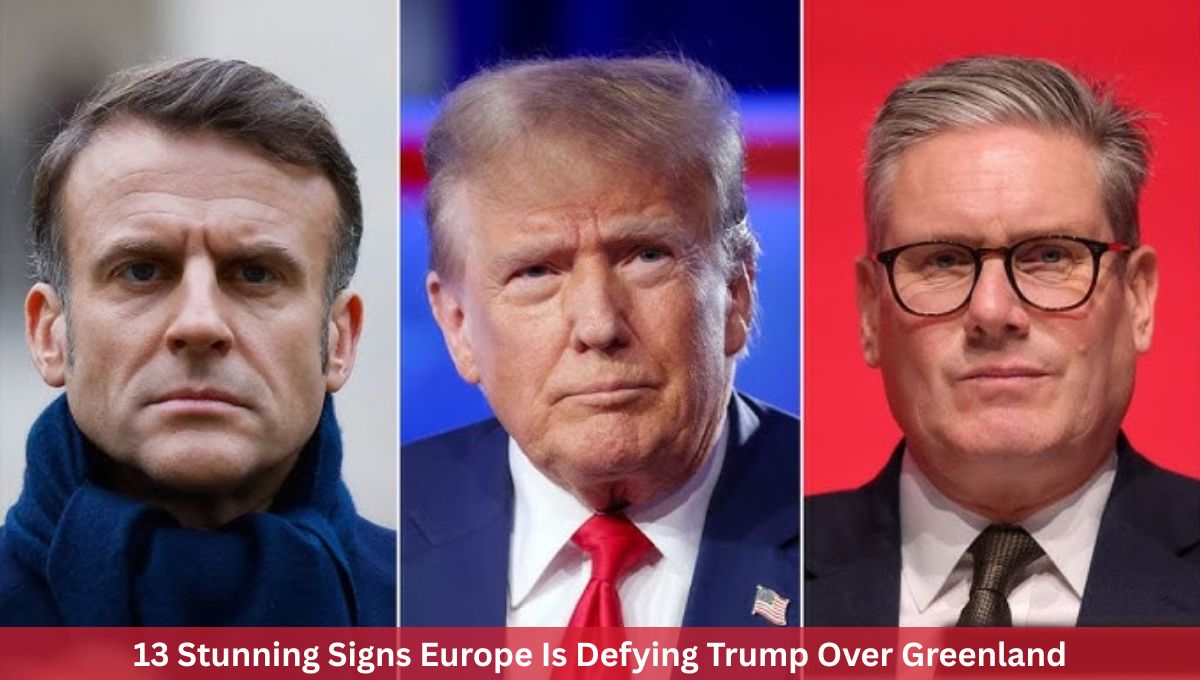
French President Emmanuel Macron went further, urging the EU to activate its anti-coercion instrument — often dubbed the bloc’s “trade bazooka.”
The tool, adopted in 2023 but never used, allows the EU to:
- Impose counter-tariffs
- Restrict market access
- Limit investment
- Block public procurement bids
Macron called Trump’s tariff threat “unacceptable”, insisting Europe would not change its position “under intimidation or threat.”
Germany, Finland, UK Join the Pushback
European leaders lined up behind Macron.
German Chancellor Friedrich Merz said Europe stood “resolutely united” with Denmark and warned tariffs could trigger escalation.
Finland’s President Alexander Stubb said such measures risked a “dangerous downward spiral.”
UK Prime Minister Sir Keir Starmer said Trump was “completely wrong” to punish allies for pursuing NATO’s collective security — a notable shift from his previously cautious approach toward Washington.
NATO Chief Steps In
As tensions soared, NATO Secretary General Mark Rutte held a call with Trump to discuss Greenland and Arctic security.
Rutte confirmed he would meet Trump in Davos, but shared no details of the conversation.
His intervention underscored growing concern that the Greenland dispute could seriously damage NATO cohesion.
Is Europe Really Ready to Defend Greenland?
Behind the symbolism lies an uncomfortable reality.
Europe is not militarily prepared to defend Greenland — or itself — without the United States.
Post-Cold War defence cuts hollowed out European forces, relying heavily on US capabilities for:
- Strategic airlift
- Missile defence
- Intelligence and surveillance
- Command and control
A German Council on Foreign Relations study found Europe would struggle to deploy 50,000 troops in a major conflict — a fraction of what modern warfare demands.
Ukraine War Exposed Europe’s Weakness
Russia’s 2022 invasion of Ukraine was a shock.
European armies lacked:
- Ammunition stockpiles
- Industrial capacity
- Long-term sustainment ability
Without US aid, Ukraine would have collapsed. And Trump’s scepticism toward European defence has reignited fears that America may not always be there.
Europe Is Rearming — But Slowly
Some European countries are now racing to catch up.
France
- €6.5 billion defence boost
- Budget doubling to €64 billion by 2027
- Targeting 3% of GDP
Poland
- Planning a 500,000-strong army
- Aiming for 5% GDP defence spending
Germany
- Expanding Bundeswehr
- Selective conscription from 2026
- Target of 260,000 troops by 2035
Finland
- 280,000 wartime troops
- 900,000 reserves
- Defence spending at 2.1% GDP
Yet even with these efforts, replacing US military power would require over $1 trillion, according to the International Institute for Strategic Studies.
Greenland: Symbol or Flashpoint?
For now, Operation Arctic Endurance remains a reconnaissance exercise.
But symbolically, it marks something far bigger:
- Europe asserting sovereignty
- NATO unity under strain
- A US president openly coercing allies
Finland-based military analyst Emil Kastehelmis warned Europe not to assume the crisis would pass with a change of administration.
“It is not just about Trump — it’s the mindset,” he said.
The UK’s Delicate Balancing Act
Britain’s role highlights the dilemma.
The UK sent just one officer — enough to show solidarity, but not enough to provoke Washington.
Starmer has invested heavily in maintaining relations with Trump, especially over Ukraine. But domestic pressure is mounting to stand firm.
Even opposition leaders have rallied behind him — a rare moment of unity against the White House.
What Happens Next?
Several paths now loom:
- Escalating tariffs and EU retaliation
- A NATO-brokered compromise
- Intensifying US pressure
- A long-term shift away from US-centric security
What seems certain is that Greenland is no longer a frozen afterthought.
It has become a symbol of Europe’s struggle to assert strategic autonomy, and of a transatlantic alliance entering uncharted territory.
Conclusion: A Small Deployment, A Big Reckoning
One British officer. Two Finnish soldiers. A handful of European troops in the Arctic.
On the surface, it looks almost absurd.
But beneath the numbers lies a profound message: Europe is beginning — however tentatively — to say no to Washington.
Whether that defiance holds, or collapses under pressure, could define the future of NATO, European security, and the global balance of power. Greenland may be cold — but the politics surrounding it are burning hot.
Also Read: 11 Explosive Signals Behind Trump’s High-Stakes Greenland Tariff Threat