9 Explosive Truths Behind Trump’s Greenland Obsession the World Can’t Ignore — Not Just About Security. At the World Economic Forum in Davos, few remarks were as eagerly anticipated as those of U.S. President Donald Trump on Greenland.
For months, his rhetoric had rattled allies, unsettled markets, and reignited fears of a 19th-century-style land grab in the Arctic. In Davos, Trump appeared to pull back—publicly ruling out the use of force.
But if anyone believed that marked the end of the Greenland saga, they were mistaken. The issue is not over. It is merely evolving—rebranded, reframed, and repackaged in the language of “security,” “framework deals,” and “shared mineral access.”
Beneath the surface lies a familiar story:
strategic control, extractive capitalism, and a fragile land once again caught between empires.
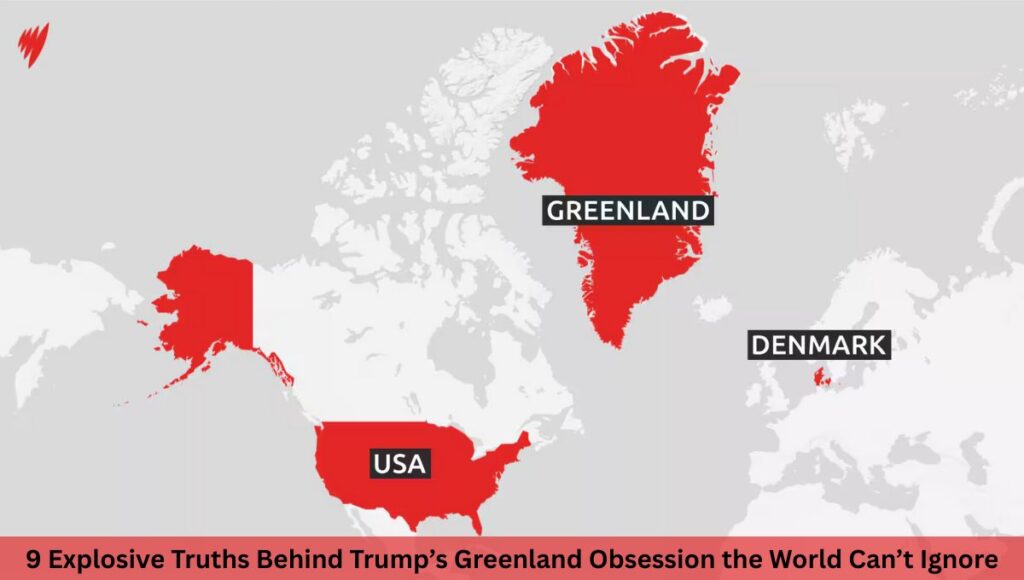
9 Explosive Truths Behind Trump’s Greenland Obsession the World Can’t Ignore
Why Greenland Matters Far Beyond the Arctic
Greenland is not just a distant ice-covered island with 57,000 people. It is one of the most critical pressure points in the 21st-century global order.
A Climate Tipping Point for the World
Greenland’s ice sheet is melting faster than at any point in the last 12,000 years. This is not an abstract environmental concern. The consequences are existential for low-lying nations such as the Maldives and Bangladesh, where rising sea levels threaten entire populations.
For much of the Global South, Greenland’s fate is inseparable from their own. Yet the dominant powers shaping Greenland’s future remain far more interested in what lies under the ice than what happens because it melts.
An Ugly History Washington Prefers to Forget
Colonisation and Control
Greenland’s history is not a blank slate. It was first inhabited by Inuit peoples migrating from Asia, followed by Norse settlers.
Danish colonisation formalised control over the island, with missionaries, mining interests, and policies that systematically marginalised Indigenous communities.
In 1953, Greenland was incorporated into Denmark without consulting its people. It gained home rule in 1979 and expanded self-rule in 2009—but Denmark still controls foreign policy, defence, and major legal oversight.
Forced Birth Control and Resource Extraction
Until as late as 1991, Inuit women were subjected to forced intrauterine birth control measures—an episode that has since become one of the most disturbing chapters in Danish colonial history.
Meanwhile, Greenland’s land was mined for aluminium and other resources, with little benefit flowing to local communities.
The Nuclear Shadow Over Greenland
The Thule Disaster
In 1968, a U.S. B-52 bomber carrying nuclear weapons crashed near Thule Air Base (now Pituffik Space Base), scattering plutonium-laced debris across Arctic ice.
Declassified documents later revealed that Denmark knew U.S. nuclear weapons were stationed in Greenland—despite officially banning them on Danish soil—and chose silence.
This pattern of “strategic blindness” is crucial. Greenland has long been treated as expendable territory in the service of larger powers.
Everyone Has Wanted Greenland—Always
The idea of acquiring Greenland did not originate with Trump. U.S. presidents from Eisenhower onward considered “buying” the island but concluded it was unnecessary. The United States already enjoyed near-total access.
The 1951 Agreement
Under a 1951 treaty with Denmark:
- U.S. sovereignty was not recognised
- But three major “defence areas” were delineated
- The U.S. gained unrestricted access to airspace
- American bases could operate with minimal oversight
In effect, Washington achieved strategic control without ownership.
Pituffik Space Base: The Arctic Crown Jewel
Formerly known as Thule Air Base, Pituffik is no longer merely a Cold War relic. It is now a cornerstone of the U.S. Space Force.
Why It Matters
- Missile warning and defence
- Space surveillance
- Near-Earth object tracking
- Early detection of hypersonic threats
Base officials claim they can detect a softball-sized object from 3,000 miles away. In an era where orbit is the new high ground, this capability is priceless.
And crucially:
Trump does not need to own Greenland to maintain it.
So Why the Obsession?
The Arctic Is Opening
Climate change has unlocked new Arctic shipping routes:
- The Northern Sea Route along Russia
- The Northwest Passage through Canada
- The future Transpolar Sea Route
These routes could dramatically shorten Asia–Europe trade times. Washington fears that Russia and China could gain leverage over global commerce.
But these fears are often exaggerated.
Russia has operated nuclear-powered icebreakers for decades. China’s presence—while growing—remains limited and largely commercial.
The China and Russia Argument Falls Apart
Greenland, as part of Denmark, is protected under NATO’s Article 5. Any hostile takeover would trigger a collective response.
Even U.S. security documents rarely identify Greenland as an imminent threat zone. The “security imperative” narrative, while compelling, does not fully explain Trump’s urgency.
Follow the Money: Rare Earths and Billionaires
This is where the story sharpens.
Greenland’s Rare Earth Jackpot
According to the U.S. Geological Survey, Greenland holds:
- Around 1.5 million metric tonnes of rare earth elements (REEs)
- Comparable reserves to the United States
- More than Canada and South Africa
REEs are critical for:
- AI chips
- EV batteries
- Missiles
- Satellites
- Renewable energy systems
Who’s Already Invested
Forbes and other reports reveal investments by:
- Jeff Bezos
- Bill Gates
- Michael Bloomberg
- Ronald Lauder (Estée Lauder heir)
Former national security adviser John Bolton has stated Lauder personally lobbied Trump to acquire Greenland in 2018.
The Race Is Already On—and the US Is Late
China already has a foothold:
- Shenghe Resources is the largest shareholder in the Kvanefjeld project
- Signed in 2018
- One of the world’s largest rare-earth sites
The EU has also moved:
- In 2025, it designated Greenland’s Amitsoq graphite project a “Strategic Project”
Washington is not leading this race. It is scrambling to catch up.
Greenlanders Are Not for Sale
Public Opinion Is Clear
A 2025 poll showed:
- 56% support eventual independence
- 85% oppose joining the United States
- Only 6% support U.S. annexation
Greenland’s leaders have been unequivocal.
Prime Minister Jens-Frederik Nielsen stated:
“Nobody else than Greenland and the Kingdom of Denmark have the mandate to make deals about Greenland.”
Caught Between Independence and Extraction
Here lies Greenland’s cruel dilemma.
Independence requires money. Greenland has:
- Near-zero agriculture
- A small population
- Limited industry
Resource extraction is one of the few viable revenue streams.
This has driven:
- Offshore oil exploration (13 projects planned)
- Mining expansion
- Foreign corporate interest
Each option threatens Greenland’s fragile ecosystem.
Trump’s ‘Golden Dome’ Pivot
In Davos, Trump unveiled a softer approach:
- A “framework” deal
- Shared mineral access
- Cooperation on the “Golden Dome” missile defence system
Denmark welcomed talks—but drew a red line on sovereignty.
“No negotiations on territorial integrity,” Prime Minister Mette Frederiksen said.
No Paper, No Clarity
Sources confirm:
- No written agreement exists
- Discussions remain verbal
- NATO allies are confused
- Further talks are planned in Washington
This ambiguity suits Trump. It allows pressure without accountability.
Greenland and the New Space Race
Why Space Changes Everything
Greenland’s geography makes it ideal for:
- Polar orbit launches
- Sun-synchronous satellites
- Space surveillance infrastructure
As private launches surge and space becomes militarised, control over Earth-based gateways like Pituffik becomes decisive.
The 1967 Outer Space Treaty never anticipated this reality.
The Collapse of Global Governance
Institutions are failing:
- The Arctic Council is paralysed
- Space law is outdated
- Resource nationalism is rising
Greenland is a warning sign of a world where territory, orbit, and minerals are all up for grabs.
What This Means for India
For New Delhi, Greenland is a case study in realpolitik.
As the AI race accelerates:
- Critical minerals will define power
- Supply chains will trump alliances
- Multi-alignment becomes survival strategy
India must identify its own mineral priorities—domestically and abroad—and pursue them without illusion.
Conclusion: Ice, Power, and the Future Order
Trump’s Greenland fixation is not eccentricity. It is a symptom.
A warming Arctic, a fractured legal order, a race for minerals, and the militarisation of space are converging on one fragile island.
Greenland is not just a block of ice. It is a mirror — reflecting how the world’s most powerful states intend to behave when the old rules no longer bind. And that should worry us all.
Also Read: 7 Explosive Reasons Greenland Keeps Resisting US Takeover
Also Read: Unpacking Trump’s Obsession: What’s So Great About Greenland Anyway?
Related Posts:
- 7 Explosive Moments as Trump’s Davos Flight Turns…

- 7 Shocking Reasons FIFA’s Peace Prize for Trump…

- Trump’s 2025 Gaza Peace Plan Signing and Historic…

- 7 Explosive Moments in the Trump–Macron Davos Showdown

- 5 Powerful Highlights as Trump Lands Second Nobel…

- 9 Stark Signals as US Deploys Aircraft to Greenland Base