

7 Explosive Facts About Trump’s $1 Billion Gaza Peace Board drawing global attention. US President Donald Trump has unveiled one of the most unconventional diplomatic initiatives of his second term:
an international Board of Peace designed initially to oversee the ceasefire, governance transition, and reconstruction of Gaza — but with ambitions that clearly extend beyond the Palestinian territory.
At the heart of the proposal lies a striking condition. While countries can join the Board of Peace for a standard three-year term at no cost, permanent membership requires a cash contribution of $1 billion within the first year of the charter’s implementation.
The proposal, first reported by Bloomberg and later confirmed by multiple US officials, has triggered intense debate among diplomats, policymakers, and analysts worldwide.
Supporters argue it could break years of deadlock over Gaza. Critics warn it risks creating a pay-to-play alternative to the United Nations system.
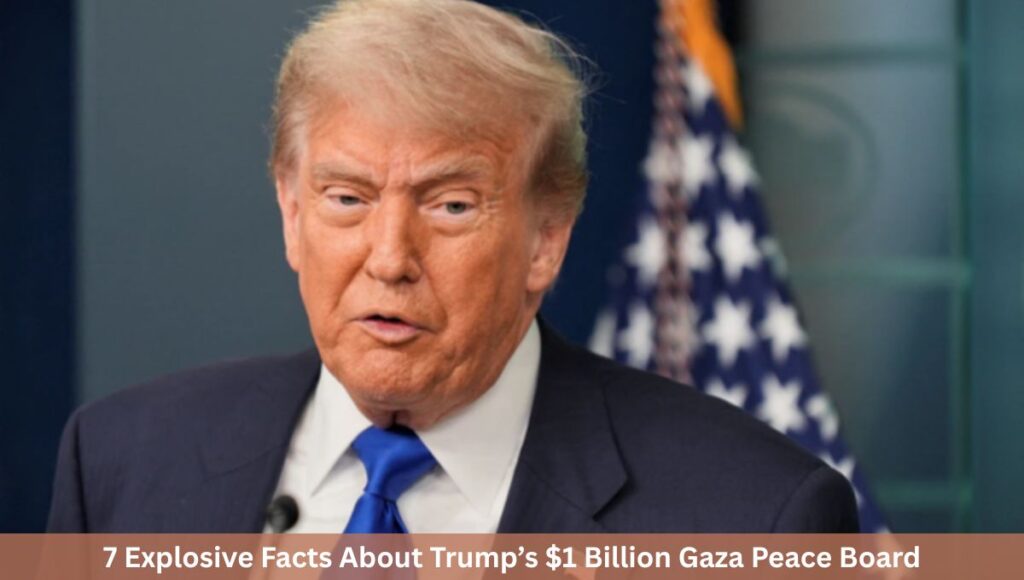
7 Explosive Facts About Trump’s $1 Billion Gaza Peace Board
What Is the Gaza Board of Peace?
The Gaza Board of Peace is envisioned as a transitional international mechanism to manage Gaza in the aftermath of more than two years of devastating war between Israel and Hamas.
Endorsed by the UN Security Council in November 2025 under Resolution 2803, the board is part of a broader US-backed, 20-point ceasefire and reconstruction framework.
Its core responsibilities include:
- Overseeing Gaza’s stabilisation after the ceasefire
- Coordinating humanitarian assistance
- Supervising reconstruction and infrastructure rebuilding
- Supporting civilian governance through Palestinian technocrats
- Preventing a security and political vacuum in the territory
While Gaza is the immediate focus, the board’s charter does not explicitly limit its mandate to Gaza, raising questions about whether it could eventually expand into a broader global conflict-resolution body.
How the $1 Billion Membership Model Works
According to a draft charter reviewed by Bloomberg, the Board of Peace will operate on a tiered membership system:
Three-Year Term Membership
- No financial contribution required
- Members serve a renewable three-year term
- Decisions are taken by majority vote
- Final approval rests with the chairman
Permanent Membership
- Requires a $1 billion cash contribution within the first year
- Secures an indefinite seat on the board
- Designed to ensure long-term financial backing for Gaza’s rebuilding
A senior US official told CNN and CNBC that “virtually every dollar” raised would go directly toward rebuilding Gaza, emphasising that the board would operate without the “exorbitant salaries and massive administrative bloat” associated with many international organisations.
Where the funds would be held, and under what legal framework they would be disbursed, remains unclear.
Trump as Chairman — And Ultimate Decision-Maker
Under the proposed charter, Donald Trump is expected to serve as the inaugural chairman of the Board of Peace.
Key powers of the chairman include:
- Selecting which countries receive invitations
- Holding final approval authority over board decisions
- Shaping the board’s agenda and long-term vision
While decisions are formally subject to a majority vote, diplomats note that the chairman’s veto-like authority gives Trump unparalleled influence over the body’s direction.
Trump has described the initiative as a “bold new approach to resolving global conflict” and has repeatedly suggested it could succeed where traditional multilateral institutions have failed.
Who’s On the Executive Board?
In addition to the larger Board of Peace, the Trump administration has created a founding executive board tasked with operationalising the initiative.
The White House says this smaller group will oversee portfolios “critical to Gaza’s stabilisation and long-term success.”
Confirmed executive board members include:
- US Secretary of State Marco Rubio
- US special envoy Steve Witkoff
- Jared Kushner, Trump’s son-in-law
- Former UK Prime Minister Tony Blair
- Apollo Global Management CEO Marc Rowan
- World Bank President Ajay Banga
- US Deputy National Security Adviser Robert Gabriel
The inclusion of financiers, former Western leaders, and Trump family members has fuelled criticism that the board reflects a commercialised, top-down governance model rather than a representative peace process.
Global Invitations: Who’s In and Who’s Hesitant?
The United States has sent invitations to dozens of countries, with the final list expected to be announced during the World Economic Forum meeting in Davos.
Countries That Have Accepted or Signalled Acceptance
- Hungary: Prime Minister Viktor Orbán has formally accepted
- Vietnam: Communist Party chief To Lam has agreed to join
- Morocco: King Mohammed VI accepted as a founding member
- Canada: Prime Minister Mark Carney accepted in principle
Countries Invited and Considering
- India
- Australia
- Jordan
- Greece
- Cyprus
- Pakistan
- Turkey
- Egypt
- Argentina
- Albania
Countries Expressing Reservations
- France: Paris has indicated it does not intend to respond favourably at this stage
- Germany: Emphasised the primacy of existing multilateral frameworks
- Russia: President Vladimir Putin is “studying the details”
The European Union has said it wants to understand how the board would fit within international law and the UN system before committing.
India’s Dilemma: Why New Delhi Is Not Rushing In
India has confirmed receiving an invitation to join Trump’s Board of Peace, but officials in New Delhi say the proposal is under careful examination.
Several factors are shaping India’s cautious approach.
Concerns Over Multilateral Norms
Indian policymakers are assessing whether the board’s structure could:
- Dilute the authority of the United Nations
- Create a parallel decision-making mechanism dominated by one leader
- Set precedents that undermine established international governance
India has traditionally supported multilateralism anchored in the UN, making any deviation a sensitive issue.
Strategic Sensitivities
Officials are also wary of the board’s potential expansion beyond Gaza.
There are concerns that:
- The board could eventually take positions on other disputes
- Sensitive issues such as Kashmir could be drawn into its remit
This unease is heightened by Trump’s repeated claims of having brokered an India–Pakistan ceasefire in 2025 — claims New Delhi has publicly rejected.
Trade and Diplomatic Context
The invitation comes amid strained US–India trade relations, with Washington imposing a combined 50% tariff on certain Indian goods, partly linked to India’s ties with Russia.
Indian officials are weighing whether participation could:
- Improve diplomatic leverage with Washington
- Or expose India to political pressure under the board’s framework
France, Europe and the Question of UN Authority
France has emerged as one of the most vocal sceptics of Trump’s initiative.
Officials close to the French presidency argue that the board’s charter:
- Goes beyond Gaza
- Raises “major issues” about respect for UN principles
- Risks undermining the post–World War II international order
Germany and other European states have echoed these concerns, stressing that any Gaza transition must remain firmly embedded within existing UN mechanisms.
The broader fear in Europe is that the Board of Peace could evolve into a rival to the UN Security Council, whose influence has already been weakened by veto paralysis and funding cuts.
Israel’s Uneasy Response
Despite being a close US ally, Israel has reacted coolly — and at times critically — to elements of the Board of Peace.
Prime Minister Benjamin Netanyahu’s office said the executive board was:
- “Not coordinated with Israel”
- “Contrary to Israeli policy”
Israel has particularly objected to:
- Roles for Turkey and Qatar, whom it accuses of backing Hamas
- The absence of clear Israeli oversight mechanisms
At the same time, the board includes provisions for Hamas’ disarmament and the deployment of an international security force — objectives Israel has long demanded.
Palestinians: On the Margins?
One of the most controversial aspects of the Board of Peace is the limited role assigned to Palestinians.
Under the US plan:
- Day-to-day governance would be handled by a Palestinian technocratic committee
- Political authority would largely reside with the international board
Critics argue this risks:
- Marginalising Palestinian political agency
- Treating Gaza as a managerial project rather than a political community
Some experts have described the model as “neocolonial”, placing global elites at the top while Palestinians are confined to municipal functions.
Can Money Buy Peace?
The $1 billion permanent membership requirement has become the initiative’s most debated feature.
Supporters say it:
- Guarantees serious commitment
- Ensures long-term funding for reconstruction
- Avoids donor fatigue that has plagued past Gaza efforts
Critics counter that it:
- Creates a pay-to-influence system
- Privileges wealthy states over affected populations
- Risks politicising humanitarian reconstruction
Whether the model delivers efficiency or entrenches inequality may determine the board’s ultimate legitimacy.
A Turning Point in Global Diplomacy?
Trump’s Board of Peace represents a sharp departure from traditional diplomacy.
It combines:
- UN endorsement
- Centralised leadership
- Private-sector logic
- Transactional membership rules
For supporters, it is a pragmatic response to a broken system. For critics, it is a dangerous experiment that concentrates power and undermines international norms.
As invitations are weighed and decisions made in capitals from New Delhi to Paris, one question looms large:
Is the Board of Peace a breakthrough for Gaza — or the beginning of a new, contested global order?
The answer may shape not just Gaza’s future, but the architecture of international governance itself.
Also Read: 9 Stark Realities Behind Gaza’s Reaction to Trump’s ‘Board of Peace’ Plan
Also Read: Trump’s ‘Board of Peace’ for Gaza to require $1 billion payment for permanent membership
Related Posts:
- Trump’s 2025 Gaza Peace Plan Signing and Historic…

- 7 Shocking Reasons FIFA’s Peace Prize for Trump…

- Trump’s 20-Point Gaza Peace Plan Gains Urgent Global…

- Israel Awards Highest Honor to Trump in 2025 for…

- 7 Explosive Fault Lines in Trump’s Global “Board of…
- 5 Powerful Highlights as Trump Lands Second Nobel…
