
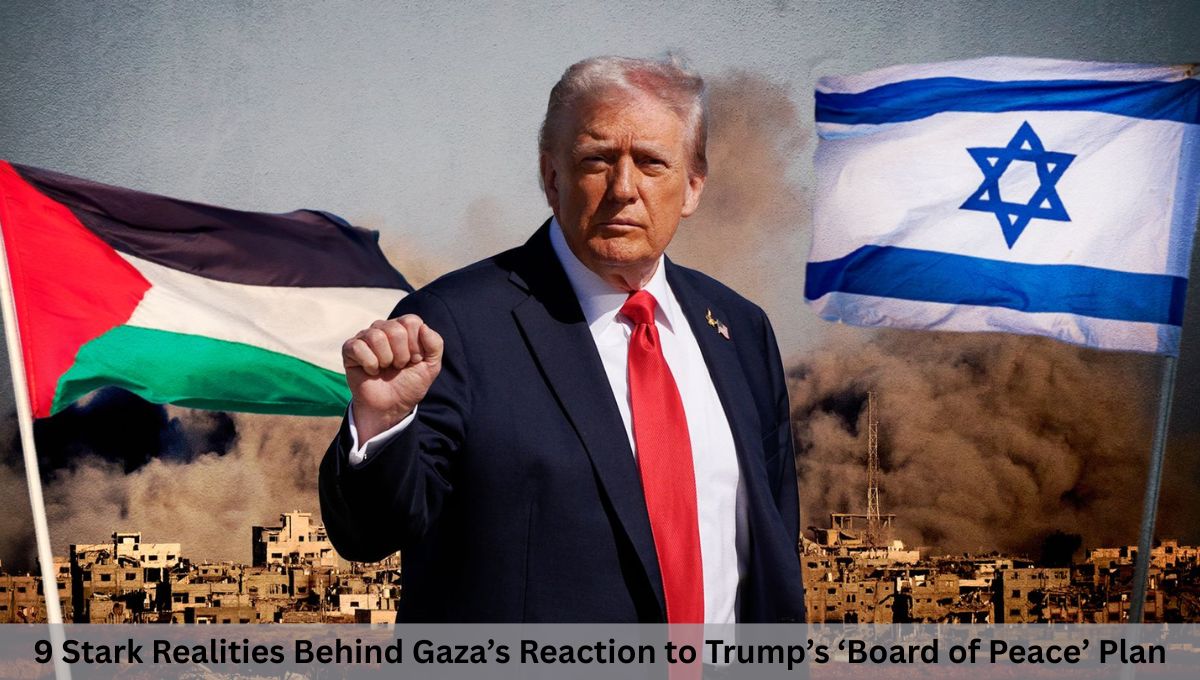
9 Stark Realities Behind Gaza’s Reaction to Trump’s ‘Board of Peace’ Plan, between fragile hope and deep scepticism. Peace feels like an abstraction in Gaza. Even as diplomats speak of ceasefire phases, governance transitions, and reconstruction frameworks, daily life in the besieged enclave remains dominated by fear, loss, displacement, and exhaustion.
Bombardment may have slowed since the ceasefire took effect in October, but it has not stopped. More than 450 Palestinians have been killed since the truce began, according to Gaza’s Health Ministry, including over 100 children.
Against this backdrop, the United States’ announcement of phase two of President Donald Trump’s Gaza ceasefire plan — including the creation of an international “Board of Peace” chaired by Trump himself — has been met in Gaza with a complicated blend of cautious hope and deep scepticism.
For many Palestinians, the question is simple:
Will this change anything on the ground?
9 Stark Realities Behind Gaza’s Reaction to Trump’s ‘Board of Peace’ Plan
Life in Gaza After the Ceasefire — A War That Never Fully Stopped
While diplomats describe the ceasefire as a success, Palestinians describe a different reality.
Israeli air strikes continue intermittently. Border crossings remain tightly controlled. Humanitarian aid flows inconsistently. Entire neighbourhoods lie in ruins. Hundreds of thousands of people remain in tents, facing winter storms, disease outbreaks, and food shortages.
“Peace, in both the physical and mental sense, feels far away,” said Arwa Ashour, a freelance journalist based in Gaza City.
“A lot of political decisions are distant from the reality faced in Gaza,” she explained. “Our daily life is filled with blockades, fear, loss, tents, and a terrible humanitarian situation. Even when decisions are made to ease the suffering, they are obstructed by the Israeli occupation authorities.”
What Is Trump’s ‘Board of Peace’?
The second phase of Trump’s 20-point Gaza peace plan, announced by US Special Envoy Steve Witkoff, aims to move beyond halting active fighting.
According to Witkoff, phase two focuses on:
- Demilitarisation
- Technocratic Palestinian governance
- Reconstruction
- Long-term stabilisation
At the centre of the plan is a Palestinian technocratic body, the National Committee for the Administration of Gaza (NCAG), which would handle daily governance.
Overseeing it all is a powerful international body: the Board of Peace, chaired by President Donald Trump.
Who Sits on the Board of Peace?
The White House has named an unusually influential lineup:
Board of Peace Members
- Donald Trump (Chair)
- US Secretary of State Marco Rubio
- Trump envoy Steve Witkoff
- Former UK Prime Minister Tony Blair
- World Bank President Ajay Banga
- Jared Kushner, Trump’s son-in-law
- Apollo Global Management CEO Marc Rowan
- US Deputy National Security Adviser Robert Gabriel
Key Gaza Officials
- Ali Sha’ath, former Palestinian Authority deputy minister, as head of the NCAG
- Nickolay Mladenov, former UN Middle East envoy, as High Representative for Gaza
- Major General Jasper Jeffers, commander of the International Stabilisation Force
Critics immediately raised concerns that the structure resembled a foreign trusteeship, with Palestinians holding limited decision-making power.
Cautious Hope — “If It Ends the Suffering, We Welcome It”
After two years of devastation and nearly two decades of Hamas rule, some Palestinians say change is desperately needed.
“People want everything back like it was before the war,” Ashour said. “Schools, hospitals, travel, a normal life.”
“If the Board of Peace is going to resolve all these crises, then we welcome it,” she added. “But if it’s unable to do so, then what is its benefit?”
This conditional optimism is widespread. Many Gazans say they no longer care who governs — only that the bombing stops and life becomes livable again.
‘Decisions Made Without Us’ — Fears of Palestinian Exclusion
One of the most common concerns voiced in Gaza is exclusion.
While the governance model includes Palestinian technocrats, ultimate authority rests with foreign officials — including US political figures with no accountability to Palestinians.
“People want to be part of creating the future, not just to accept decisions already made,” Ashour said.
Maha Hussaini, head of media and public engagement at Euro-Med Human Rights Monitor, warned that exclusion risks repeating historical failures.
“Decisions made without the meaningful participation of those most affected reproduce the same power structures that enabled this occupation and genocide,” she said.
Justice Missing From the Peace Plan
For many Palestinians, reconstruction without justice feels hollow.
More than 71,400 Palestinians have been killed since Israel’s offensive began in late 2023, according to Gaza’s Health Ministry — figures widely considered credible by the United Nations and independent experts.
“Peace does not mean silence after bombardment,” Hussaini said. “For Gaza, peace means safety, dignity, and freedom from collective punishment. It also means justice.”
Without accountability, she warned, peace becomes “a temporary arrangement that leaves the genocide intact.”
Hamas Signals Willingness to Step Aside — With Conditions
In a significant development, Hamas has welcomed the formation of the technocratic administration and said it is prepared to hand over governing responsibilities in Gaza.
A senior Hamas official told Reuters that the group views the move as potentially stabilising.
However, major questions remain:
- What happens to Hamas’s military wing?
- Will civil servants affiliated with Hamas be retained?
- Will Israel allow the new body to function independently?
Hamas has rejected demands to disarm entirely, insisting resistance is an internal Palestinian matter.
Demilitarisation — The Biggest Sticking Point
Demilitarisation lies at the heart of phase two — and may be its greatest obstacle.
Political analyst Ahmed Fayyad warned that Israel could weaponise demilitarisation requirements.
“Israel might attach demilitarisation to reconstruction, border crossings, education, and health investments,” he said.
“This will reflect negatively on civilians who yearn for an improvement to their harsh reality.”
Building a new Palestinian security force acceptable to Israel, he added, could take years — time Gaza’s civilians do not have.
Israel’s Role — The Ultimate Gatekeeper
No matter how detailed the plan, Gaza’s fate remains deeply shaped by Israel.
Israel controls:
- Airspace and sea access
- Border crossings
- Imports, exports, and fuel
- Security conditions for reconstruction
Fayyad said Israel has historically resisted political solutions that lead to Palestinian self-determination.
“Israel wants Gaza to be disarmed, exhausted, and focused only on survival,” he said. “Not on political rights.”
Netanyahu Calls Phase Two ‘Declarative’
Israeli Prime Minister Benjamin Netanyahu has publicly downplayed the significance of the second phase, calling it largely symbolic.
Even as the US announced progress, Israeli strikes continued, killing nine people in a single day.
The disconnect between diplomatic language and battlefield reality has only deepened Gaza’s scepticism.
What Reconstruction Really Means — $50 Billion and Years of Waiting
The UN estimates Gaza’s reconstruction will cost over $50 billion and take years.
Ali Sha’ath has outlined a three-year recovery timeline, starting with:
- Emergency shelter
- Clearing rubble and unexploded ordnance
- Restoring basic infrastructure
But funding pledges remain scarce, and Israel’s security conditions loom over every step.
‘Peace Is Sleeping Without Fear’ — Voices From Gaza
For Sami Balousha, a 30-year-old programmer displaced 17 times, peace is not geopolitical.
“It is simply to sleep at night assured that I wake up the next morning,” he said.
“I don’t think they understand our needs,” he added. “I don’t think we are being listened to seriously.”
Balousha fears Gaza’s current misery may become permanent.
“I am afraid the next generation will accept living in an open grave,” he said. “People are tired — so tired — but they want to live.”
Scepticism and Hope — Both Fragile
Rights advocates say Gazans have learned to distrust announcements labelled “turning points”.
“There is more fear than hope,” Hussaini said. “Hope exists, but it is fragile.”
The Board of Peace may represent a diplomatic breakthrough — or another externally imposed framework that fails to protect civilians.
Conclusion: A Plan Tested by Reality, Not Rhetoric
Trump’s Board of Peace is ambitious, unprecedented, and controversial.
For Palestinians in Gaza, its success will not be measured by board members or press releases — but by tangible change:
- No bombs at night
- Real access to food and medicine
- Homes instead of tents
- Freedom instead of fear
Until then, Gaza watches with scepticism — and a hope tempered by experience.
Also Read: 7 Key Takeaways as the UN Approves Trump’s Gaza Peace Plan
Also Read: Trump names Tony Blair, Jared Kushner to Gaza ‘Board of Peace’
Related Posts:
- Trump’s 20-Point Gaza Peace Plan Gains Urgent Global…

- 7 Heartbreaking Facts About Venezuela's Earthquake Disaster
- Dramatic Moments Behind Trump’s Gaza Peace Push and…

- 5 Major Takeaways from the US Supreme Court's…

- 5 Powerful Highlights as Trump Lands Second Nobel…

- Israel–Hamas Ceasefire Under Strain: 4 More Hostage…
