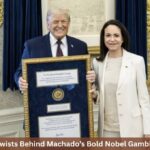
7 Alarming Reasons Trump Accepting Machado’s Nobel Medal Is No Laughing Matter in post-Maduro Venezuela.What looked, at first glance, like political theatre bordering on farce — Donald Trump accepting a Nobel Peace Prize medal he did not win — may turn out to be one of the most revealing moments of his second presidency.
Late-night comedians laughed. Critics mocked. Social media erupted with memes.
But the episode involving Venezuelan opposition leader María Corina Machado handing over her Nobel Peace Prize medal to President Donald Trump is no joke. It is a window into a dangerous mix of personal vanity, transactional diplomacy, and foreign policy decisions with life-and-death consequences.
At stake is not only Venezuela’s future, but the integrity of how the United States wields power abroad.
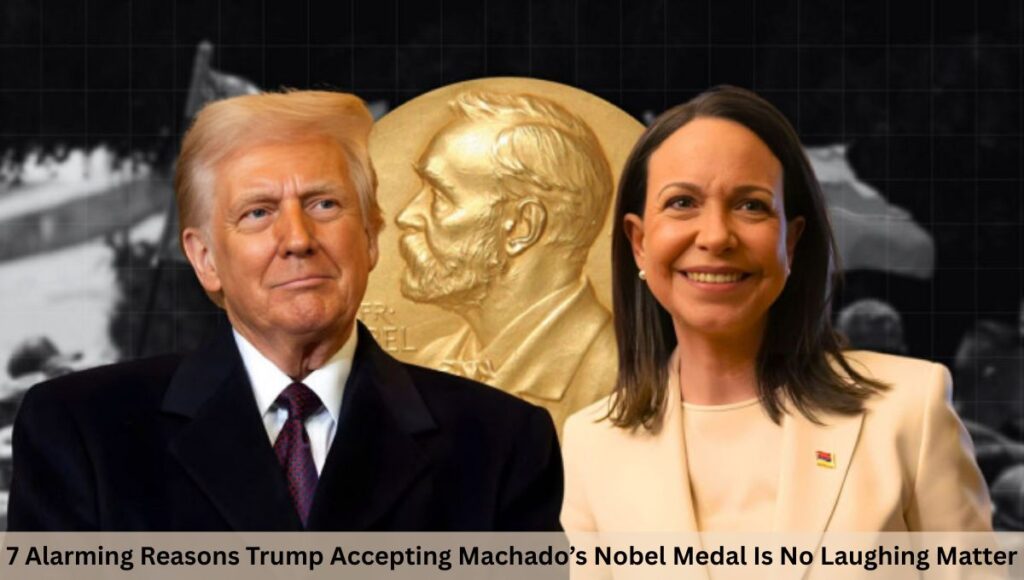
7 Alarming Reasons Trump Accepting Machado’s Nobel Medal Is No Laughing Matter
Why the Medal Matters — Even If the Prize Can’t Be Transferred
The Norwegian Nobel Committee has been unequivocal:
The Nobel Peace Prize is inseparable from its laureate.
Machado remains — and will always remain — the official Nobel Peace Prize winner. The medal is merely a physical object, one she is legally allowed to give away, sell, or donate.
But symbols matter in geopolitics.
And in this case, the symbol is a foreign political leader gifting the world’s most prestigious peace award medal to a US president known for craving recognition — at a moment when that same president holds enormous leverage over her country’s fate.
Trump’s Long Obsession With the Nobel Prize
Donald Trump’s fixation on winning the Nobel Peace Prize predates this episode by years.
During his first term, he openly complained that Barack Obama had received the award “for nothing,” while he believed his own actions — from North Korea diplomacy to Middle East normalization deals — deserved similar recognition.
That obsession never faded.
In recent months, Trump:
- Accepted a newly created “FIFA Peace Prize”, widely viewed as a vanity award
- Publicly praised foreign leaders who flattered his “historic” role in global peace
- Repeatedly hinted that the Nobel Committee had “missed” his contributions
Against this backdrop, Machado’s gesture was not accidental — and certainly not naïve.
From Dedication to Deployment — A Timeline That Raises Eyebrows
October — The Dedication
When Machado won the Nobel Peace Prize in October, she quickly dedicated it not just to Venezuelans — but to Trump himself.
“Today, more than ever, we count on President Trump… as our principal ally to achieve freedom and democracy.”
It was an extraordinary political signal.
December — The Appeal
In a CNN interview with Christiane Amanpour, Machado escalated her message, pleading for US intervention to end what she described as Maduro’s “war” on Venezuela.
She stopped just short of explicitly calling for military action — but did not deny it when pressed.
January 3 — The Ouster
Less than three months later, US forces carried out a direct operation to remove Nicolás Maduro, abducting him and transporting him to the United States to face narcotics charges.
The speed and decisiveness stunned even seasoned Venezuela watchers.
And Then Came the Snub
If Machado believed her flattery had secured her political future, she was quickly disabused of that notion.
On the very day Maduro was removed, Trump publicly refused to back Machado as Venezuela’s next leader.
“It would be very tough for her to be the leader,” Trump said. “She doesn’t have the respect within the country.”
Instead, Trump signaled comfort with Delcy Rodríguez, Maduro’s former vice president — a move that shocked Venezuelan pro-democracy activists.
Two days later, Fox News host Sean Hannity floated the idea of Machado giving Trump her Nobel medal.
Machado did not dismiss it.
Within days, it happened.
A Gift, a Bargain, or Political Pressure?
There are two plausible interpretations — neither reassuring.
Scenario One — Subtle Coercion
Machado, having risked her life for democracy, may have felt compelled to offer her most valuable symbolic asset to keep Trump engaged.
If so, it reflects an alarming power imbalance:
A Nobel laureate bargaining for her country’s future with a medal.
Scenario Two — Strategic Leverage
Alternatively, Machado knowingly used the medal as currency — a calculated attempt to influence the most transactional president in modern US history.
Given the stakes — political survival, democratic transition, and national sovereignty — few would blame her.
But both scenarios point to the same underlying problem.
Flattery as Foreign Policy
Trump has never hidden his responsiveness to praise.
From NATO leaders to autocrats, those who flatter him often receive warmer treatment than those who challenge him — regardless of democratic credentials.
This episode underscores the risks of that approach.
When:
- Regime change
- Interim governance
- Control over oil reserves
- Recognition of legitimate leadership
can be influenced — even marginally — by personal adulation, the system becomes dangerously arbitrary.
The Emoluments Clause — And Why It Still Matters
The US Constitution’s Emoluments Clause exists precisely to prevent foreign influence over American officials.
“Foreign powers will intermeddle in our affairs, and spare no expense to influence them.”
— Elbridge Gerry
Legally, Machado’s gift likely does not violate the clause. She is not a head of state, and precedent exists — including Barack Obama accepting his Nobel Prize in 2009.
But legality is not legitimacy.
The concern is not corruption in the narrow sense — but influence through symbolism.
History Shows Medals Carry Power
Machado is not the first Nobel laureate to part with her medal.
- Dmitry Muratov auctioned his medal for $103.5 million to help Ukrainian children
- Niels Bohr sold his medal to fund war relief
- Knut Hamsun infamously gave his to Nazi propagandist Joseph Goebbels
Each act sent a message — noble or grotesque.
Machado’s message was clear:
Trump matters more than the medal itself.
Venezuela’s Future — Still Uncertain
Despite the gift, Trump has not changed his stance.
- He continues to sideline Machado
- He favors a managed transition via Delcy Rodríguez
- His focus remains oil, stability, and leverage — not democratic symbolism
Machado remains popular among Venezuelans and the diaspora, but Washington holds the keys.
And Trump has shown that personal interest often precedes institutional logic.
Why This Episode Should Worry Americans
This is not about mockery or memes.
It is about whether:
- US foreign policy is guided by strategy or ego
- Democratic movements must flatter rather than persuade
- Symbolic gifts can tilt decisions with global consequences
If personal accolades — even borrowed ones — influence presidential judgment, then national interest becomes secondary.
Conclusion: Not a Joke — A Warning
Trump accepting María Corina Machado’s Nobel Peace Prize medal may look absurd.
But beneath the spectacle lies a sobering truth:
Power, vanity, and desperation have collided at a critical geopolitical moment.
Machado gave up a medal. Trump gained a symbol he always wanted.
What Venezuela — and the world — may pay in return is still unclear. But history suggests that when flattery becomes policy, the costs are never trivial.
Also Read: Trump’s 2025 Nobel Peace Prize Snub: Politics Over Global Peace
Also Read: “Unbelievably Embarrassing”: Outrage Over Machado’s Nobel Prize Gift To Trump