
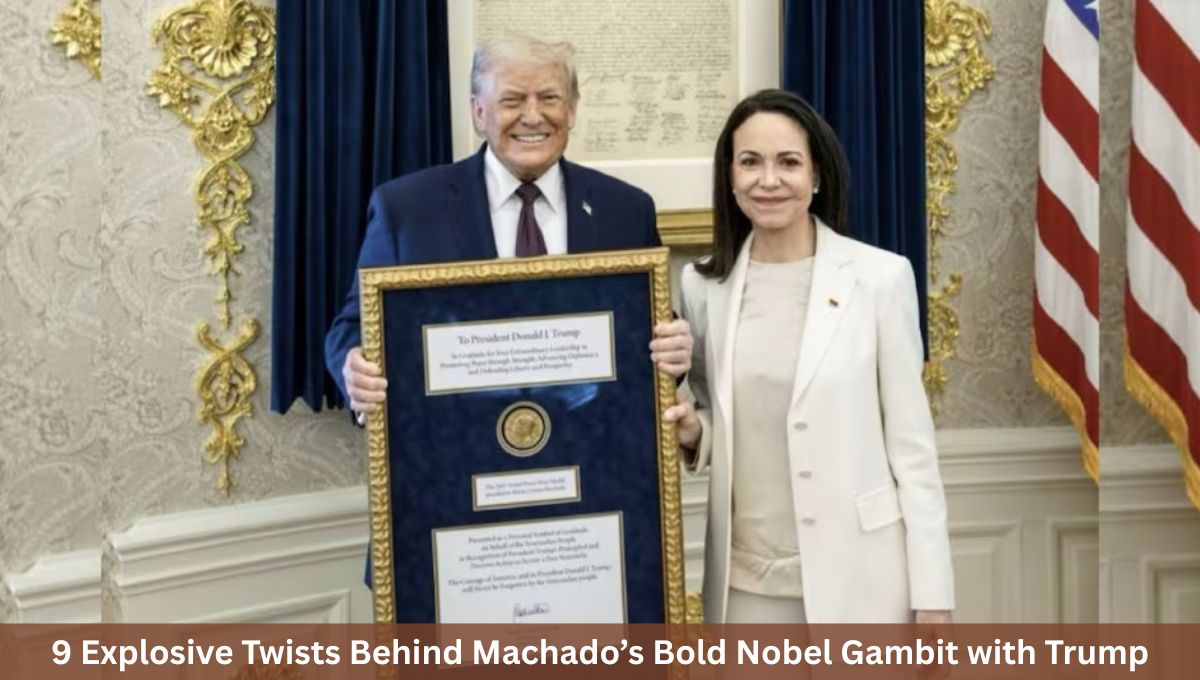
9 Explosive Twists Behind Machado’s Bold Nobel Gambit with Trump, as she seeks US backing for a post-Maduro transition. When Venezuelan opposition leader María Corina Machado walked into the White House this week, she carried with her one of the world’s most powerful political symbols: a Nobel Peace Prize medal.
For US President Donald Trump, the Nobel has long represented an elusive personal ambition. For Machado, the medal represented something far more urgent—a final attempt to secure Washington’s backing in Venezuela’s chaotic post-Maduro transition.
What followed was a meeting heavy with symbolism, historical anecdotes, and political theater—but short on guarantees. Machado left the White House holding a Trump-branded swag bag, smiling for photographs, and insisting the meeting was “historic.”
What she did not leave with was a clear US endorsement of her leadership ambitions. The episode encapsulates the volatility, contradictions, and raw power politics shaping Venezuela’s future.
9 Explosive Twists Behind Machado’s Bold Nobel Gambit with Trump
A Meeting Laden With Symbolism—and Desperation
Machado’s White House visit came at an extraordinary moment.
Former Venezuelan president Nicolás Maduro had been dramatically captured by US special forces earlier this month and flown to New York to face narcotics trafficking charges—an operation that sent shockwaves through Latin America and beyond.
In theory, this should have opened the door for Venezuela’s long-oppressed opposition to step into power.
In reality, it created a vacuum—one that Washington quickly filled by backing Delcy Rodríguez, Maduro’s former vice president, as acting president.
Machado, widely regarded as the moral and political face of Venezuela’s democratic opposition, found herself sidelined at the very moment she expected vindication.
Her response was audacious. She brought Trump a Nobel Peace Prize.
The Nobel Gesture: Gratitude or Political Currency?
Machado won the 2025 Nobel Peace Prize for her campaign to promote democracy and human rights in Venezuela. From the moment the award was announced, she framed it not only as personal recognition but as a collective honour for the Venezuelan people—and for Trump.
“I dedicate this prize to the suffering people of Venezuela and to President Trump,” she said last October, praising his “decisive support” for the democratic cause.
Her decision to physically present the medal to Trump was unprecedented—and controversial.
A White House photo showed Trump holding a gold-framed plaque containing the medal and a dedication praising his role in securing “a free Venezuela.” Trump later posted on Truth Social:
“María presented me with her Nobel Peace Prize for the work I have done. Such a wonderful gesture of mutual respect.”
The Nobel Committee was swift to respond.
What the Nobel Rules Actually Say
The Norwegian Nobel Institute reiterated a long-standing rule:
A Nobel Peace Prize cannot be transferred, shared, or revoked.
“A medal can change owners, but the title of a Nobel Peace Prize laureate cannot,” the committee said.
In practical terms, Trump can display the medal—but he does not become a Nobel laureate.
Machado remains the sole official recipient.
The clarification underscored a broader truth: while symbols matter in politics, they cannot rewrite institutional reality.
Trump’s Calculus: Stability Over Sentiment
Despite the theatrics, Trump’s position on Venezuela appears unchanged.
The administration continues to view Delcy Rodríguez as a more stable, pragmatic interlocutor—someone Washington believes it can work with on oil flows, prisoner releases, and regional security.
White House Press Secretary Karoline Leavitt was blunt:
“At this moment in time, the president’s opinion on Ms. Machado’s leadership prospects has not changed.”
Trump himself has repeatedly questioned Machado’s domestic support, saying she lacks the respect needed to govern Venezuela.
For a president who prides himself on deal-making, Machado’s moral authority may matter less than Rodríguez’s perceived ability to keep Venezuela functioning—and cooperative.
A Closed-Door Meeting That Raised More Questions Than Answers
Unlike Trump’s typically theatrical Oval Office encounters, his meeting with Machado was held behind closed doors, with no joint press conference and no formal readout.
The two reportedly spoke over lunch for just over an hour.
Outside, supporters cheered as Machado emerged, telling them:
“We can count on President Trump.”
Yet even sympathetic US lawmakers later acknowledged she received no concrete commitments.
Senator Chris Murphy confirmed Machado warned of instability if elections or a transition were delayed—but said the White House offered no timetable or guarantees.
Machado’s Personal Stakes—and Long Political Struggle
Machado’s journey to this moment has been marked by resilience and sacrifice.
Once a member of Venezuela’s National Assembly, she was removed from office, prosecuted, and repeatedly disqualified from running for president. She spent months in hiding and eventually fled the country in a daring escape by sea.
In the October 2023 opposition primary, she won more than 92 percent of the vote—an overwhelming mandate that was later nullified by government-aligned courts.
When elections were held in 2024, opposition-backed candidate Edmundo González Urrutia appeared to win decisively, based on independently obtained tallies. Maduro nevertheless claimed victory, triggering mass protests and a brutal crackdown.
For Machado, the Nobel Prize was both validation and shield.
But it has not translated into political power.
Why Trump Backed Rodríguez Instead
Trump’s support for Rodríguez shocked many anti-Maduro figures.
Rodríguez is a longtime Chavista insider who has defended Maduro’s legitimacy and denounced US actions as violations of international law—even while cooperating with Washington behind the scenes.
Analysts suggest Trump’s choice reflects cold symbolism-free calculation.
Rodríguez controls the bureaucracy, the security apparatus, and—critically—the oil sector.
She has signalled openness to foreign investment and legal reforms, even as she maintains Chavismo’s ideological language.
From Trump’s perspective, Rodríguez represents continuity without Maduro—a manageable outcome.
Oil, Power, and the Real Drivers of Policy
Venezuela’s vast oil reserves loom over every political decision.
Since Maduro’s capture, US forces have seized multiple sanctioned oil tankers, tightening Washington’s grip on Venezuelan crude exports.
A first US-brokered sale of Venezuelan oil worth around $500 million has already been finalised.
Rodríguez has pledged to revisit Venezuela’s hydrocarbon laws to allow greater foreign involvement—music to Washington’s ears.
Machado, by contrast, represents uncertainty.
Human Rights: Still an Open Wound
Despite recent prisoner releases, Venezuela remains deeply repressive.
Human rights group Foro Penal estimates at least 804 political prisoners remain behind bars, with some counts running much higher.
Machado has insisted that rebuilding institutions, protecting free speech, and ensuring genuine elections are essential for Venezuelans to return home.
Whether Washington will prioritise those goals over stability remains unclear.
The Optics vs the Reality
The image of Machado leaving the White House clutching a Trump-branded gift bag has become emblematic of the meeting’s imbalance.
It captured a moment where symbolism flowed one way—and power the other.
The Nobel medal, meant as a gesture of gratitude and persuasion, may ultimately be remembered as a symbol of how limited moral authority can be when confronted with realpolitik.
A Political Gamble That May Still Pay Off
Despite the lack of immediate gains, Machado has not been sidelined entirely.
She retains strong support among Venezuelans and has cultivated allies on Capitol Hill, where bipartisan sympathy for the opposition remains high.
Experts argue excluding her coalition from governance would undermine legitimacy.
“It would be very illegitimate to exclude those who genuinely represent the Venezuelan people,” said Renata Segura of the International Crisis Group.
In that sense, Machado’s gamble may yet yield returns—just not on her timetable.
Why This Moment Matters Beyond Venezuela
The episode highlights a broader truth about global politics in the Trump era:
- Symbolism matters—but only to a point
- Moral clarity does not guarantee power
- Stability often trumps democracy in US foreign policy
- Personal relationships shape outcomes as much as institutions
For Venezuela, the future remains unresolved.
For Machado, the Nobel Prize remains hers alone—but the presidency does not.
Conclusion: A Medal, a Moment, and a Missed Promise
María Corina Machado came to Washington with history on her side, moral authority in her hands, and a nation’s hopes on her shoulders.
She left with photographs, praise, and a souvenir bag—but no clear promise of US support.
The Nobel medal may glitter, but Venezuela’s political reality remains grimly opaque. And for now, the future of a post-Maduro Venezuela will be decided not by symbolism—but by power, oil, and the cold arithmetic of geopolitics.
Also Read: Israel Awards Highest Honor to Trump in 2025 for Gaza Peace Efforts
Also Read: Why Maria Machado presented Trump with her Nobel Peace Prize medal. Venezuelan leader explains
Related Posts:
- 7 Alarming Reasons Trump Accepting Machado’s Nobel…
- Trump’s 2025 Nobel Peace Prize Snub: Politics Over…

- 7 Shocking Reasons FIFA’s Peace Prize for Trump…

- Trump’s Nobel Peace Prize Bid: Gaza Peace Plan, 8…
- Trump Says “They Won’t Give It to Me” as Pakistan…
- Dramatic Moments Behind Trump’s Gaza Peace Push and…
