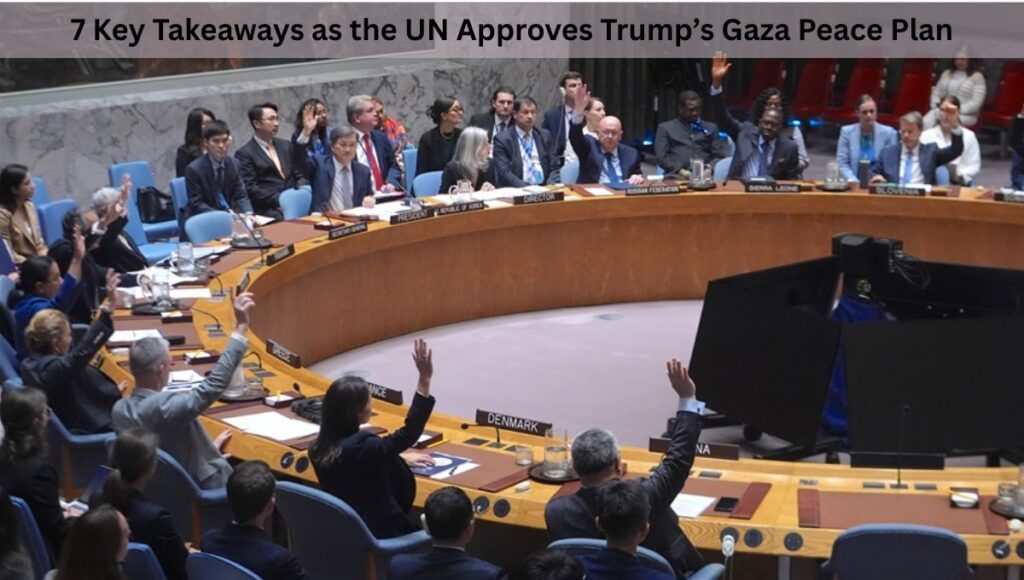
7 Key Takeaways as the UN Approves Trump’s Gaza Peace Plan and Hamas rejects it. The United Nations Security Council (UNSC) has taken a landmark step by adopting a US-drafted resolution endorsing President Donald Trump’s 20-point Gaza peace plan—an ambitious blueprint that aims to end two years of devastating conflict, rebuild the Gaza Strip, and create a structured path toward Palestinian self-determination.
Thank you for reading this post, don't forget to subscribe!Backed by 13 of the 15 Security Council members, the resolution marks the first time the international community has formally thrown its weight behind a comprehensive, internationally-coordinated stabilisation and reconstruction mission in Gaza.
Russia and China, both veto-holding members, abstained but did not block the resolution—an outcome many diplomats viewed as pivotal. The plan’s endorsement not only elevates Trump’s Gaza roadmap into an internationally backed mandate but also authorizes the creation of two major mechanisms: an International Stabilisation Force (ISF) and a transitional governance body called the Board of Peace (BoP).
However, Hamas forcefully rejected the resolution within minutes of its passage, labelling it an attempt to impose “international guardianship” on Gaza and criticizing provisions that require the dismantling and disarmament of armed groups. This article breaks down the significance of the UNSC vote, the details of Trump’s 20-point plan, the reactions from regional stakeholders, and what the new roadmap could mean for the future of Gaza, Israel, and Palestinian statehood.
7 Key Takeaways as the UN Approves Trump’s Gaza Peace Plan
What the UN Security Council Approved
The adopted resolution transforms Trump’s Gaza plan from a US-driven diplomatic proposal into an internationally recognised framework. It outlines the mandate for:
1. A temporary International Stabilisation Force (ISF)
The ISF will operate with UN backing to:
- Support demilitarisation of Gaza
- Secure streets and key facilities
- Escort humanitarian aid
- Work with Israel, Egypt, and vetted Palestinian police units
- Oversee the dismantling of tunnels, weapons factories, and armed actors
According to US Ambassador Mike Waltz, several Muslim-majority nations—including Indonesia and Azerbaijan—have agreed in principle to contribute troops under a unified command structure.
2. A transitional governance authority called the Board of Peace (BoP)
The BoP will:
- Oversee Gaza’s reconstruction
- Supervise a Palestinian technocratic, apolitical committee
- Coordinate humanitarian aid
- Support governance reforms and civil administration
- Facilitate a future handover to the Palestinian Authority (PA)
Trump announced he will chair the Board of Peace, with the full membership list to be released “soon.”
3. A pathway toward Palestinian self-determination
At the insistence of several member states—particularly France, the UK, and Arab nations—the resolution includes language referencing a future pathway to Palestinian statehood.
This clause became a flashpoint in Israel’s internal politics.
Hamas Rejects the Resolution: “International Trusteeship”
While the US and its allies praised the UNSC vote as a diplomatic breakthrough, Hamas dismissed the decision as illegitimate and dangerous.
Hamas argued:
- The resolution “fails to meet Palestinians’ rights and demands.”
- It imposes “international guardianship” or “trusteeship” over Gaza.
- The stabilisation force is not neutral if it is tasked with disarming armed groups.
- Disarmament is viewed as support for Israel’s demands, not Palestinian rights.
In statements released via Telegram and quoted widely by media, Hamas said that assigning the ISF to conduct operations “strips it of neutrality and turns it into a party to the conflict in favour of the occupation.”
This uncompromising stance signals possible resistance to implementation, especially regarding demilitarisation.
Trump Calls It a “Historic” Global Victory
Within minutes of the vote, Donald Trump posted a celebratory message on his social media platform, calling the UN Security Council’s decision:
- “One of the biggest approvals in the history of the United Nations.”
- “A moment of true historic proportion.”
- “A step that will lead to peace all over the world.”
Trump also emphasized that the Board of Peace will include “the most powerful and respected leaders throughout the world” and said additional announcements will follow in the coming weeks.
His supporters hailed the resolution as validation of his approach to Middle East crisis management, positioning it as a major foreign-policy victory.
Israel’s Reaction: Support for Demilitarisation, But No Statehood
Israeli Prime Minister Benjamin Netanyahu welcomed the plan’s emphasis on the demilitarisation of Gaza and the dismantling of Hamas. However, he categorically rejected any implication that the resolution supports the creation of a Palestinian state.
Netanyahu said Israel would ensure Gaza’s demilitarisation “the easy way or the hard way,” reiterating his long-held stance against a fully sovereign Palestinian state.
The Israeli government remains concerned that international involvement—particularly through the Board of Peace—could limit Israel’s operational freedom in Gaza.
The 20-Point Gaza Peace Plan: Inside Trump’s Blueprint
Trump’s peace plan is extensive, covering governance, humanitarian aid, reconstruction, demilitarisation, and long-term political goals. Below is a concise overview of its core components:
1. Gaza becomes a deradicalised, “terror-free zone.”
All militant and offensive capabilities will be removed.
2. Massive reconstruction effort.
Hospitals, power, water, roads, homes, and critical infrastructure will be rebuilt with international aid.
3. Fighting stops immediately upon acceptance.
Israeli troops pull back to designated lines.
4. Hostages returned within 72 hours.
5. Israel releases prisoners and detainees.
Including 250 life-sentence prisoners and 1,700 Gazans detained after 7 October 2023.
6. Amnesty for disarmed Hamas members.
7. Large-scale humanitarian aid flows in.
8. Aid distribution managed by UN, Red Crescent, and neutral bodies.
9. Gaza governed by a Palestinian technocratic committee.
10. Trump will lead a redevelopment initiative with global experts.
11. A special economic zone created for Gaza.
12. No forced displacement.
13. Hamas barred from governance entirely.
14. Regional states will guarantee compliance.
15. International Stabilisation Force deployed immediately.
16. Israel will not annex or occupy Gaza.
17. Humanitarian assistance continues even if Hamas rejects the plan.
18. Interfaith dialogue programme launched.
19. Conditions created for a credible path to Palestinian statehood.
20. US will facilitate Israel-Palestinian political dialogue.
These points reflect Trump’s attempt to balance Israel’s security demands with international calls for Palestinian political rights and long-term stability.
Russia and China Abstain: Why They Didn’t Block the Plan
Russia and China, both permanent members with veto power, abstained for several reasons:
Russia’s Concerns
- Lack of clarity on Board of Peace composition
- Limited UN role in oversight
- Insufficient guarantees on a two-state solution
- Fear the plan undermines multilateral diplomacy
Russian diplomats warned the resolution must not become “a death knell for the two-state solution.”
China’s Objections
- Claimed Palestinian sovereignty was “barely visible” in the text
- Wanted stronger language on Palestinian ownership of the process
- Objected to ambiguities in governance and security arrangements
However, both countries ultimately allowed the resolution to pass, largely because the Palestinian Authority and multiple Arab nations endorsed it.
Why the Palestinian Authority Backed the Resolution
The Palestinian Authority (PA), which governs parts of the West Bank, issued a statement supporting the resolution, calling for its “urgent and immediate” implementation.
The PA saw key benefits:
- A structured path toward Palestinian statehood
- A transitional authority that excludes Hamas
- International oversight of reconstruction
- Security arrangements that reduce Israeli unilateral control
- A return to diplomatic engagement with the US and Arab partners
For PA leadership, the resolution represents both an opportunity to regain political relevance and a step toward long-term statehood aspirations.
Arab States Push for Self-Determination Language
Egypt, Saudi Arabia, Turkey, Qatar, the UAE, and Jordan were instrumental in shaping the final text. They demanded explicit references to:
- Palestinian self-determination
- A credible pathway to statehood
- A governance transition that excludes Hamas
- An end to indefinite occupation
Their coordinated diplomatic pressure ensured that Palestinian political rights were not sidelined.
What Happens Next? Implementation Challenges Ahead
Despite the historic vote, the plan faces multiple obstacles:
1. Hamas refuses to disarm
Without Hamas acceptance, demilitarisation will be extremely difficult.
2. Israel rejects Palestinian statehood
This creates tension with key elements of the resolution.
3. Transition timelines remain vague
The resolution provides no fixed deadlines for the PA to assume control.
4. International Stabilisation Force must deploy quickly
Logistics, troop contributions, and command structure are still unclear.
5. Rebuilding Gaza requires billions in funding
The World Bank-backed trust fund is only a starting point.
6. Civilian trust in governance is low
Gaza residents remain wary of both external control and internal political actors.
7. Competing regional interests remain in play
Iran, Qatar, Turkey, Egypt, UAE, and Saudi Arabia will all vie for influence.
The Significance of the UNSC Vote
The UN Security Council’s decision does not end the Gaza conflict overnight. But it represents:
- The first internationally legitimized roadmap for Gaza’s recovery
- A major shift from unilateral military approaches to multilateral peacekeeping
- Strong global endorsement of a ceasefire and reconstruction framework
- Renewed momentum toward a two-state solution
- A diplomatic victory for the United States
Whether it will succeed depends heavily on implementation, cooperation, and political will from all sides.
Conclusion: A New Phase Begins—but Uncertainty Remains
The UNSC’s endorsement of Trump’s Gaza peace plan is undoubtedly a historic development. For the first time, an internationally backed transitional authority and stabilisation force will take on the enormous challenge of rebuilding Gaza and charting a political future for Palestinians.
Yet the plan faces strong opposition from Hamas, scepticism from Israel, and practical hurdles that could delay or derail implementation. The coming months will determine whether this international mandate becomes a turning point for peace—or another stalled initiative in the long and tragic history of the Israeli-Palestinian conflict.
Also Read: Trump’s 2025 Gaza Peace Plan Signing and Historic Global Reaction
Also Read: Mixed reactions to UN Security Council approval of Gaza plan
Related Posts:
- Trump’s 20-Point Gaza Peace Plan Gains Urgent Global…

- Trump’s 2025 Gaza Peace Plan Signing and Historic…

- Dramatic Moments Behind Trump’s Gaza Peace Push and…

- Trump’s Breakthrough Gaza Ceasefire Deal 2025: Key Insights

- Israel–Hamas Ceasefire Under Strain: 4 More Hostage…

- Hamas Divided Over Trump’s Gaza Ceasefire Plan as…