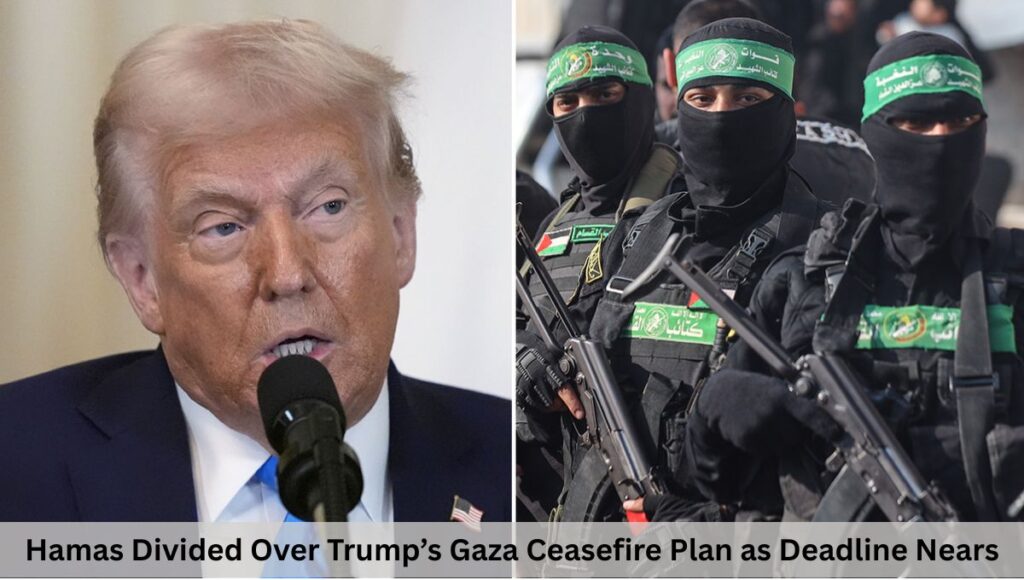
Hamas Divided Over Trump’s Gaza Ceasefire Plan as Deadline Nears with military leaders rejecting disarmament and political leaders weighing conditional acceptance. The war in Gaza, approaching its second anniversary, has entered a decisive phase. United States President Donald Trump has unveiled a 20-point Gaza ceasefire plan that Israel has already endorsed. Yet, the proposal has placed Hamas at a crossroads.
While Trump set a deadline of three to four days for a response, Hamas remains internally divided. Its military leadership in Gaza has strongly rejected the plan’s demand for disarmament, while its political bureau in Doha and Istanbul has shown cautious openness, seeking revisions before possible acceptance.
International mediators—chiefly Egypt, Qatar, and Turkey—are pressing Hamas to compromise. Meanwhile, Israeli Prime Minister Benjamin Netanyahu has issued stark warnings, vowing to “finish the job” if Hamas stalls or refuses outright.
This article explores in depth the Trump ceasefire plan, Hamas’s internal divisions, international reactions, and the implications for Israel, the Palestinians, and the broader Middle East.
Hamas Divided Over Trump’s Gaza Ceasefire Plan as Deadline Nears
Trump’s 20-Point Gaza Ceasefire Proposal
Key Elements of the Plan
The proposal, formally titled the “Comprehensive Plan to End the Gaza Conflict,” outlines sweeping terms designed to halt nearly two years of bloodshed. Its main pillars include:
- Immediate Ceasefire between Israel and Hamas.
- Hostage Exchange: Hamas must release all 48 remaining hostages, alive or deceased, within 72 hours. In return, Israel would release over 1,000 Palestinian prisoners, including 250 serving life sentences.
- Israeli Withdrawal: Gradual retreat of the Israeli military to a buffer zone along Gaza’s perimeter, with no annexation or occupation of Gaza.
- Disarmament of Hamas: All weapons must be surrendered. Members willing to renounce violence would receive amnesty; others would be granted safe passage to third countries such as Egypt, Jordan, Qatar, or Iran.
- International Stabilisation Force (ISF): A temporary multinational security force, backed by Arab and US partners, would oversee Gaza’s security and train vetted Palestinian police forces.
- Transitional Governance: Gaza would be managed by a technocratic Palestinian committee under the oversight of an international “Board of Peace”, headed by Trump and including figures like Tony Blair.
- Humanitarian Assistance: Large-scale entry of food, medicine, fuel, and reconstruction materials under UN and Red Crescent supervision.
- Future Pathway: A “credible path” to Palestinian statehood, contingent on Gaza being secure and demilitarised.
Israel’s Response
Netanyahu’s government quickly endorsed the plan, noting it incorporated many of Israel’s demands. Yet, Netanyahu simultaneously undercut the US framework by stating Israel would maintain military presence in parts of Gaza and “forcibly resist” Palestinian statehood.
This contradiction between Israel’s acceptance and its leader’s rejection of key terms complicates prospects for implementation.
Hamas’s Response: Deep Divisions
Military Leadership’s Objection
According to BBC reports, Izz al-Din al-Haddad, the head of Hamas’s military wing in Gaza, views the plan as an existential threat. He reportedly believes that whether Hamas accepts or rejects the deal, it is designed to “finish” the movement.
Hamas’s armed wing opposes:
- Disarmament, a non-negotiable red line.
- The surrender of hostages within 72 hours, giving up their last bargaining chip.
- The deployment of an international stabilisation force, perceived as a new form of occupation.
Many fighters, especially younger militants, argue Israel is under long-term strategic strain and Hamas should hold out militarily rather than capitulate.
Political Leadership’s Calculations
In contrast, Hamas’s political leaders in Doha and Istanbul have signaled willingness to treat Trump’s plan as a basis for negotiations.
- They see value in the prisoner release, which could be framed as a victory.
- They want adjustments to withdrawal timelines and governance structures.
- They emphasize guarantees for Palestinian return to northern Gaza, now devastated and depopulated.
Hamas official Mohammed Nazzal told Al Jazeera that the group would respond “soon” but would not rush “under the logic that time is a sword pointed at our neck.”
Shared Red Lines
Despite differences, analysts argue Hamas is unified on disarmament. Armed struggle is embedded in its identity, and surrendering weapons without a political process or two-state solution remains unacceptable.
The Hostage Question
The fate of 48 hostages still held in Gaza lies at the heart of negotiations.
- Israel believes only 20 are alive.
- Families in Israel protest weekly, demanding their return.
- Hamas views hostages as their last negotiating leverage.
The Trump plan’s demand for their immediate release within 72 hours is viewed by Hamas as unrealistic and strategically dangerous.
International Mediation
Egypt’s Role
Egyptian Foreign Minister Badr Abdelatty has stressed the need for Hamas to disarm, warning against giving Israel a pretext for continued bloodshed. Speaking in Paris, he condemned Israel’s assault as “ethnic cleansing and genocide in motion”, but urged Hamas to avoid escalation.
Cairo, coordinating with Qatar and Turkey, insists displacement of Palestinians will not be tolerated, calling it the “end of the Palestinian cause.”
Qatar and Turkey
Qatar and Turkey, both hosts of Hamas’s political leadership, are urging constructive engagement. Doha in particular has played a central role in hostage negotiations throughout the conflict.
Broader International Reaction
- European Union: Called on Hamas to accept, release hostages, and disarm.
- Russia: Expressed conditional support if the plan leads to a two-state solution.
- France: Declared Hamas “has lost” and must accept its “own surrender.”
- Arab States: Eight Arab and Muslim nations—including Saudi Arabia, Egypt, Qatar, and Jordan—welcomed the proposal.
Obstacles and Controversies
Buffer Zone Concerns
The US plan envisions a security buffer zone inside Gaza along the borders with Egypt and Israel. Critics argue this is effectively a rebranded occupation. Hamas fears it could give Israel permanent control.
Governance by Foreign Bodies
The creation of an international Board of Peace, chaired by Trump and including Tony Blair, has raised alarm. Blair’s legacy in the Iraq war makes him deeply unpopular in the Arab world.
Analysts warn this looks like another attempt to reshape the Middle East from outside, repeating the mistakes of Iraq.
Lack of Palestinian Input
Hamas, as well as other Palestinian factions, were excluded from the drafting process. The plan reflects Israeli conditions, undermining its legitimacy among Palestinians.
Humanitarian Crisis in Gaza
The war has inflicted catastrophic losses:
- 66,225 killed, according to Hamas-run health ministry (mostly women and children).
- UN experts estimate the real death toll could be three times higher.
- 2.3 million people displaced, many multiple times.
- Northern Gaza has been largely reduced to rubble, with famine spreading.
While Trump’s plan promises massive aid flows, Hamas fears this will only occur in areas controlled by the international stabilisation force—leaving other zones vulnerable.
Why Hamas Hasn’t Responded Yet
Four days after the plan’s unveiling, Hamas has not issued an official reply. Key reasons include:
- Divisions between military hardliners in Gaza and political pragmatists abroad.
- Disarmament demand, seen as unacceptable across all factions.
- Unclear withdrawal timelines for Israeli forces.
- Absence of guarantees for Palestinian political rights or statehood.
- Fear of betrayal by Israel, especially after its past violations of ceasefires.
Trump’s Legacy and Personal Stakes
For Trump, this plan is as much about legacy as about peace.
- Success would burnish his credentials as a peacemaker and bolster his push for a Nobel Prize, much like the Oslo Accords’ architects.
- His business background looms large: critics warn of plans for real estate projects, hotels, and malls in a “new Gaza.”
- His son-in-law Jared Kushner, with deep business ties in the Gulf, is a key architect.
Implications for India
For India, the Gaza peace plan carries both opportunities and risks:
- Energy Security: With 80% of India’s oil from the Middle East, peace could stabilize prices.
- Economic Ties: Arab investments in India could flourish in a stable region.
- Strategic Projects: The India-Middle East-Europe Economic Corridor may benefit.
- Caution: Pakistan’s involvement in the plan’s negotiations, highlighted by Trump, signals closer US-Pakistan ties—something India views warily.
What Happens Next?
If Hamas Accepts with Conditions
- Opens door to further negotiations.
- May allow international mediators to salvage momentum.
- Risks being treated as rejection by Israel and the US.
If Hamas Rejects
- Netanyahu has vowed to intensify military operations and “finish the job.”
- The US may impose consequences or back unilateral Israeli action.
- Civilian casualties in Gaza are likely to surge.
If Hamas Delays
- Trump’s deadline may expire without a reply.
- Mediators will struggle to sustain dialogue.
- Pressure from Egypt, Qatar, and Turkey may intensify.
Conclusion
The Trump Gaza ceasefire plan is the most ambitious attempt yet to end the war, but it suffers from critical flaws: lack of Palestinian input, unrealistic disarmament demands, and deep distrust on all sides.
For Hamas, the choice is stark—accept terms that look like surrender, or reject them and risk annihilation. For Israel, the plan legitimises many of its demands while allowing it to keep pressure on Hamas.
For the international community, the stakes are monumental: the possibility of ending one of the world’s most devastating wars, or watching it spiral further into tragedy.
As the deadline approaches, Hamas’s decision will not just shape the future of Gaza—it could redefine the trajectory of the entire Middle East.
Also Read: Trump’s Shocking Gaza Ceasefire Fallout: 47 Israeli Violations
Related Posts:
- Trump’s 20-Point Gaza Peace Plan Gains Urgent Global…

- 5 Major Revelations in the BBC–Trump Panorama…

- 11 Explosive Warnings as Trump Vows to ‘Knock the…

- 12 Explosive Claims as Donald Trump Says Iran War…
- 7 Shocking Reasons FIFA’s Peace Prize for Trump…

- 7 Explosive Moments in the Trump–Macron Davos Showdown