
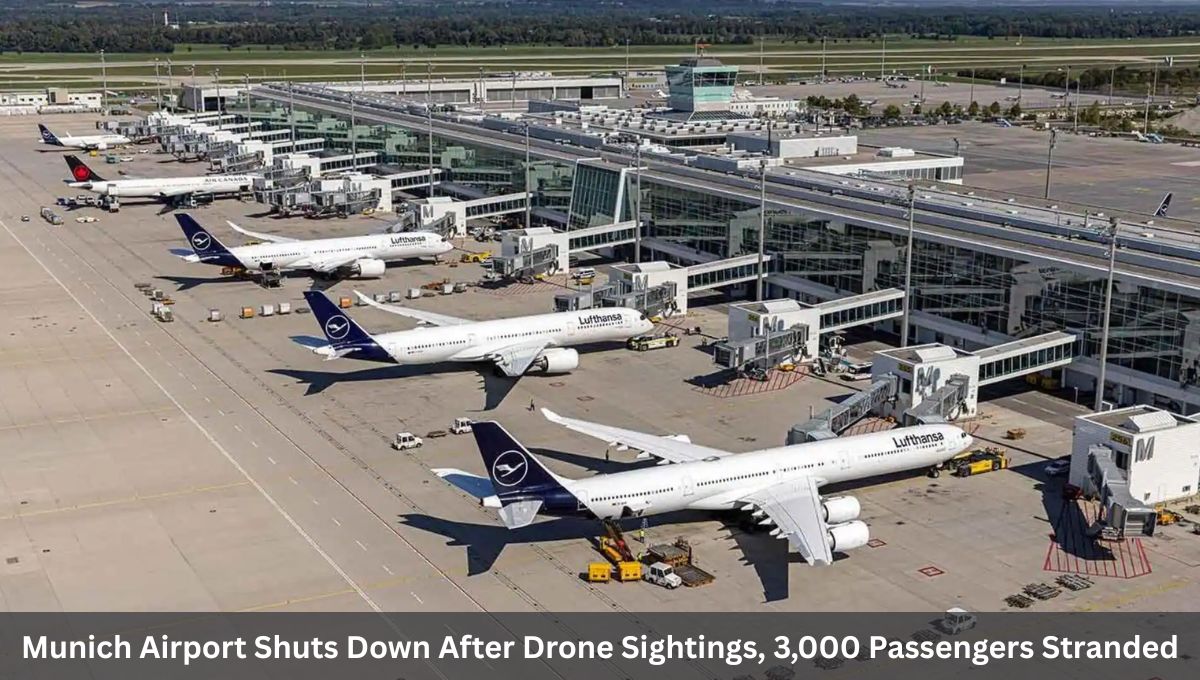
For nearly seven hours, Munich Airport Shuts Down After Drone Sightings, 3,000 Passengers Stranded. Germany’s Munich Airport, one of Europe’s busiest aviation hubs, was forced to shut down for nearly seven hours overnight after multiple drone sightings, grounding and diverting dozens of flights and leaving nearly 3,000 passengers stranded. The sudden closure, which began late Thursday evening and lasted until early Friday morning, is the latest in a string of mysterious drone disruptions across Europe that have heightened security fears and reignited tensions with Russia.
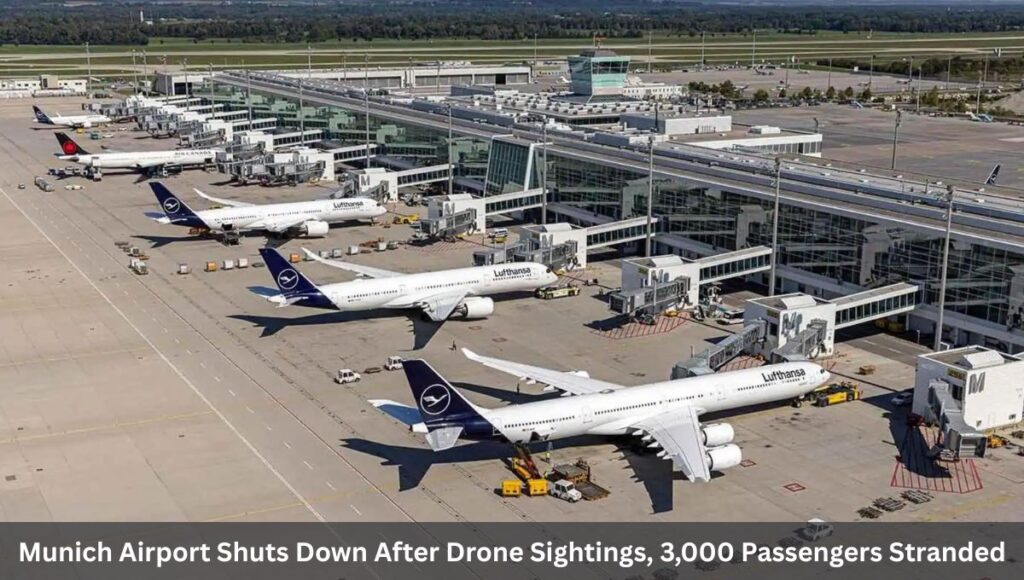
Munich Airport Shuts Down After Drone Sightings, 3,000 Passengers Stranded
Flights Suspended as Drones Reported Over Munich
According to airport officials, German air traffic control first reported a drone near the airport at 10:18 p.m. local time (20:18 GMT) on Thursday. Within minutes, flights were restricted, and by 10:30 p.m., all takeoffs and landings were suspended.
- 17 flights were grounded at Munich.
- 15 incoming flights were diverted to Stuttgart, Nuremberg, Frankfurt, and Vienna.
- Nearly 3,000 passengers were left stranded overnight.
Passengers faced hours of uncertainty as authorities investigated the reports. Some travelers were provided with camp beds, blankets, and food in the terminals, while others were taken to hotels as operations remained halted.
A spokesperson confirmed that the airport reopened at 5 a.m. Friday after flight arrivals and departures were deemed safe. The first flight to land was a Lufthansa long-haul from Bangkok at 5:25 a.m.
Lufthansa: “Operations Resumed According to Schedule”
As the airport’s main hub, Lufthansa bore the brunt of the disruptions.
- At least 19 Lufthansa flights were cancelled or diverted, including three long-haul flights to Asia.
- The airline rescheduled affected long-haul journeys and provided food, drinks, and blankets to stranded passengers.
“Flight operations have since resumed according to schedule,” a Lufthansa spokesperson said Friday morning.
Police: “No Information on Drone Type or Number”
German Federal Police and Bavarian state authorities dispatched helicopters and ground teams to track the drones, but no concrete evidence of their origin or type has yet emerged.
Police acknowledged that several people reported seeing drones near or over the airport grounds, though it remains unclear whether there were multiple drones or a single device sighted from different locations.
“Safety of travelers is the top priority,” the airport’s statement stressed. “Detection and defense against drones remain the sovereign responsibility of federal and state police.”
Europe on Edge: A Pattern of Drone Disruptions
The Munich closure is not an isolated incident. It comes after a series of unexplained drone sightings across Northern and Eastern Europe in recent weeks:
- Denmark: Multiple drone sightings forced temporary closures at airports, including Copenhagen, and prompted a nationwide ban on civilian drone flights during a European summit on Ukraine.
- Norway: Airports were forced to halt flights after drones were spotted over restricted airspace.
- Poland: NATO confirmed that nearly 20 Russian drones entered Polish airspace in early September, triggering an urgent scramble of fighter jets.
- Romania: Authorities reported drones near the Danube River, close to the Ukrainian border.
- Estonia: Claimed Russian fighter jets violated its airspace.
These incidents have raised concerns that Europe’s skies are vulnerable to low-cost, difficult-to-detect drone incursions that could disrupt aviation, spy on critical infrastructure, or even serve as cover for military operations.
European Leaders Blame Russia
The spate of drone activity has led many European leaders to point the finger at Moscow.
- Danish Prime Minister Mette Frederiksen said that while no definitive proof exists, “there is primarily one country that poses a threat to Europe’s security – and that is Russia.”
- The European Commission has backed calls for a “drone wall,” a network of sensors and interception systems designed to protect the EU’s skies from foreign unmanned aircraft.
- NATO officials have described recent incursions as deliberate provocations meant to sow chaos and test European defenses.
Russia has repeatedly denied involvement, dismissing the claims as “baseless hysteria” designed to justify higher European defense spending.
Putin’s Jokes and Warnings
Speaking at the Valdai Discussion Club in Sochi on Thursday – just hours before Munich’s shutdown – Russian President Vladimir Putin mocked the West’s concerns about drone flights.
- “I won’t anymore. Not to France, not to Denmark, not to Copenhagen,” he quipped, referring to accusations of Russian drones flying over NATO countries.
- Joking further, he said: “We do not have drones that can fly all the way to Lisbon.”
But Putin also issued a thinly veiled threat, warning that Russia was monitoring the “growing militarization of Europe” and would not hesitate to take “countermeasures” if it felt provoked.
“No one should doubt that Russia’s response will not take a long time to come,” he warned.
Security Measures Under Review
Following the Munich incident, German aviation authorities are expected to review their drone detection and counter-drone systems. While airports in Germany are equipped with radar and surveillance technology, drones often evade conventional detection due to their small size, low altitude, and plastic components.
Experts warn that commercial drones can be modified to carry surveillance equipment, explosives, or jamming devices – making them a potent tool for hybrid warfare.
The EU’s proposed “drone wall” would combine radar, acoustic sensors, and anti-drone weapons such as signal jammers and net guns to form a layered defense along Europe’s eastern borders.
Munich on High Alert
The drone disruption comes just days after Munich’s Oktoberfest beer festival was temporarily shut down due to a bomb threat, adding to the city’s sense of unease. Police also recently uncovered explosives in a residential building in northern Munich.
The city, home to more than 1 million residents, is now under heightened surveillance as both local and federal authorities monitor potential threats to critical infrastructure.
Passengers Describe “Chaotic Night”
Travelers caught in the disruption described a night of confusion, frustration, and exhaustion.
- Some passengers complained of poor communication from airlines during the suspension.
- Families with young children had to sleep on camp beds in terminals.
- Business travelers missed connections in Frankfurt and Vienna, where diverted flights were redirected.
“I was supposed to be in Barcelona by midnight. Instead, I spent the night on a cot at Munich airport,” one passenger told German media.
The Growing Drone Threat to European Aviation
The Munich incident highlights a broader vulnerability: Europe’s airports, nuclear plants, and military bases are increasingly exposed to the risks posed by unmanned aerial systems.
Authorities face a difficult balancing act: ensuring aviation security without unnecessarily grounding flights due to false alarms.
But after several high-profile cases – including the 2018 Gatwick Airport drone chaos in the UK, which shut the airport for 36 hours and disrupted 140,000 passengers – governments are now prioritizing anti-drone technology as part of their national security strategy.
Conclusion: Munich a Wake-Up Call for Europe
While Munich Airport has resumed normal operations, the incident underscores how disruptive even a handful of drones can be to Europe’s transport and security infrastructure.
With NATO and EU leaders warning of Russian hybrid tactics and Moscow dismissing the allegations, the mystery of the drones remains unsolved. For the nearly 3,000 passengers stranded overnight in Munich, the shutdown was an exhausting inconvenience.
But for European leaders, it is yet another reminder that modern security threats no longer come only from missiles and jets – but from small, silent drones buzzing over the horizon.
Related Posts:
- Drone Sightings Shut Copenhagen and Oslo Airports,…
- 7 Heartbreaking Facts About Venezuela's Earthquake Disaster

- 5 Major Takeaways from the US Supreme Court's…

- Germany Probes Russian ‘Shadow Fleet’ as Drone…

- Denmark Airport Drone Shutdowns: Aalborg Closure,…

- Afghanistan–Pakistan War 2025: Inside the 48-Hour Ceasefire
