
Denmark Airport Drone Shutdowns: Aalborg Closure, ‘Hybrid Attack’ Fears, NATO on Alert amid suspicions of Russian involvement. Denmark is grappling with a wave of unauthorized drone incursions that have disrupted air traffic, shut down airports, and sparked fears of a systematic hybrid attack targeting European critical infrastructure.
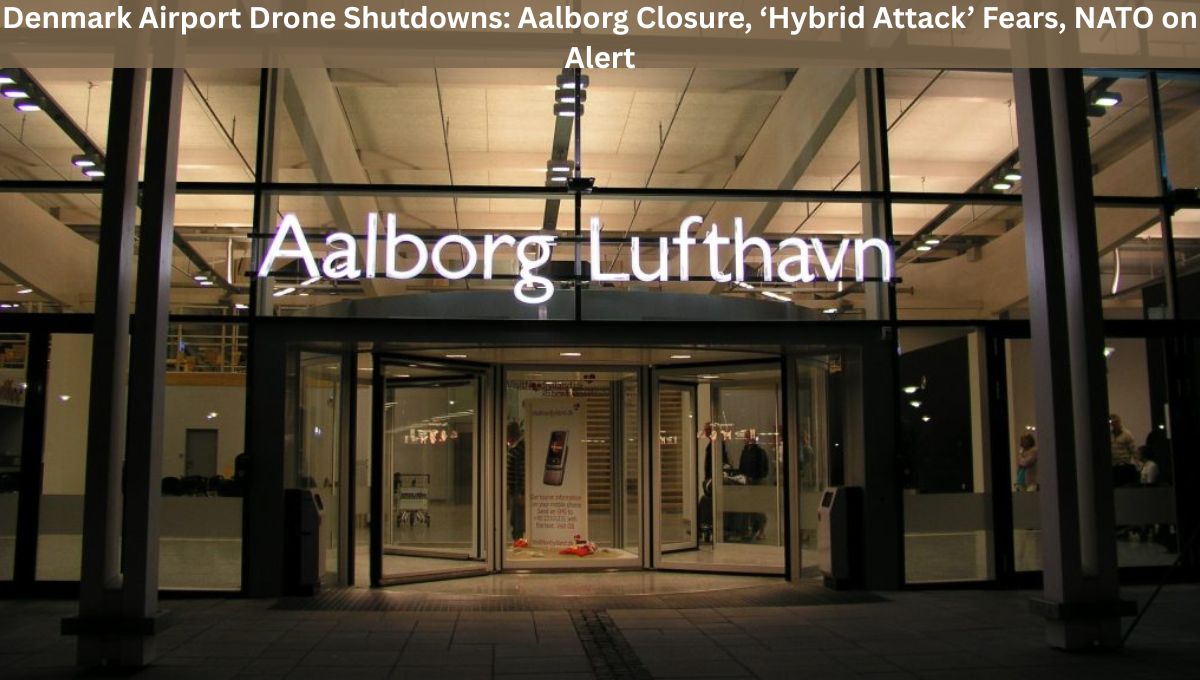
On Wednesday night, Aalborg Airport, located in northern Denmark and also serving as a military base, was forced to suspend operations for several hours after police reported “more than one drone” flying over its airspace.
The incident came just two days after Copenhagen Airport, Scandinavia’s busiest hub, was paralyzed for nearly four hours by a similar swarm of large drones. Officials now warn that the drone incursions bear the hallmarks of a coordinated professional operation, with Denmark’s defense minister labeling it a “hybrid attack.”
Denmark Airport Drone Shutdowns: Aalborg Closure, ‘Hybrid Attack’ Fears, NATO on Alert
Aalborg Airport Shutdown: “More Than One Drone”
According to Northern Jutland police, multiple drones were spotted over Aalborg at 9:44 p.m. local time on Wednesday, flying with lights switched on. The unmanned aerial vehicles remained in the restricted zone until just before 1 a.m. Thursday.
“More than one drone was seen flying near Aalborg Airport… the drones are no longer in the area,” police said in a statement.
The disruption forced the closure of Aalborg’s airspace, halting both commercial and military flights. At least four passenger flights, including services from SAS, Norwegian Airlines, and KLM, were diverted.
Eurocontrol, which oversees European air traffic, announced that arrivals and departures would remain at a “zero rate” until 04:00 GMT due to the drone activity.
Drone Sightings Spread to Four Danish Airports
The chaos was not limited to Aalborg. Police confirmed that three smaller airports — Esbjerg, Sonderborg, and Skrydstrup — also reported drone activity overnight.
- Skrydstrup Air Base is home to Denmark’s fleet of F-16 and F-35 fighter jets, raising security alarms about the targeting of military installations.
- Though these airports did not shut down, the simultaneous sightings suggest a systematic operation across Denmark’s airspace.
The drones disappeared shortly before dawn, but police launched an “intense investigation” with support from Denmark’s armed forces and intelligence agencies.
Copenhagen Airport Attack: “Most Serious Threat Yet”
The Aalborg incident came just 48 hours after Copenhagen Airport — one of Europe’s busiest — was forced to ground flights for nearly four hours following reports of two to three large drones circling overhead.
Danish Prime Minister Mette Frederiksen called the Copenhagen drone incursion “the most serious attack yet on Danish critical infrastructure.”
“The obvious motive is to disrupt and create unrest. To test how far you can go. This is about testing NATO’s defenses,” Frederiksen told Danish media.
Authorities confirmed that the drones near Copenhagen were large, professionally operated devices — not the hobby drones typically seen in civilian hands.
Also Read: Drone Sightings Shut Copenhagen and Oslo Airports, Disrupt Thousands of Travelers
Denmark Labels Incident a “Hybrid Attack”
Following the Aalborg disruption, Defense Minister Troels Lund Poulsen said the incidents “cannot be considered accidents or pranks.”
“There can be no doubt that everything points to this being the work of a professional actor. We are talking about a systematic operation at several locations almost simultaneously. This is what I define as a hybrid attack using drones,” Poulsen told a press conference.
Poulsen added that Denmark did not consider itself under direct military threat but acknowledged that the attacks were designed to weaken confidence in NATO defenses and disrupt society.
While Danish police are investigating whether the drones were launched locally within Denmark, officials are not ruling out foreign state-backed involvement.
NATO Article 4 Considerations
Although Denmark has not yet invoked NATO’s Article 4, which calls for urgent consultations among member states facing security threats, officials said the option remains open.
Last week, Estonia triggered Article 4 after three Russian MiG-31 fighter jets violated its airspace over the Gulf of Finland. NATO jets from Italy, Sweden, and Finland scrambled to intercept them.
Given Denmark’s escalating drone incidents, observers warn that the alliance may face increasing pressure to respond collectively.
European Context: Drone and Airspace Intrusions Rising
The Danish drone shutdowns come amid a series of alarming airspace violations across Europe:
- Norway temporarily closed Oslo Airport for three hours earlier this week after drone sightings.
- Poland shut down four airports, including Warsaw, after repeated incursions by Russian drones.
- Romania scrambled F-16s after a Russian drone breached its airspace earlier this month.
- Estonia saw its sovereignty violated by Russian fighter jets, sparking NATO’s Eastern Sentry air defense response.
These incidents highlight the growing use of drones and hybrid tactics by suspected adversaries to test NATO’s defenses.
EU and NATO Reaction: “Critical Infrastructure at Risk”
European Commission President Ursula von der Leyen said the drone incursions reveal a “pattern of persistent contestation at our borders.”
“Our critical infrastructure is at risk. And Europe will respond to this threat with strength and determination,” von der Leyen posted on social media.
She later told CNN that NATO must be prepared to “defend every square centimeter of territory,” including the option of shooting down intruding aircraft or drones.
NATO Secretary-General Mark Rutte reinforced this position:
“We are a defensive alliance, yes, but we are not naive. We see what is happening and will use all necessary tools — military and non-military — to defend ourselves.”
Suspicion of Russian Involvement
Denmark’s Prime Minister Frederiksen suggested she “cannot rule out in any way that it could be Russia” behind the drone incursions.
Similar incidents in Poland, Romania, and Estonia have already been linked to Moscow, which has been accused of conducting hybrid warfare to undermine NATO unity.
However, Defense Minister Poulsen stressed there is no concrete evidence yet tying Russia directly to the Danish drone events.
Kremlin spokesperson Dmitry Peskov dismissed the allegations as “unfounded,” insisting that Russian aircraft “follow international rules and do not violate borders.”
Hybrid Threats: “Here to Stay”
Denmark’s Justice Minister Peter Hummelgaard warned that hybrid threats like drone incursions are “here to stay.”
Poulsen confirmed that the EU will convene a meeting to discuss enhancing drone preparedness across Europe. Among the proposals is a “drone wall” — a system of advanced detection and neutralization technology to secure borders and airports.
Experts say Europe will need to invest heavily in counter-drone systems, radar coverage, and coordinated response mechanisms to prevent future shutdowns.
US Pressure: Calls to Shoot Down Intrusions
U.S. President Donald Trump went further, urging NATO nations to shoot down Russian aircraft in their airspace.
His comments echo growing frustration in Washington over repeated incursions that jeopardize aviation safety and undermine NATO credibility.
So far, Denmark has not shot down any drones, citing safety concerns for civilians near airports. Chief Inspector Jesper Bøjgaard Madsen said:
“If we get the opportunity, we will take down the drones. But passenger safety comes first.”
Cyberattacks Add to Aviation Chaos
The drone shutdowns coincided with a major cyberattack on a provider of check-in and boarding systems that crippled operations at major European airports, including London Heathrow.
The timing has fueled speculation that Europe is facing a coordinated campaign of hybrid attacks, combining drones, cyberwarfare, and airspace violations to disrupt daily life.
Impact on Passengers and Airlines
For travelers, the incidents have been deeply disruptive:
- At Aalborg, at least four flights were diverted, stranding passengers overnight.
- At Copenhagen, tens of thousands were affected by delays and cancellations.
- At Oslo, flights were suspended for three hours, creating a ripple effect across Nordic air travel.
While authorities assure passengers there was no direct physical danger, the economic and logistical costs are mounting.
Expert Views: Testing NATO’s Response
Aviation security experts warn that the pattern of drone incursions is designed to probe NATO responses without triggering open conflict.
- Dr. Ulrik Pram Gad, Danish security analyst:
“This is about psychological warfare. The goal is to create uncertainty, show vulnerabilities, and test how quickly NATO reacts.”
- Former NATO official Jamie Shea:
“Hybrid attacks give plausible deniability to adversaries. Russia can deny involvement while NATO wastes time debating responses.”
What Happens Next?
The Danish drone incidents have escalated into a serious European security concern, with three urgent questions still unanswered:
- Who is behind the drone operations? Are they state-backed, proxy groups, or highly skilled private actors?
- How should NATO respond? Will Article 4 be invoked again, leading to heightened military readiness?
- Can airports be secured? What counter-drone defenses can be deployed quickly without endangering civilians?
For now, Denmark remains on high alert, with police, military, and intelligence services working together to prevent further disruptions.
As Defense Minister Poulsen put it:
“We do not consider this a direct military threat. But make no mistake — this is a professional hybrid attack. And it will not be the last.”
Conclusion
The shutdown of Aalborg Airport following unauthorized drone incursions marks the second Danish airport closure in a week, highlighting the escalating hybrid threats facing Europe.
With Copenhagen, Oslo, and other European hubs also affected, the incidents fit into a wider pattern of airspace violations and cyberattacks suspected to be linked to Russia’s campaign of destabilization.
While no definitive evidence points to Moscow yet, the timing and scope of the incursions suggest state-backed coordination.
For Denmark and NATO, the challenge is clear: how to defend critical infrastructure against drones and hybrid threats without escalating into open conflict. The coming weeks — as the EU and NATO deliberate responses — will determine whether Europe strengthens its defenses or continues to face disruptive drone warfare at its airports.
Related Posts:
- Drone Sightings Shut Copenhagen and Oslo Airports,…

- Germany Probes Russian ‘Shadow Fleet’ as Drone…

- Munich Airport Shuts Down After Drone Sightings,…
- 7 Heartbreaking Facts About Venezuela's Earthquake Disaster

- 5 Major Takeaways from the US Supreme Court's…

- Afghanistan–Pakistan War 2025: Inside the 48-Hour Ceasefire
