
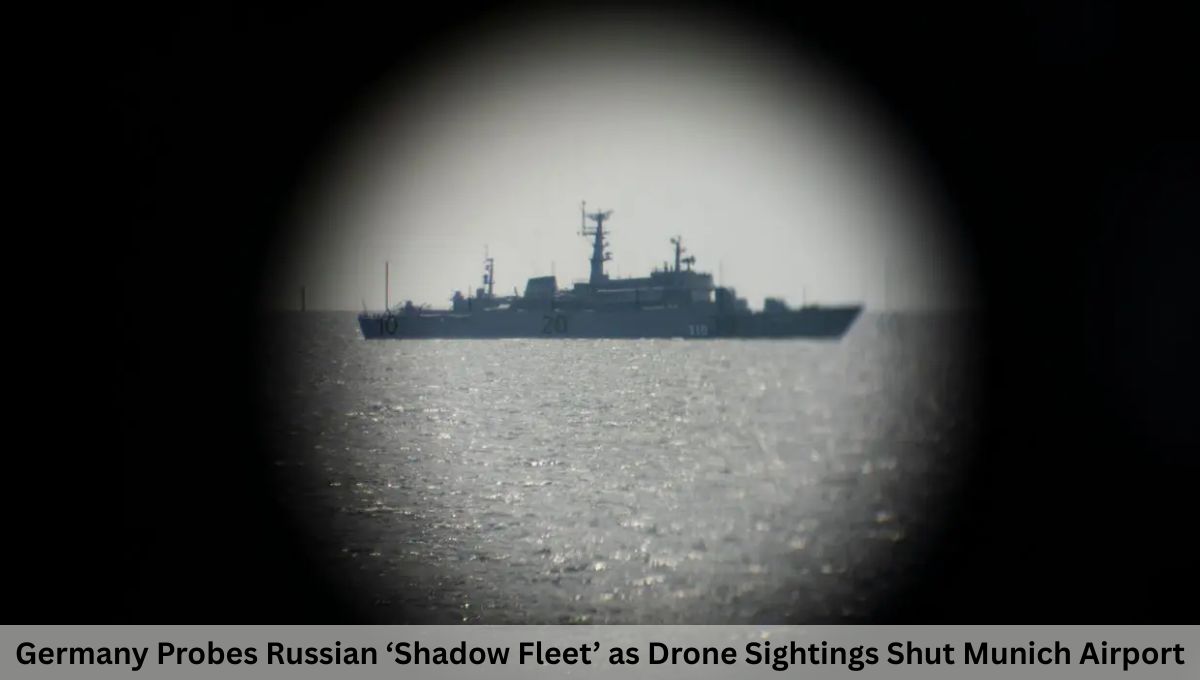
Germany Probes Russian ‘Shadow Fleet’ as Drone Sightings Shut Munich Airport twice in 24 hours, fueling Europe’s growing security fears. Germany is stepping up its investigations into mysterious drone sightings that have disrupted aviation and sparked national security alarms across Europe. On October 2, German magazine Spiegel reported that investigators are probing a Russian-linked “shadow fleet” cargo ship suspected of launching large drones near Schleswig-Holstein.
The revelations came just as Munich Airport, one of Europe’s busiest hubs, was forced to shut down flight operations twice in 24 hours due to unconfirmed drone sightings. The incidents have intensified fears of covert Russian drone activity targeting NATO airspace and European infrastructure.
Germany Probes Russian ‘Shadow Fleet’ as Drone Sightings Shut Munich Airport
The Russian “Shadow Fleet” Suspect
The “shadow fleet” refers to a network of vessels with opaque ownership structures, often flagged under Caribbean states, designed to bypass Western sanctions and oversight. According to security officials cited by Spiegel, the vessel under investigation was a 100-meter cargo ship operating in the Baltic Sea near Kiel when the drone sightings occurred in late September.
Investigators believe the ship’s movements and route suggested deliberate coordination with the drone activity. The ship was reportedly equipped with the technical capability to launch and recover large drones, including rigid-wing models with wingspans of over four meters.
One such drone was observed flying over strategic infrastructure in Schleswig-Holstein, accompanied by several smaller drones. Although the ship was tens of kilometers away and outside German territorial waters at the time, officials said its behavior raised serious suspicions.
Also Read: Detained oil tanker linked to Russia’s ‘shadow fleet’ makes shock move
Zelensky Warns of Russian Tankers in the Baltic
The revelations echo Ukrainian President Volodymyr Zelensky’s warning at the Warsaw Security Forum on September 29. Zelensky claimed Russia may be using oil tankers in the Baltic Sea to launch drones into NATO airspace, describing it as “de facto Russia’s military activity against European countries.”
He urged European states to ban Russian tankers from the Baltic Sea, stressing that the growing drone threat was not only aimed at Ukraine but at the wider European continent.
His warning came just weeks after Russian drones were shot down over Poland, and others entered Romanian airspace, escalating concerns of deliberate NATO airspace incursions.
Munich Airport: Two Closures in 24 Hours
Amid these tensions, Munich Airport, a critical hub for German flag-carrier Lufthansa, has become the latest flashpoint.
On Thursday evening (October 2), air traffic control halted flights around 10 p.m. after multiple drone sightings. At least 17 flights were grounded, 15 diverted, and nearly 3,000 passengers affected. Flights were diverted to Stuttgart, Nuremberg, Frankfurt, and even Vienna.
The airport reopened at 5 a.m. Friday, only for drone sightings to force another shutdown by 9:30 p.m. Friday evening. This time, 6,500 passengers were stranded as both runways closed. A total of 23 flights were diverted, 12 arrivals canceled, and 48 departures postponed or scrapped.
Authorities distributed camp beds, blankets, and food to stranded travelers, as photos showed rows of passengers sleeping on cots.
A Lufthansa spokesperson confirmed that 19 of its flights were disrupted, including three long-haul services to Asia, which will be rescheduled.
Europe’s Drone Chaos
Munich is not alone. Drone sightings have disrupted Copenhagen, Oslo, and Aalborg airports in recent weeks, affecting tens of thousands of passengers.
- On September 26, Aalborg Airport in Denmark was shut after an unidentified drone entered restricted airspace.
- In Belgium, 15 drones were seen above the Elsenborn military site near the German border, before flying into Germany’s town of Düren, alarming police.
- Earlier in September, Russian drones crossed into Poland, and Romania also reported drones in its airspace.
- Estonia accused Russia of violating its airspace with MiG-31 fighter jets.
The spate of sightings has prompted European Union leaders to urgently debate coordinated defenses.
The Push for a European “Drone Wall”
At a leaders’ summit in Copenhagen, several EU states endorsed a “drone wall” initiative. Unlike a physical barrier, the plan envisions a multi-layered detection and interception system capable of spotting, tracking, and destroying drones before they reach sensitive targets.
German Chancellor Friedrich Merz said before the summit that incursions were worsening and it was “reasonable to assume the drones are coming from Russia.”
Danish Prime Minister Mette Frederiksen echoed this, noting:
“We cannot conclude who is behind every drone, but we can conclude that primarily one country poses a threat to Europe’s security – and that is Russia.”
German Interior Minister Pushes Tougher Laws
German Interior Minister Alexander Dobrindt has pledged urgent action. He announced plans to bring forward legislation enabling police to request military assistance to shoot down drones.
Dobrindt also confirmed he would raise anti-drone defense measures with fellow European ministers at a summit originally scheduled to discuss migration.
Putin Scoffs, But Warns of Countermeasures
Russian President Vladimir Putin, speaking at a forum in Sochi, dismissed accusations that Moscow was behind the drone incursions.
“I won’t do it again. Not to France or Denmark or Copenhagen,” he joked sarcastically.
Yet, he issued a thinly veiled warning:
“We are carefully watching the growing militarization of Europe. Is it time for us to take countermeasures? No one should doubt Russia’s countermeasures will not take a long time to come.”
The Kremlin has repeatedly denied involvement in drone incursions and fighter jet violations of Estonian airspace.
Also Read: Putin at Valdai 2025: Paper Tigers, Trump, NATO, Oil & Ukraine
Aviation at the Frontline of Hybrid Warfare
The drone disruptions highlight aviation’s vulnerability to hybrid warfare tactics. Unlike missiles or fighter jets, drones are cheap, stealthy, and hard to trace. Even “unconfirmed sightings” force airports to shut down for safety, creating massive economic and logistical fallout.
Munich Airport alone handled 20 million passengers in the first half of 2025, making any shutdowns costly. The most recent disruptions stranded nearly 10,000 passengers in two days, hitting Lufthansa and other carriers.
Analysts warn that repeated drone sightings—whether state-backed or rogue operations—could amount to a low-cost, high-impact strategy to disrupt European economies and sow fear.
Europe on Edge
The combination of shadow fleet operations, unidentified drones, and airspace incursions by Russian aircraft points to a dangerous escalation in Europe’s security environment.
Munich’s twin airport shutdowns serve as a wake-up call that Europe’s skies remain vulnerable. As the EU races to build its “drone wall,” the unanswered question remains:Are these just isolated drone sightings—or the opening phase of a larger Russian hybrid campaign against NATO?
Related Posts:
- Munich Airport Shuts Down After Drone Sightings,…
- Drone Sightings Shut Copenhagen and Oslo Airports,…

- Denmark Airport Drone Shutdowns: Aalborg Closure,…

- 7 Key Details About Deadly UPS Cargo Plane Crash in Kentucky

- 7 Alarming Drone Sightings Over US Military Base…

- 9 Explosive Revelations Behind Yemen’s Separatist…
