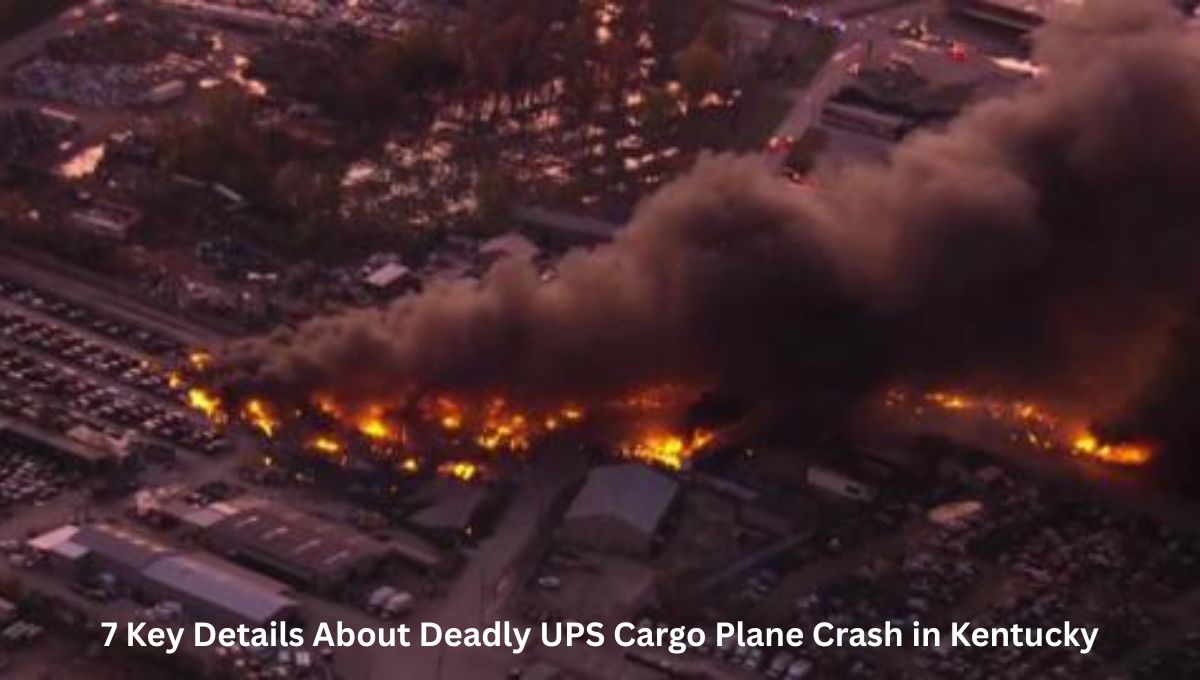
7 Key Details About Deadly UPS Cargo Plane Crash in Kentucky, sparks massive fire, killing seven. At least seven people were killed and 11 others injured after a United Parcel Service (UPS) cargo plane crashed during takeoff from Louisville Muhammad Ali International Airport in Kentucky on Tuesday evening. The aircraft, a McDonnell Douglas MD-11F, burst into flames after skidding off the runway, striking nearby buildings and causing a large explosion.
Officials said the death toll is expected to rise as emergency teams continue searching through the wreckage. The crash triggered a massive fire and prompted a temporary shelter-in-place order for residents within a five-mile radius of the airport due to fears of additional explosions and toxic fumes.
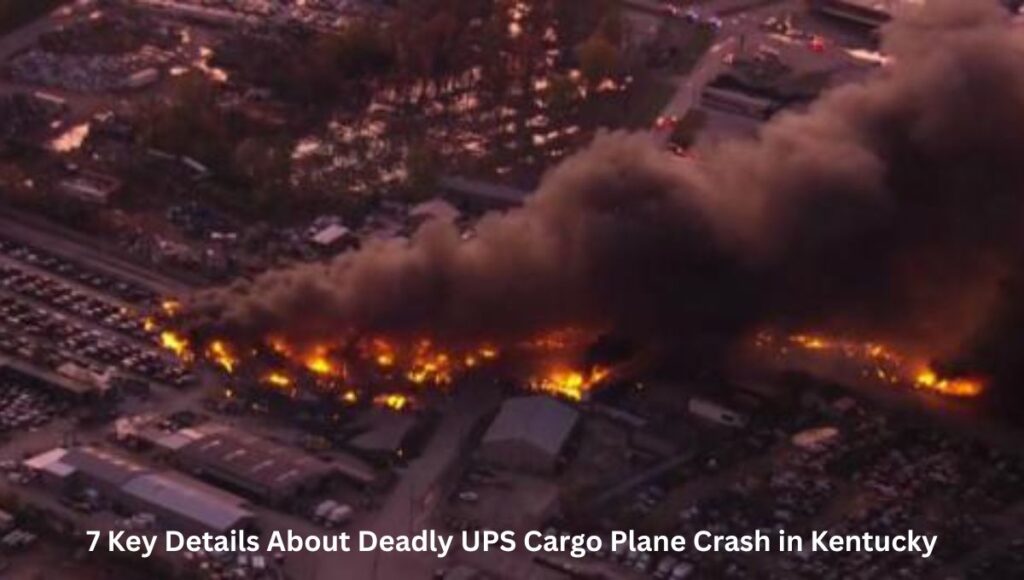
7 Key Details About Deadly UPS Cargo Plane Crash in Kentucky
Massive Fire After Takeoff
The UPS flight, identified as Flight 2976, was bound for Honolulu, Hawaii, and was carrying around 38,000 gallons (144,000 litres) of jet fuel at the time of the crash.
The aircraft exploded at around 5:15 p.m. local time (22:15 GMT), sending thick black smoke into the air and forcing the shutdown of all outgoing flights from the airport.
Governor Andy Beshear confirmed that the three crew members aboard the plane were likely among the dead. “Anyone who has seen the images and the video knows how violent this crash is,” Beshear said during a press conference, describing the devastation near the crash site.
Louisville Fire Department Chief Brian O’Neill said the fire had been largely contained by late Tuesday, but crews were still combing through the wreckage.
“When you have such a large-scale incident and fire spread over a massive area, we have to use hundreds of personnel to surround it, contain it, and slowly bring it in,” he said.
Crash Impacted Nearby Businesses
The aircraft struck two nearby businesses after veering off the runway, causing significant damage. Kentucky Petroleum Recycling was hit “pretty directly,” according to Governor Beshear, while another business — Grade A Auto Parts — was also impacted.
The explosion tore through parts of both buildings and ignited secondary fires. Louisville Metro Police Chief Paul Humphrey said search and recovery operations were ongoing and the scene would remain active for several days.
“We don’t know how long it’s going to take to render that scene safe for the investigation to take place,” Humphrey said.
Two employees from the affected auto parts business were reported missing on Tuesday night. Officials said that search operations would continue through Wednesday to locate anyone unaccounted for.
Eyewitness Accounts and Video Footage
Dramatic video footage posted online showed flames shooting from the left wing of the aircraft shortly after takeoff.
The plane appeared to lift briefly before slamming back onto the runway and erupting into a massive fireball. Thick black smoke could be seen rising from the site as firefighters rushed to the scene.
Nearby residents reported hearing a loud explosion followed by smaller blasts. “It felt like an earthquake,” said a witness who lives near the airport. “The entire neighborhood shook, and then we saw smoke and fire everywhere.”
Emergency services established a wide perimeter around the area and urged residents to stay indoors. The shelter-in-place advisory, initially set for five miles, was later reduced to one mile as air quality levels improved.
Confusion Over Fuel Load
Louisville Mayor Craig Greenberg initially stated on X (formerly Twitter) that the plane was carrying “280,000 gallons of fuel.” The figure quickly drew scrutiny from aviation experts, as the MD-11F cargo jet’s maximum fuel capacity is roughly 36,000 gallons.
Officials later clarified that the mayor likely meant “280,000 pounds” of fuel, not gallons — a common metric used in aviation. The error caused brief confusion online but was later corrected. Greenberg expressed condolences to the victims and praised emergency crews for their response.
“Our community will never forget this tragedy,” the mayor said. “We are so thankful for our brave first responders who have flooded the scene to help try and control the fire and provide support for any victims on the ground.”
What We Know About the Aircraft
The aircraft involved in the crash was a McDonnell Douglas MD-11F, a three-engine widebody cargo jet built in 1991. According to aviation data from FlightRadar24, the plane first entered service with Thai Airways before joining UPS’s fleet in 2006.
The model is known for its large cargo capacity and range but has had a history of landing and stability issues in past incidents.
The MD-11F measures about 61 metres in length with a 52-metre wingspan — smaller than a Boeing 747 but large enough to carry more than 200,000 pounds of freight.
The plane was returning from a short flight to Baltimore earlier in the day before preparing for its trans-Pacific route to Honolulu.
UPS and rival FedEx have both announced plans to gradually retire their MD-11 fleets over the next decade in favor of more fuel-efficient aircraft such as the Boeing 767 and 777.
Boeing, which acquired McDonnell Douglas in 1997, said in a statement that it was “ready to support our customer” and would assist the National Transportation Safety Board (NTSB) investigation. “Our concern is for the safety and well-being of all those affected,” the company said.
Investigation Underway
The Federal Aviation Administration (FAA) and NTSB have both launched investigations into the cause of the crash. A team of NTSB investigators was scheduled to arrive in Kentucky on Wednesday to begin examining flight data, maintenance records, and communication logs between the crew and air traffic control.
Governor Beshear urged residents to avoid speculation about the cause until investigators have more information. “The NTSB will be leading this investigation, and they’ll get us answers,” he said. “Right now, we’re focused on supporting the families and our first responders.”
FAA officials confirmed that the last radar signal from the plane showed it traveling at 184 knots at ground altitude before contact was lost. No distress call was reported before the crash.
UPS Operations Affected
UPS, one of the world’s largest logistics companies, operates its global air hub — known as Worldport — at Louisville’s airport. The facility handles up to 300 flights a day and sorts more than 400,000 packages per hour. Following the crash, UPS temporarily halted package-sorting operations at the hub on Tuesday night.
In a statement, the company said it was “terribly saddened” by the tragedy. “UPS is committed to the safety of our employees, customers, and the communities we serve. This is particularly true in Louisville, home to our airline and thousands of UPSers,” the company said.
Louisville Metro Council member Betsy Ruhe noted the city’s close ties to the company. “Louisville is a UPS town,” she said. “Everyone here knows someone who works there. People are texting their friends and family, trying to make sure everyone is safe.”
Emergency Response and Containment
Firefighters from across the region joined the Louisville Fire Department to contain the blaze. Chief O’Neill said crews used aerial suppression and foam units to control the jet fuel fire, which spread over a large industrial zone.
“Given the amount of fuel onboard, this was a very dangerous situation,” O’Neill said. “Our teams worked grid by grid to make sure we accounted for everyone and reduced further risk.”
By late evening, much of the fire had been extinguished, though smoldering hotspots remained. Crews continued to monitor for structural instability and potential air quality hazards overnight.
Community Reaction
The tragedy has shaken Louisville residents and the wider Kentucky community. State Senator Keturah Herron expressed sympathy for affected families, noting that many locals have relatives employed at the UPS hub.
“Many of us watch our loved ones pass through that airport every day,” she said. “It’s heartbreaking to think of something like this happening so close to home.”
Governor Beshear called the crash “a heartbreaking day for Kentucky.” He said state and federal officials were coordinating to provide assistance to affected families and businesses.
What’s Next for the Investigation
The NTSB is expected to examine whether mechanical failure, pilot error, or weather conditions played a role in the crash. Investigators will also analyze the aircraft’s black boxes — the flight data recorder and cockpit voice recorder — once recovered from the site.
Experts note that MD-11 aircraft have experienced several high-profile cargo incidents in the past, including crashes involving FedEx and China Airlines. Analysts say the model’s handling characteristics can make it more difficult to control during takeoff and landing under heavy load conditions.
Preliminary findings from the Kentucky crash investigation are expected within a few weeks, though a full report could take up to a year.
Conclusion
The Louisville crash marks one of the deadliest U.S. cargo aviation accidents in recent years. As investigators work to determine the cause, focus remains on supporting victims’ families, restoring airport operations, and ensuring the safety of future cargo flights.
“This is a tragedy that has touched every corner of our community,” Governor Beshear said. “We will learn what happened here, and we will make sure it never happens again.”
Also Read: Bangladesh Jet Crash Kills 27, Including 25 Children
Also Read: Cargo plane crashes in Kentucky, killing 7. Here is what went wrong
Related Posts:
- 7 Shocking Moments: Congo Minister’s Plane Bursts…
- Southend Plane Crash: Jet to Netherlands Explodes…

- 7 Dramatic Moments as Buddha Air Plane Overshoots…

- Tragedy in Ahmedabad: Air India AI-171 Crash Claims…
- 8 Shocking Updates After Air Canada Plane Crash at…
- 7 Heartbreaking Facts About Venezuela's Earthquake Disaster