5 Key Takeaways as Zohran Mamdani Wins Historic New York Mayoral Race — signaling a political shift in the United States.New Yorkers elected 34-year-old Zohran Mamdani as the next mayor of the United States’ largest city on Tuesday, marking a historic victory for the self-described democratic socialist who will become New York’s first Muslim mayor.
NBC News projected Mamdani’s win late Tuesday night, following record voter turnout that surpassed two million ballots — the highest in more than five decades.
The victory caps a stunning political rise for Mamdani, a Ugandan-born state Assembly member, who defeated former New York Governor Andrew Cuomo, running as an independent, and Republican nominee Curtis Sliwa. “Tonight we have spoken in a clear voice: Hope is alive,” Mamdani told cheering supporters at his victory rally in Queens.
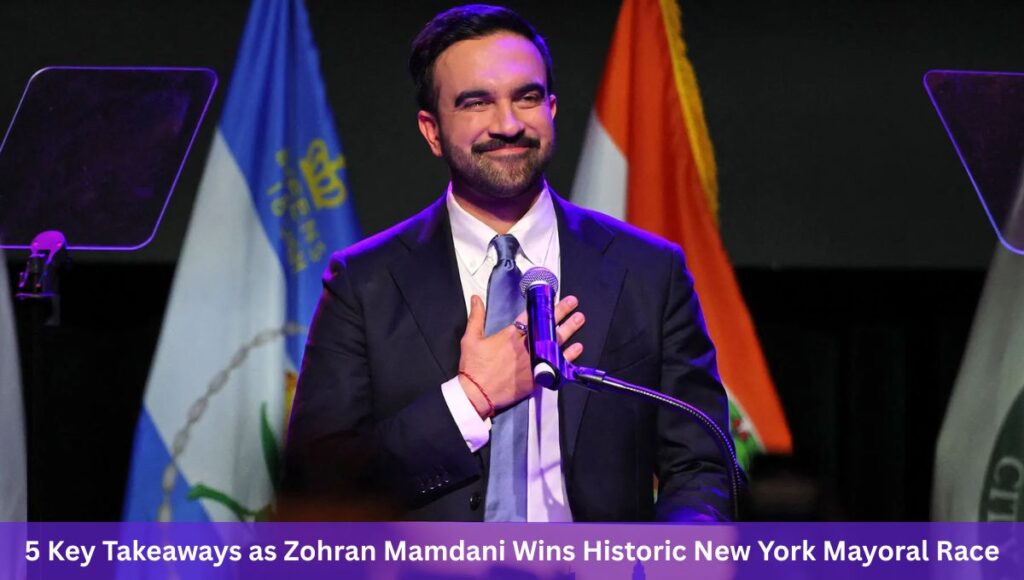
5 Key Takeaways as Zohran Mamdani Wins Historic New York Mayoral Race
High-Stakes Election Draws National Attention
The New York City mayoral race unfolded as one of the most closely watched contests in this year’s local elections, seen as an early test of voter sentiment during President Donald Trump’s second term.
Across the country, voters in Virginia, New Jersey, and California also cast ballots in pivotal gubernatorial and policy races, offering a glimpse of the national political mood ahead of next year’s congressional midterms.
Virginia Democrats celebrated an early victory as Abigail Spanberger captured the governor’s mansion, defeating her Republican rival and signaling potential headwinds for the GOP.
But the spotlight remained firmly on New York, where Mamdani’s surge energized progressive voters and alarmed moderates within the Democratic Party and the White House alike.
A Progressive Vision Meets Political Resistance
Zohran Mamdani campaigned on a populist platform emphasizing affordability, housing reform, and public transport access. His proposals — including a rent freeze for rent-stabilized apartments, free public buses, and city-owned grocery stores — drew both grassroots enthusiasm and intense criticism from business interests.
The democratic socialist’s campaign leaned heavily on social media outreach and street-level engagement. Videos of Mamdani walking through neighborhoods and conversing with residents went viral, helping him build a devoted following among younger and working-class voters.
Opponents painted his policies as impractical and his rhetoric as divisive. Business-backed political action committees reportedly spent over $40 million attempting to block his path to City Hall.
Despite that, Mamdani maintained a consistent lead in most polls, capitalizing on discontent over New York’s high living costs and political fatigue following scandals under outgoing Mayor Eric Adams.
Trump’s Rhetoric and Endorsement Drama
President Donald Trump, who has maintained a combative relationship with New York City, played a prominent role in the campaign’s closing weeks.
Trump frequently targeted Mamdani, labeling him a “communist lunatic” and a “Jew hater,” accusations the candidate and his allies rejected as false and inflammatory.
On Monday, the president endorsed Andrew Cuomo, urging Republicans to vote strategically against Mamdani. “Whether you personally like Andrew Cuomo or not, you really have no choice. You must vote for him and hope he does a fantastic job,” Trump wrote on his social media platform.
Cuomo welcomed the endorsement, saying Trump’s message reflected “the reality of the situation — if Republicans don’t consolidate, Mamdani wins.”
Trump’s move underscored the high political stakes, as he warned he might withhold federal funding from New York under a Mamdani administration.
A Divided Democratic Party
Mamdani’s victory has intensified debate within the Democratic Party over its future direction.
While some see him as a symbol of generational change and renewed energy, others fear his left-wing platform could alienate moderates and swing voters.
“There’s a civil war in the Democratic Party,” Cuomo said on Election Day. “You have an extreme radical left that is challenging what they call moderate Democrats. I’m a moderate Democrat.”
Former President Barack Obama reportedly spoke with Mamdani ahead of the vote but stopped short of a public endorsement, highlighting the unease among party veterans.
Political analysts say Mamdani’s success could reshape the Democratic strategy nationwide, particularly if his policies gain traction in the nation’s largest city.
Historic Turnout and Voting Surge
New York’s Board of Elections reported record participation, with more than 1.5 million votes cast by mid-afternoon Tuesday — far exceeding totals from the 2021 mayoral race.
Turnout was fueled by intense media coverage, polarizing rhetoric, and a perception that the contest represented a broader referendum on Trump’s leadership and the Democratic Party’s ideological split.
“Voter enthusiasm is off the charts,” said Grant Reeher, a political science professor at Syracuse University. “New Yorkers sense this race matters beyond city limits.”
Voting across the city’s five boroughs was largely smooth, with long queues forming in Manhattan and Brooklyn as residents rushed to cast ballots before polls closed at 9 p.m.
Cuomo’s Comeback Falls Short
Andrew Cuomo, 67, mounted a high-profile comeback attempt following his 2021 resignation as New York governor amid allegations of sexual harassment, which he has denied.
Running as an independent, Cuomo sought to position himself as a moderate alternative capable of negotiating with Trump and restoring fiscal stability. His campaign emphasized expanding the police force, increasing affordable housing, and reducing class sizes in public schools.
Despite significant funding from billionaire donors and backing from outgoing Mayor Eric Adams, Cuomo failed to overcome Mamdani’s grassroots momentum.
“I’ve always believed in redemption and public service,” Cuomo said after conceding. “But the voters have spoken. I wish Mayor-elect Mamdani success — New York needs it.”
Republican Curtis Sliwa Fades Amid Pressure
Republican nominee Curtis Sliwa, the Guardian Angels founder and a longtime radio host, focused his campaign on crime and public safety. He proposed hiring 7,000 additional police officers and restoring tougher law enforcement measures.
However, Sliwa’s campaign struggled to gain traction beyond conservative enclaves in Staten Island and Queens. With Trump endorsing Cuomo, calls for Sliwa to withdraw intensified in the final days.
“I’m not quitting,” Sliwa told reporters before polls opened. “New Yorkers deserve a candidate who puts safety first.” He finished third, drawing roughly a quarter of the vote, according to early projections.
Adams’ Exit and Corruption Fallout
Outgoing Mayor Eric Adams withdrew from the race in September after his campaign became embroiled in a corruption scandal, although charges were later dismissed.
Adams endorsed Cuomo late in the race, calling him the “experienced hand” New York needed. His departure created an opening for Mamdani’s insurgent candidacy to consolidate progressive and independent voters.
Adams’ decision to suspend his campaign came too late to remove his name from ballots, though he still attracted a small share of votes.
Mamdani’s Background and Rise
Born in Kampala, Uganda, Zohran Mamdani immigrated to the United States as a child and became a naturalized citizen in 2018.
Before entering politics, he worked as a community organizer and housing activist. His mother, novelist Mahmuda Mamdani, and father, academic Mahmood Mamdani, have both been influential public intellectuals.
Mamdani first won election to the New York State Assembly in 2020, representing Queens’ 36th District. Known for his advocacy on housing, healthcare, and transportation, he built a reputation as a rising figure in the Democratic Socialists of America.
His mayoral campaign leaned on a message of inclusion and economic justice. “This city belongs to everyone who calls it home,” he said during his final campaign rally.
Reaction and Next Steps
World leaders and U.S. political figures reacted swiftly to the result.
Progressive lawmakers, including Representative Alexandria Ocasio-Cortez, congratulated Mamdani, calling his victory “a new chapter for working people in New York.”
The White House issued a brief statement congratulating the mayor-elect and pledging to “work constructively with the new administration in advancing shared priorities.”
Analysts predict that Mamdani’s relationship with President Trump will be tense. “Trump will treat New York City more aggressively,” said Reeher. “We could see a political showdown over federal funding and urban policy.”
What Mamdani Promises to Do First
Mamdani has outlined a 100-day plan centered on affordable housing, public transportation, and climate resilience.
He has pledged to expand social housing, cap rent increases, and initiate a pilot program for fare-free buses. His administration also plans to review city contracts with large developers and reassess property tax structures.
“We will make this city work for everyone — not just the wealthy few,” Mamdani told supporters. “That means fighting for every dollar New York is owed, using every legal and political tool at our disposal.”
He also emphasized unity following a divisive campaign. “This campaign was about hope, not hate. About lifting up the people who make this city run,” he said.
A Symbolic Moment for Representation
Mamdani’s election as New York’s first Muslim and South Asian mayor marks a watershed moment in American urban politics.
Civil rights organizations hailed his victory as proof of the city’s enduring diversity and openness to change.
For younger progressives, his success underscores the growing influence of leftist politics in major urban centers — from housing policy to public welfare.
Still, challenges loom large. The new mayor faces a city grappling with budget constraints, rising costs, and strained relations with Washington.
Political observers say his ability to balance idealism with pragmatism will determine whether his administration becomes a turning point or a brief experiment in progressive governance.
The Road Ahead
As New York prepares for its transition, Mamdani’s team faces the task of forming a cabinet that reflects the city’s diversity while ensuring experienced leadership.
Analysts expect early tests as the administration confronts negotiations with the federal government, pressure from business groups, and the challenge of delivering on bold promises.
For now, however, Mamdani’s victory has energized a base long yearning for political transformation. “Tonight, New York has made history,” said campaign volunteer Leyla Ba. “This isn’t just a win for Mamdani — it’s a win for everyone who believes in a fairer city.”
Also Read: Zohran Mamdani Faces GOP Deportation Calls Over Anti-ICE Agenda
Also Read: The inside story of Zohran Mamdani’s triumph and what happens next for New York
Related Posts:
- 7 Key Numbers That Reveal Who’s Winning the New York…
- 7 Key Takeaways: Trump’s Surprise Meeting with NYC…

- 7 Powerful Insights into Zohran Mamdani’s Historic…

- Zohran Mamdani’s Historic NYC Mayoral Win Sparks…

- 11 Defining Challenges Facing NYC’s Youngest Mayor…

- Trump Calls Zohran Mamdani a “Pure Communist” as NYC…