
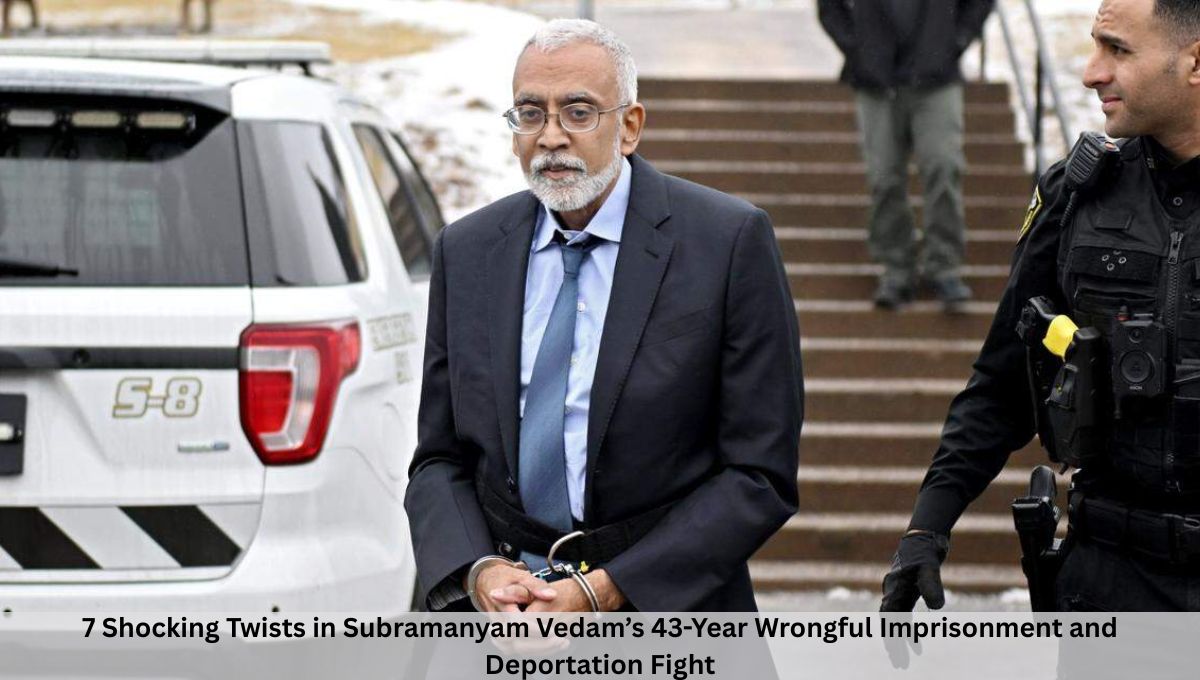
7 Shocking Twists in Subramanyam Vedam’s 43-Year Wrongful Imprisonment and Deportation Fight over a decades-old drug charge. In a story that exposes the dark intersections of wrongful convictions and immigration injustice, Subramanyam “Subu” Vedam, a 64-year-old Indian-origin man, spent 43 years in a US prison for a murder he didn’t commit — only to face deportation the moment he was freed.
Two US courts have now intervened to pause his deportation, offering him a lifeline while his case goes before the Board of Immigration Appeals. But his ordeal is far from over.

7 Shocking Twists in Subramanyam Vedam’s 43-Year Wrongful Imprisonment and Deportation Fight
Who Is Subramanyam “Subu” Vedam?
Born in India and brought to the United States as a nine-month-old infant, Subramanyam Vedam grew up in State College, Pennsylvania, where his father was a professor at Penn State University.
Known to friends as “Subu,” he attended school and later Pennsylvania State University, living a life indistinguishable from any American youth. He was a legal permanent resident, and his citizenship application was pending before disaster struck in 1982.
That year, at just 20 years old, Vedam was arrested and later convicted of murdering his friend, 19-year-old Thomas Kinser — a crime he always insisted he did not commit.
The 1980 Murder Case That Changed His Life Forever
In December 1980, Thomas Kinser went missing. His body was discovered nine months later in a wooded area near State College, shot in the head. The police, under public pressure to solve the case, quickly zeroed in on Vedam, the last person seen with Kinser.
Despite no physical evidence, no eyewitnesses, and no clear motive, prosecutors built a case on circumstantial evidence and alleged inconsistencies in Vedam’s behavior.
In 1983, he was convicted of murder and sentenced to life imprisonment without parole. A separate drug-related no-contest plea involving LSD delivery charges from his early 20s added another 2.5 to 5 years to his sentence, though it was to run concurrently.
The verdict destroyed his life. Vedam’s family — immigrants who had believed in the fairness of the American system — began a decades-long battle for justice.
How the Conviction Was Overturned After 43 Years
The turning point came more than four decades later, thanks to the persistence of his sister, Saraswathi Vedam, and the Pennsylvania Innocence Project, which took up his case in 2022.
His legal team uncovered suppressed FBI ballistic evidence proving that the bullet found in the victim’s skull did not match the .25-caliber gun prosecutors claimed was tied to Vedam.
Handwritten notes and reports revealed that prosecutors had intentionally withheld this exculpatory evidence, violating Vedam’s constitutional rights.
In August 2025, a Pennsylvania judge vacated his conviction, declaring that no reasonable jury would have convicted him if the evidence had been disclosed. The District Attorney’s Office declined to retry the case, and on October 3, 2025, Vedam walked out of prison — a free man, or so he thought.
From Prison to Immigration Detention: Freedom Interrupted
Vedam’s release was short-lived. Moments after stepping out of prison, Immigration and Customs Enforcement (ICE) agents took him into custody and transferred him to a detention facility in Alexandria, Louisiana, known for housing detainees awaiting deportation.
The reason? The decades-old LSD delivery conviction from his youth — a nonviolent offense for which he had already served his sentence. According to ICE, the vacation of his murder conviction did not erase his immigration violation tied to the old drug plea.
A spokesperson for ICE, Tricia McLaughlin, stated:
“Having a single conviction vacated will not stop ICE’s enforcement of federal immigration law.”
Why ICE Wants to Deport Him
Under US immigration law, certain drug-related offenses can trigger mandatory deportation, even for permanent residents. ICE argues that Vedam’s no-contest plea from the early 1980s falls under that category.
His lawyers, however, insist that deporting a man who has spent 43 years wrongfully imprisoned would amount to a second grave injustice.
Attorney filings argue that Vedam’s case deserves humanitarian discretion, noting that he has lived in the US his entire life, has no ties to India, and used his time in prison to educate and uplift others.
Life Behind Bars: A Legacy of Education and Resilience
Despite his wrongful confinement, Vedam transformed his life behind bars. Over four decades, he earned three college degrees, including an MBA with a perfect 4.0 GPA, and became a teacher and mentor to fellow inmates.
He founded literacy programs and even helped hundreds of prisoners prepare for their GED exams.
“He spent 43 years not just surviving but helping others find hope,” said his sister Saraswathi. “That’s who Subu is — a man of strength and compassion.”
Tragically, during his imprisonment, Vedam lost both his parents — his father in 2009 and his mother in 2016. Neither lived to see his name cleared.
Two Courts Step In to Halt Deportation
On October 31, 2025, Vedam’s legal team secured twin victories. First, an immigration judge issued a stay of deportation, allowing time for the Board of Immigration Appeals (BIA) to decide whether to reopen his case — a process that could take months.
That same day, the US District Court in Pennsylvania also granted a temporary stay, reinforcing the immigration court’s decision.
Both courts recognized the extraordinary circumstances of Vedam’s case — a man who spent his entire adult life in prison for a crime he didn’t commit, now facing deportation to a country he hasn’t seen since infancy.
Family’s Emotional Response: “Another Injustice Averted — For Now”
Vedam’s sister, Saraswathi Vedam, expressed cautious relief:
“We’re relieved that two different judges have agreed that Subu’s deportation is unwarranted while his effort to reopen his immigration case is still pending. We’re hopeful that the Board of Immigration Appeals will ultimately agree that his deportation would represent another untenable injustice.”
She added that her brother, who came to the US at nine months old, speaks no Indian languages and has no family ties left in India. “To send him to India now would be cruel,” she said. “He’s lived his entire life here. This is his home.”
A Case That Raises Deeper Questions
Subramanyam Vedam’s story has sparked national debate about how the US criminal and immigration systems intersect — often at the expense of justice.
Legal experts say his situation underscores several critical issues:
- Wrongful Convictions: How evidence suppression can lead to decades of lost freedom.
- Immigration Law Rigidity: How outdated laws can punish individuals twice for the same or unrelated offenses.
- Moral Responsibility: Whether deporting someone who has suffered immense injustice aligns with American values.
Professor Alan Rosenberg, an immigration law expert, told NBC News:
“This case exposes a glaring flaw — when the justice system finally corrects one wrong, the immigration system can impose another.”
What Happens Next
Vedam’s fate now lies with the Board of Immigration Appeals (BIA), which will decide whether to reopen his immigration case. The process could take several months or even years.
If the Board rules in his favor, he could remain in the United States, possibly eligible for permanent relief.
If not, ICE could resume deportation proceedings, potentially sending him to a country he doesn’t know and where he has no support system.
For now, Vedam remains in detention in Louisiana, surrounded by barbed wire — a grim reminder that even freedom, for some, comes with shackles.
An Extraordinary Journey of Survival and Hope
Vedam’s 43-year ordeal reflects extraordinary resilience. Despite being locked away for nearly his entire life, he emerged not bitter, but determined to rebuild.
He dreams of teaching, mentoring, and helping others who were wrongfully convicted. Supporters, including former inmates and advocacy groups, are now rallying for his full exoneration and permanent stay in the US.
His sister says the family’s mission isn’t over:
“Subu’s fight is not just about him anymore. It’s about every innocent person lost in a system that forgets mercy.”
The Bigger Picture: Lessons from Subramanyam Vedam’s Case
Vedam’s story symbolizes the fragility of justice and how immigration enforcement can sometimes clash with moral fairness.
It highlights:
- The importance of transparency in prosecution.
- The need for reform in immigration laws affecting wrongfully convicted individuals.
- The human cost of decades-long incarceration.
His case joins a growing list of wrongful convictions overturned after years of advocacy — including those of Anthony Ray Hinton, Richard Phillips, and Walter Forbes — each reminding society that justice delayed is justice denied.
Public and Media Reaction
The story of Subramanyam Vedam has gained traction across international media, including BBC, NBC News, AP, and The Washington Post.
Public opinion overwhelmingly supports halting his deportation, with thousands signing online petitions demanding that the US government grant him permanent residence and compensation for his wrongful imprisonment.
Advocacy groups like the Pennsylvania Innocence Project and American Civil Liberties Union (ACLU) have called his detention “deeply unjust,” urging immigration authorities to consider his unique humanitarian circumstances.
A Man Freed but Not Free
As he awaits his fate, Subramanyam “Subu” Vedam remains behind locked doors — not in a prison cell, but in an immigration holding facility.
He has survived 43 years of injustice, yet must now fight another battle: to stay in the only country he knows.
Whether he is granted freedom or deported to a foreign land will reveal much about the moral compass of American justice.
Conclusion
Subramanyam Vedam’s journey — from wrongful conviction to near-deportation — represents the collision of two flawed systems.
He lost his youth, his parents, and most of his life to an error of justice. Now, he stands at a crossroads, once again depending on the courts to recognize his humanity.
His story isn’t just about a man wrongfully imprisoned. It’s about how justice can fail, twice — and the hope that compassion can still prevail.
Also Read: Trump Administration is Scrutinizing 55 million US Visa Holders for Deportation Violations
Related Posts:
- 5 Major Takeaways from the US Supreme Court's…

- 7 Heartbreaking Facts About Venezuela's Earthquake Disaster

- 7 Powerful Insights into Zohran Mamdani’s Historic…

- Trump Honors Late Activist Charlie Kirk With…

- 7 Powerful Facts About Ayatollah Ali Khamenei’s…

- 5 Key Developments as Israel Confirms Hamas Handed…
