
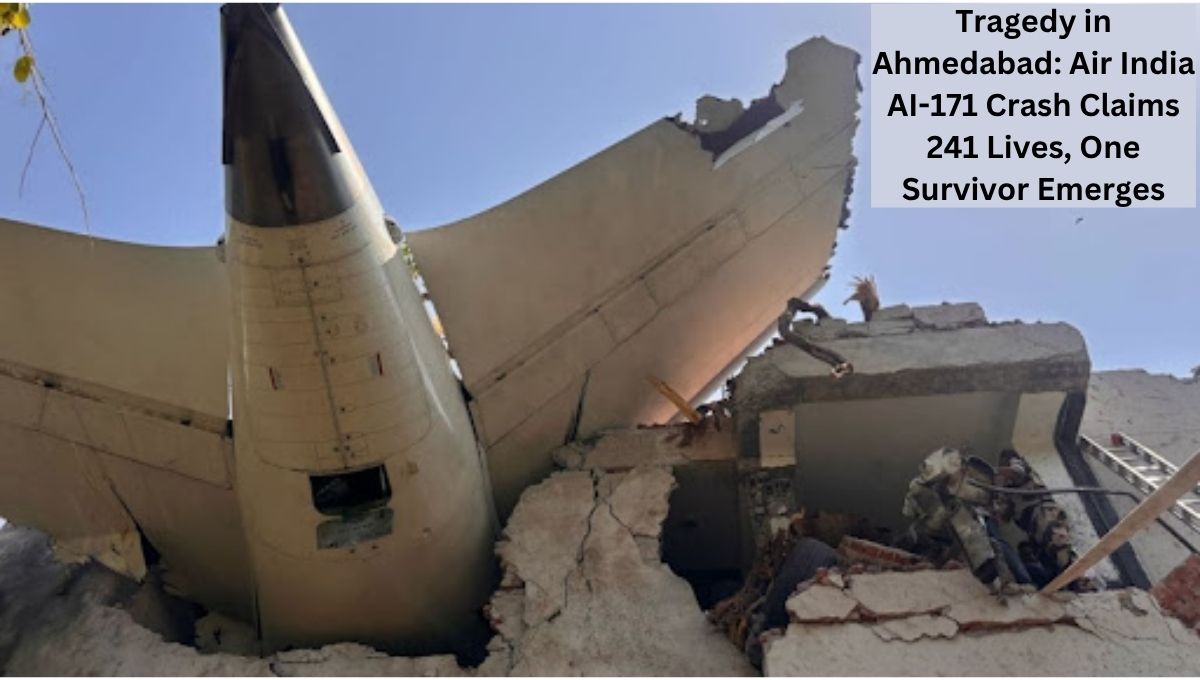
Ahmedabad, Gujarat – June 13, 2025
In decades, one of the worst national Tragedy in Ahmedabad: Air India AI-171 Crash Claims 241 Lives, One Survivor Emerges. An Air India Boeing 787-8 Dreamliner, designated as Flight AI-171, crashed shortly after takeoff from Ahmedabad’s Sardar Vallabhbhai Patel International Airport.
The aircraft, en route to London’s Gatwick Airport, plunged into the BJ Medical College complex in the Meghaninagar area, claiming the lives of 241 of its 242 occupants. The devastating impact sent shockwaves through India and the world, leaving families and communities in deep sorrow.
Prime Minister Narendra Modi, visibly shaken by the tragedy, visited the crash site and the city’s Civil Hospital to meet survivors and the injured. “We are all devastated by the air tragedy in Ahmedabad. The loss of so many lives in such a sudden and heartbreaking manner is beyond words,” Modi expressed on X (formerly Twitter), adding that the void left behind would be felt for years to come.
Tragedy in Ahmedabad: Air India AI-171 Crash Claims 241 Lives, One Survivor Emerges
One Survivor, Hundreds of Lives Lost: The Miracle of Flight AI-171
In the midst of chaos and carnage, one miraculous story emerged. Vishwash Kumar Ramesh, a 40-year-old British national of Indian origin, is the sole passenger to have survived the crash. Seated in 11A, near an emergency exit, Ramesh recounted his harrowing escape from the wreckage while receiving treatment in the C7 ward at Civil Hospital.
“Thirty seconds after takeoff, there was a loud noise and then the plane crashed. It all happened so quickly,” Ramesh said, his voice trembling as he recalled the moments of terror.
Clutching his boarding pass as a keepsake of survival, he described an unbearable scene: “When I got up, there were bodies all around me.
I was scared. I stood up and ran. Someone grabbed me and put me in an ambulance.” Ramesh, who has lived in London for 20 years, was visiting India with his brother Ajay Kumar Ramesh, who remains missing.
His survival stands in stark contrast to the loss experienced by hundreds of other families, underscoring the fragility of life and the randomness of fate.
The Catastrophic Impact: Crashing into a Hostel
Eyewitnesses described the moment the Dreamliner struck the BJ Medical College hostel with horrifying clarity. The aircraft, which took off at 1:38 p.m., barely managed to reach 672 feet in altitude before losing lift.
It then plummeted into the hostel and mess, igniting a massive explosion that enveloped the building in flames and thick smoke.
The crash occurred during the lunch hour, a factor that tragically compounded the disaster. Not only were almost all the passengers on the plane lost, but the impact also claimed the lives of several people on the ground.
Reports indicate that four MBBS students and a doctor’s wife were among the victims, adding to the mounting toll of this catastrophic event.
What Went Wrong? Theories and Early Investigations
Preliminary investigations by aviation experts have started to piece together the sequence of events leading to the crash. The Boeing 787-8 Dreamliner, renowned for its state-of-the-art technology and exemplary safety record, appeared to experience a sudden loss in engine thrust immediately after takeoff.
Videos captured by nearby residents and security cameras show the aircraft struggling to gain altitude, followed by a rapid descent before it burst into flames.
According to aviation expert Captain Saurabh Bhatnagar, “This kind of rapid descent shortly after takeoff can only happen if the engines lose power or the aircraft fails to generate lift.”
Experts believe that the pilots, in their desperate bid to recover the aircraft, were likely “yanking the yoke” to raise the nose but were stymied by insufficient engine power.
Additionally, reports indicate that the landing gear was still down during the critical phase of flight, which could have further hampered the necessary lift. A Mayday call was issued by the cockpit moments after takeoff, signaling distress. However, communication ceased abruptly, and the aircraft was never able to recover.
High-level inquiries involving the Directorate General of Civil Aviation (DGCA) and the Aircraft Accident Investigation Bureau (AAIB) are now underway, with both Boeing and GE Aerospace ready to dispatch expert teams to India.
PM Modi’s Heartfelt Visit and Government Response
In the hours following the crash, Prime Minister Narendra Modi made a solemn visit to both the crash site and Civil Hospital. Modi spent nearly 20 minutes at the scene, absorbing the gravity of the devastation, and later consoled those injured by the disaster.
His visit was accompanied by top state officials, including Gujarat Chief Minister Bhupendra Patel, Civil Aviation Minister Kinjarapu Ram Mohan Naidu, and Home Minister Harsh Sanghavi.
During an emergency meeting at the GujSail office near the airport, Modi stated, “The void left behind will be felt for years to come.” His heartfelt words resonated with a nation in mourning, as officials and citizens alike grappled with the scale of the loss.
In a related gesture of accountability, Air India issued a statement expressing their “deepest condolences to the families of the deceased” and announced that a helpline number (1800 5691 444) had been set up for relatives seeking information.
Ongoing Rescue and Cleanup Operations
Rescue workers and emergency services have been tirelessly working at the crash site since the incident. Despite their best efforts, many victims were charred beyond recognition, necessitating the collection of DNA samples for proper identification.
Deputy Commissioner of Police Kanan Desai confirmed that cleanup operations continued well into the night, as teams sought to clear debris and recover all bodies.
A particularly crucial task for investigators is the recovery of the “black box” the flight data recorder and cockpit voice recorder, painted bright orange for visibility. This device is vital to understanding the technical failures that led to the tragedy.
A high-level committee formed by the Civil Aviation Ministry is overseeing the investigation, and efforts remain concentrated on recovering every piece of evidence that might help determine the cause.
The Human Toll: Beyond the Numbers
The loss of life in the Air India crash is staggering, with 241 fatalities on board. Among the dead were 169 Indian nationals, 53 British citizens, 7 Portuguese, and 1 Canadian.
The passenger list also included notable figures, such as former Gujarat Chief Minister Vijay Rupani, who is currently reported missing. His close aide, Sailesh Mandliya, has been seen at Civil Hospital, desperately searching for any sign of him.
Beyond the official tally, this tragedy has shattered countless families and disrupted lives across two nations. For many, the loss goes beyond statistics the pain, grief, and long-lasting emotional scars are immeasurable.
Global Reaction and International Condolences
The shock of the Ahmedabad crash reverberated far beyond India. International leaders, including UK Prime Minister Keir Starmer and U.S. President Donald Trump, expressed their condolences and solidarity with the victims and their families.
The British Foreign Office has coordinated with Indian authorities, particularly to assist the 53 British nationals on board.
The Air Accidents Investigation Branch (AAIB) of the United Kingdom has pledged to send a multidisciplinary team to support the investigation.
Such international cooperation underscores the global implications of this tragic event, particularly given the impeccable safety record of the Boeing 787 Dreamliner over its 15 years in service.
Immediate Market Impact and Economic Concerns
Following the disaster, the aviation market experienced immediate repercussions. Shares in Boeing fell by approximately 5%, while stocks related to Indian airlines, such as IndiGo (Interglobe Aviation) and SpiceJet, each saw a dip of about 4% in early trading on the day of the crash.
Although Air India is not a publicly traded entity, the incident has stirred widespread concerns about aviation safety in India, one of the world’s fastest-growing aviation markets.
This incident poses significant questions for regulators and aviation experts alike about the maintenance protocols, safety measures, and overall oversight within India’s aviation industry.
Conclusion: A Nation in Mourning, A Call for Answers
The Air India Flight AI-171 crash is a tragedy that has left the nation reeling in grief and disbelief. The loss of 241 lives coupled with the miraculous survival of just one individual serves as a haunting reminder of how quickly life can change in the blink of an eye. As rescue and investigation efforts continue, questions remain about what led to this catastrophic failure during one of the most crucial phases of flight.
Prime Minister Narendra Modi’s visit, his words of condolence, and his promise that “the void left behind will be felt for years to come” capture the somber mood of the country. In the wake of this disaster, India faces an arduous journey of healing and an urgent demand for comprehensive safety reforms in its aviation sector.
As families mourn their loved ones and the nation seeks answers, the tragedy of Flight AI-171 calls for unified efforts to ensure that such an unprecedented loss of life is never repeated. For now, the focus remains on supporting the survivors, identifying the victims, and uncovering the causes behind one of the most devastating aviation disasters in decades.
Also Read: San Diego Plane Crash: Music Industry Mourns as Tragic Jet Crash Devastates Murphy Canyon
Also Read: AI 171 Crash: $475 million insurance claim ranks among India’s costliest
Related Posts:
- 7 Explosive Revelations Behind Kash Patel’s FBI…

- Kash Patel Faces Fire Over “Valhalla” Tribute, Rao’s…

- Kash Patel Faces Senate Showdown Amid FBI Turmoil…

- Southend Plane Crash: Jet to Netherlands Explodes…

- Bangladesh Fighter Jet Crashes into Dhaka School, Killing 19

- 7 Key Details About Deadly UPS Cargo Plane Crash in Kentucky
